| Flooring Type | Best For… | Key Consideration |
|---|---|---|
| Solid Parquetry | Maximum authenticity and creating a stunning, high-impact feature in formal rooms like hallways, living, and dining areas. | Intricate patterns like Herringbone and Chevron are historically accurate for Victorian and Edwardian homes and add immense value. |
| Solid Timber Planks | A classic, versatile, and highly durable choice that can be sanded and polished multiple times, offering incredible longevity. | The choice of timber species and plank width can dramatically alter the feel, from rustic wide boards to elegant narrow strips. |
| Engineered Timber | Achieving an authentic timber look with enhanced stability, making it ideal for areas with potential temperature or humidity fluctuations. | The real timber top layer provides the look and feel of solid wood, while the layered core resists cupping and warping. |
Why Timber is the Unrivalled Choice for Period Homes
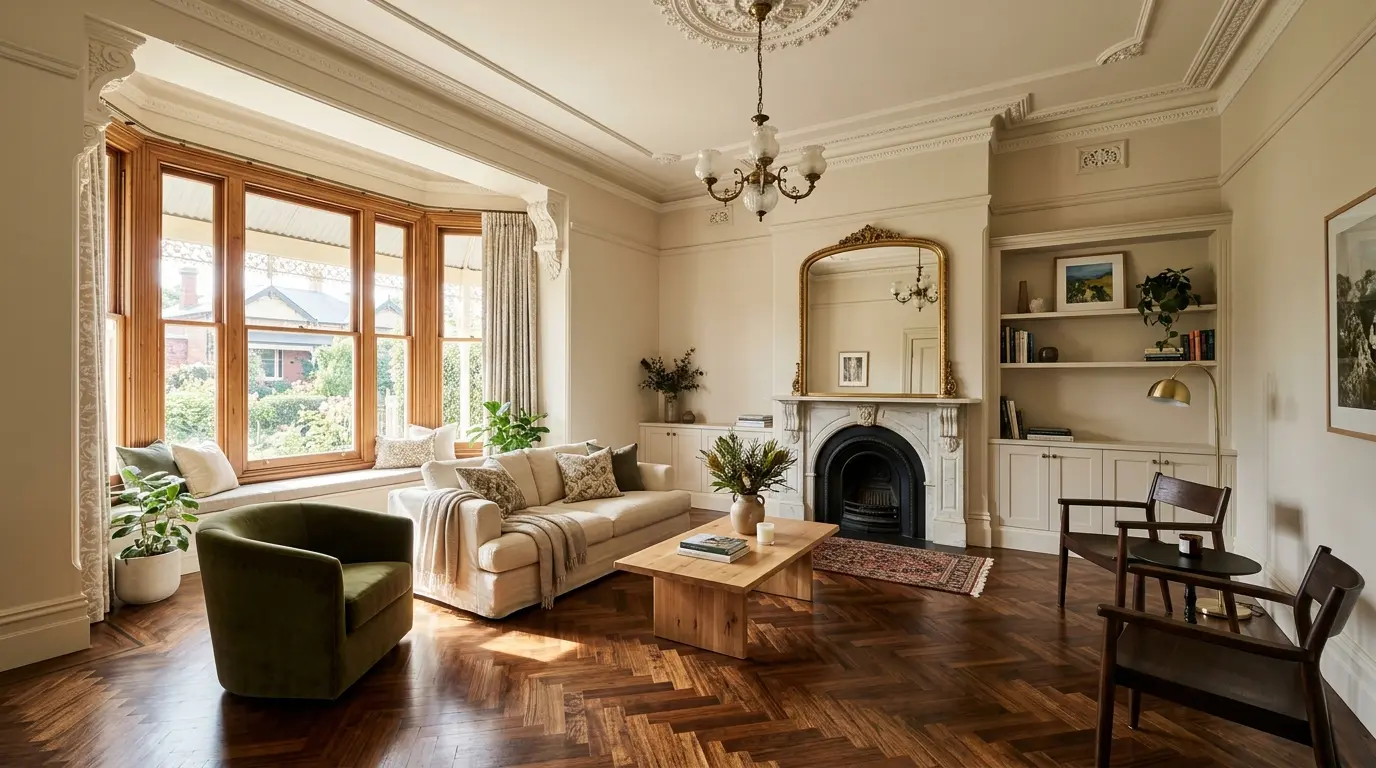
The aim of restoring and renovating a period property is to improve, rather than to obscure, its history. Timber is the obvious option as it was the most commonly used material at the time of their construction. It adds warmth, texture and timeless elegance that can’t be matched by any other material. Wood’s natural grain and character harmonies perfectly with the detailed features of the heritage architecture, including the skirting boards, ceiling roses and original fireplaces.

The Best Timber Floors for Period Properties
Thanks to modern development, you now have a number of great types of timber flooring that possess distinct advantages for a period house.
Solid Timber Flooring: The Traditional Choice
Solid Timber flooring is a strong choice for homeowners who want an authentic, durable timber floor. Made from solid pieces of timber, these floorboards can be sanded and refinished several times over their lifespan, making it possible to remove surface wear or update the stain as the interior changes. For Melbourne homes, Australian timbers such as Tasmanian Oak and Blackbutt can offer a natural appearance with distinctive grain and colour variation, while the right species should ultimately be chosen to suit the home’s existing features, style and practical requirements.
Parquetry flooring is a timeless choice that exudes elegance.
Parquetry flooring is an excellent choice if you want to create a distinctive, period-appropriate look. A feature of many Victorian-era interiors, parquetry uses individual timber pieces arranged in geometric patterns, with Herringbone and Chevron among the most recognisable designs. It can add a sense of elegance and grandeur, making it particularly well suited to entrance halls and formal living rooms. Although it may involve a higher upfront cost, its visual impact can complement the character and architectural details of a period property.
“Have the installer pre-stain some timber samples and see how each appears in different light all around the house.”
Source: Home Beautiful – A Buyer’s Guide to Timber Flooring

Timber Flooring by Melbourne Period Home Style
| Period / Style | Approx. Date | Flooring Commonly Seen | What to Look For in a New Floor |
|---|---|---|---|
| Victorian | c. 1840–1901 | Timber floorboards, often pine; decorative parquetry in some formal interiors | Traditional board widths, natural timber tones and finishes that complement ornate features |
| Edwardian | c. 1901–1915 | Timber floorboards, with polished timber and feature parquetry seen in some homes | Natural or warm tones, restrained finishes and proportions suited to the room |
| Federation | c. 1890–1915 | Timber floorboards, with hardwoods such as jarrah appearing in some surviving Melbourne homes | Visible grain, warm timber character and finishes that work with leadlight and decorative joinery |
| Californian Bungalow | c. 1915–1940 | Timber floorboards, including Baltic Pine in many surviving Melbourne examples | Warm timber tones, practical board layouts and finishes that suit the bungalow’s simpler, earthy character |
Long-Lasting and Eco-Friendly Engineered Timber
Engineered Timber can offer a practical balance of traditional timber character and modern performance. It typically features a layer of real timber, such as oak or Blackbutt, bonded to a more stable multi-layer core. This construction can provide greater dimensional stability than solid timber when conditions change, which can help reduce the risk of movement, gapping or cupping. With a wide range of plank widths, surface finishes and timber species available, engineered timber can achieve a natural appearance while offering a practical flooring option for a variety of Melbourne homes.
Tips for Choosing the Right Timber and Finish
Plank Width: In a period ambiance, narrow-width planks may give a more traditional look, while planks that are wider might give a rustic or contemporary appearance. Take the size of the room into account.
Colour and Stain: Darker shades, such as walnut or Japan Black make a formal and dramatic statement, which is a perfect fit for Victorian dining rooms. Lighter and more natural finishes can enliven a space and be more relaxed, appropriate to Edwardian or Federation style homes.
Finish: A satin or matte finish works well to be less “shiny,” and may appear more authentic than a high gloss finish which can sometimes look “out of place” with the “patina” finish of a period home.
Check the Subfloor, Ventilation and Stumps Before Choosing Your Floor
Many older Melbourne homes have suspended timber floors, with the flooring supported above a subfloor space. Before selecting a new timber floor, it is worth checking the condition of the joists, bearers and stumps, as well as the moisture conditions below the house. Older properties can experience settlement or movement over time, and an uneven or unstable subfloor may affect the suitability of the flooring system chosen.
Underfloor ventilation is equally important. Suspended timber floors rely on adequate airflow beneath the building to help control moisture, and blocked or inadequate ventilation can contribute to damp conditions and timber deterioration. Any renovation should therefore avoid obstructing existing ventilation paths and should address drainage or moisture issues before the new floor is installed.
For homes supported on older timber stumps, the flooring selection should follow — rather than hide — any structural work required underneath. A new floor cannot compensate for movement caused by defective supports, poor drainage or an unhealthy subfloor environment.

Reclaimed Timber and Matching New Floorboards
Reclaimed timber can be a useful option when you want a new floor to sit naturally within the character of a period home. Salvaged boards can retain the marks, grain variation and patina that are difficult to reproduce with brand-new timber, while reclaimed flooring can also be useful when trying to match an existing species or board profile.
When reclaimed boards are not available in sufficient quantities, a close match can often be created with new timber. Species is only one part of the equation: board width, thickness, profile, grain, existing age and the finish applied to the old floor can all affect how closely the two areas blend. An exact visual match should not be assumed, particularly when the original boards have changed colour over decades.
For an extension or newly floored room, compare physical samples against the existing boards before installation. In some cases, using the same species and a compatible width and finish will give the most cohesive result; in others, deliberately separating old and new areas with a doorway or transition can look more natural than trying to make two different-aged floors appear identical.
Period Homes Across Kew, Hawthorn and Ivanhoe
Melbourne’s established suburbs are home to a wide mix of Victorian, Edwardian, Federation and inter-war properties, so choosing new flooring often involves more than selecting a timber species from a sample board. The architectural details, existing floor proportions and condition of the subfloor all need to be considered together.
For homeowners in Kew, timber flooring in Kew can involve working around older floors, heritage features and existing timber that needs to be visually coordinated with new work. Boss Timber Flooring’s Kew service page also highlights matching existing timber colours and finishes for renovation projects.
In Hawthorn, timber flooring in Hawthorn covers solid timber, engineered timber and parquetry, allowing new flooring to be selected according to the character and practical requirements of the property.
For Ivanhoe, this section should only link to a dedicated Ivanhoe location/project page once that page is confirmed on the site. I would not create a fictional project description just to add the suburb.
Professional Installation: Preserving the Integrity of Your Period Home
It is a common misconception that installing new flooring in a period property is a straightforward job. Older homes can have uneven subfloors, existing features that need to be worked around, and changes in floor levels between rooms. Proper preparation, accurate measurements and careful installation are important to achieve a stable, even result without compromising the character of the home.
Boos Timber Flooring‘s team is well versed in installing timber flooring in Melbourne’s historic homes. We know what the challenges are and are experienced in providing a flawless finish that will last for generations. The Society for the Protection of Ancient Buildings asserts that “skilled craftsmanship is needed for honest repairs and sensitive alterations.” This is applicable directly to flooring: The new piece is adding to the old one without disrupting it, or the old piece is being complemented by the new.
FAQs
1. What is the most authentic flooring for a Victorian house?
The most authentic choice will depend on the home’s original flooring and architectural style. Where possible, matching or complementing the existing timber can help preserve the character of the property, while decorative Parquetry flooring in patterns such as Herringbone or Chevron can also suit Victorian-era hallways and formal rooms.
2. Can engineered flooring look good in a period home?
Absolutely. High-quality Engineered Timber, particularly in wider planks with a natural-looking matte or satin finish, can look stunning. It provides the authentic appearance of solid wood with added stability, which is a significant advantage in older buildings.
3. How do I protect new timber floors in a period house?
Protect your investment with regular sweeping or vacuuming (using a soft head), placing felt pads under all furniture legs, using doormats to trap grit, and cleaning up spills immediately. Maintaining a relatively stable indoor humidity level also helps.
4. Should I restore my existing timber floor or choose new flooring?
If the original floor is still structurally sound, restoration may be worth considering. However, when the existing boards are extensively damaged, inconsistent, or unsuitable for the renovated layout, a new timber floor may provide a more practical and consistent result. This article focuses on choosing and planning new timber flooring for a period home; detailed advice on restoring an existing timber floor should be covered in a dedicated restoration guide.


2 Responses
We’re restoring an older Melbourne home and want the new flooring to suit the original features rather than look too modern. Would you normally recommend matching the existing timber species, or is choosing a similar colour and finish enough?
For an older Melbourne home, matching the existing timber species is usually the better starting point, especially if the original flooring is still visible elsewhere. However, an exact species match isn’t always necessary. The timber’s tone, grain, board width, finish and overall ageing can be just as important in making the new flooring feel consistent with the original features. If the species can’t be matched closely, we’d generally focus on achieving a complementary colour, texture and finish rather than forcing an imperfect match.