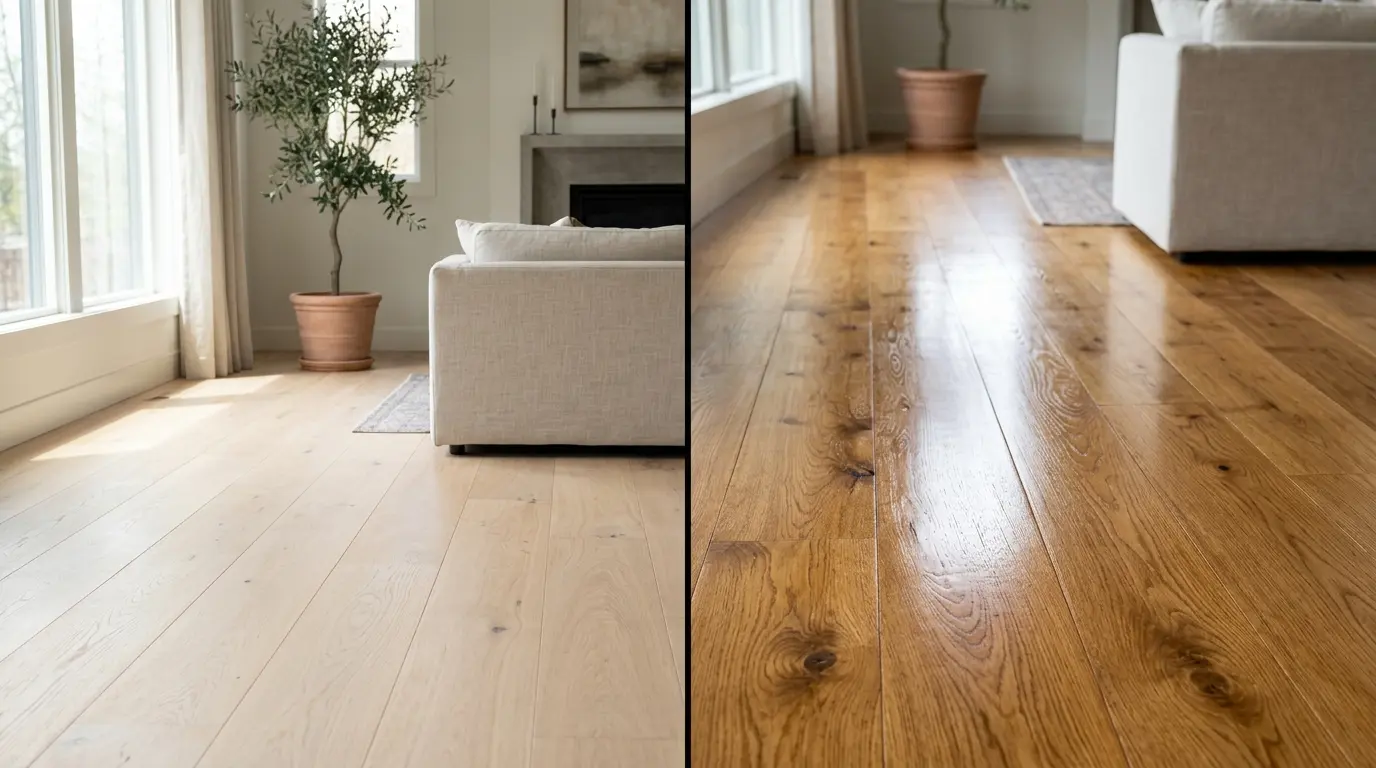
When comparing a water-based vs solvent-based timber floor finish, the primary difference comes down to colour tone, drying time, and chemical emissions. Water-based finishes dry clear in 2 to 3 hours with virtually no odour, keeping the natural raw look of the wood, whereas solvent-based polyurethanes impart a rich, amber glow that darkens over time but release strong toxic fumes for several days.
Your choice of protective coating will dictate not only the aesthetic character of your home for the next decade, but also how long your family must vacate the premises during renovations. In a variable climate like Melbourne where winter heating cycles and humid summer swells constantly test structural timber selecting a finish with the right balance of elasticity and hardness is crucial. Below is a comprehensive breakdown to help you compare performance, costs, and longevity.
| Feature | Water-Based Polyurethane | Solvent-Based Polyurethane |
| Visual Appearance | Completely clear, non-yellowing, preserves raw timber tone | Warm amber/yellow glow that deepens and darkens over time |
| Odour & VOCs | Low VOC, almost odourless, non-toxic during application | Very high VOC, strong chemical odour requiring home evacuation |
| Drying Time | 2 to 3 hours per coat (can apply multiple coats in one day) | 8 to 12 hours per coat (typically one coat per day) |
| Full Cure Time | 5 to 7 days before heavy rugs and furniture can return | 10 to 14 days for complete chemical hardness |
| Durability & Wear | Excellent scratch resistance, highly elastic under floor movement | Extreme surface hardness, highly resistant to liquid penetration |
| Edge Bonding Risk | Low risk; allows individual timber boards to expand naturally | High risk; can glue boards together, causing winter split lines |
| Average Cost (AUD) | Materials & Labour for 3 coats | Materials & Labour for 3 coats |
What Is a Polyurethane Timber Floor Finish?
A polyurethane timber floor finish is a protective coating applied to sanded timber floors to help resist everyday wear, dirt and surface damage. It also determines the floor’s final appearance, including its colour tone and sheen level. Water-based and solvent-based polyurethane finishes use different carrier systems, which influence their drying time, odour, appearance and maintenance requirements. Neither option is completely scratch-proof, and the final performance depends on product quality, application and ongoing care.
What is the Difference Between Solvent Based and Water Based Timber Finishes?
A basic understanding of the chemistry will assist in selecting between Solvent vs Water-based Floor Finishes. Although both products use a tough polyurethane resin to provide sacrificial wear protection on your hardwood, the carrier medium, or liquid that evaporates during drying is quite distinct in each.
Solvent-based finishes: The Chemistry.
Solvent-based coatings (sometimes called oil-based polyurethanes or moisture-cured polyurethanes) are composed of petroleum-based liquids or white spirits as the primary liquid component. In the case of timber, the solvent slowly evaporates and the aromatic polyurethane resins, through reaction with moisture in the air, cross-linked and hardened.
The resins are suspended in solvents and thus deeply penetrates the open pores of the wood grain. This deep penetration results in a “wet look” of the timber, which instantly begins to react with fire and cause reds, browns and golds to appear naturally in the wood. Aromatic polyurethanes are also sensitive to the sun’s rays, however, the finish will fade and change colour over the years as your floor is exposed to the sun.
The Mechanism of Water-Based Finishes
Acrylic and aliphatic polyurethane resins are used in water-based coatings where they are suspended in tiny water droplets. The water gradually evaporates from the polymer droplets when rolled onto the floor, drawing the polymer droplets into closer contact, and they merge and coalesce into a continuous, smooth protective film.
Most modern high quality water-based systems are generally a two-component (2K) product; that is, a liquid hardener (isocyanate catalyst) is added to the finish just before it is used. This forms a very close molecular bond that is as abrasion resistant or more than a conventional oil-based coating. Aliphatic polyurethanes are unaffected by ultraviolet radiation and will not yellow in time, so your timber will be just as colourful after 10 years as it was the day it was coated.
What About Oil, Hard-Wax Oil and Limewash Finishes?
Water-based and solvent-based polyurethane are not the only options available for timber floor protection. Penetrating oils, hard-wax oils and limewash treatments offer different finishes and maintenance requirements.
- Penetrating Oil: Absorbs into the timber and enhances its natural grain, but generally requires periodic maintenance.
- Hard-Wax Oil: Combines oil and wax to create a natural-looking finish with a different maintenance approach from polyurethane.
- Limewash: Changes the colour and appearance of timber, creating a lighter or washed effect. It requires a suitable finishing system to provide the desired level of protection.
The right option depends on the timber species, desired appearance, expected foot traffic and ongoing maintenance preferences. These finishes should be compared as alternative systems rather than treated as identical types of polyurethane.
Choose Water-Based or Solvent-Based Based on Your Home
Choose a water-based finish if:
You want to retain a lighter, more natural timber colour.
You prefer lower odour during the refinishing process.
You need a faster coating schedule with shorter intervals between coats.
You are considering a future maintenance recoat and the existing coating and selected product are compatible.
You want matt, satin or gloss options without relying on the deeper amber appearance associated with traditional solvent coatings.
Consider solvent-based if:
You specifically want a warmer amber appearance.
You prefer the traditional appearance associated with older polyurethane finishes.
The flooring system and existing coating are better suited to a solvent-based product.
The project schedule allows for longer drying, curing and ventilation requirements.
For homes with children, pets or occupants who are particularly sensitive to strong odours, the product’s current safety and ventilation requirements should be considered carefully rather than choosing a finish based on colour alone.
“The technology of water-based finishes provides equal or better wear resistance to solvent-based and better retains the natural colour of timber.”
Bona – Water-Based vs Solvent-Based Timber Floor Finishes

Recoating and Long-Term Maintenance
One of the biggest differences between timber floor finishes is what happens when the floor begins to look worn.
A compatible water-based maintenance or recoat system may allow a sound existing coating to be lightly abraded and recoated without sanding the timber completely back to bare wood. This can reduce disruption and, where the floor is suitable, make future maintenance simpler.
However, this is not automatic for every water-based product. The existing coating must be sound, clean and compatible with the new system, and the manufacturer’s preparation requirements need to be followed. Some products specifically designed for pre-finished or previously coated timber can be recoated without full sanding after the required preparation.
Solvent-based and water-based polyurethane floors can both require more extensive preparation when the existing coating has failed, is badly worn or is incompatible with the proposed new finish. The condition of the existing coating should therefore be assessed before deciding whether a maintenance coat or full sanding is appropriate.
How Much Do Water-Based and Solvent-Based Floor Finishes Cost?
The cost of water-based and solvent-based timber floor finishes depends on more than the coating itself. Product quality, floor condition, preparation requirements and the number of coats all influence the final price.
Factors that can affect the total cost include:
- Product Quality: Commercial-grade and two-component polyurethane systems may have different material costs.
- Floor Preparation: Existing coating removal, repairs and sanding can increase labour requirements.
- Number of Coats: Different products have specific application and recoating requirements.
- Floor Size and Access: Larger areas and difficult site access can affect installation time and labour costs.
- Finishing Requirements: Custom colours, sealers and additional preparation may influence the overall quote.
When comparing prices, consider the complete preparation and coating system rather than choosing based on the cost of the finish alone. A detailed quote can help you understand the materials, labour and finishing work included in your project.
Why Your Choice of Floor Finish Matters
The choice of protective coating is not just a matter of style; it has a direct impact on the health of the home, structural stability of the floor and maintenance costs over time.
1. Thermal Comfort and Energy Efficiency of Buildings
The biggest practical difference between these coatings, at least for now, is the off-gassing effect. Polyurethanes cured with solvents emit volatile organic compounds (VOCs) like xylene, toluene and benzene into the air during the curing process. These fumes are unhealthy for people and animals, damaging their bodies with intense headaches, respiratory irritation and nausea. If using a solvent-based finish, your home must be completely emptied, all indoor plants and pets removed and pilot lights turned off for 3-5 days.
Water-based finishes have up to 80% fewer VOCs and comply with strict Australian green building code. The faint smell is similar to latex wall paint and fades in a few hours. If you have asthma, young children, or a pregnant woman in your home, water-based coatings are the only logical and safe option for home renovations.
2. The Problem of “Edge Bonding” in Melbourne Homes
A phenomenon referred to as edge bonding is one important mechanical factor that is ignored in the Difference between solvent based and water based timber coatings. Solvent-based polyurethanes form a very hard, brittle plastic film. When the liquid finish is applied, it may work its way into the spaces between the floorboards, and while curing can essentially “glue” the edges of the planks together.
Structural timber loses moisture, and tries to shrink during a dry winter in Melbourne, when heating systems are on duty all the time. When the boards are glued by solvent finish they are not able to contract separately. Rather, the tension stretches for five or six boards until one board snaps, leaving a large unsightly blemish or a split in the face of a board through the middle. A water-based finish has better elasticity – it’s able to stretch and flex without the edges of the boards gluing together at the microscopic level, meaning that seasonal changes in movement can be spread out across the whole room.
Matt, Satin or Gloss: Which Finish Looks Best?
The sheen level can change the overall appearance of a timber floor almost as much as the coating type itself.
Matt finishes create a softer, more natural appearance and tend to draw less attention to minor surface marks.
Satin is a popular middle ground, providing some light reflection without the pronounced shine of a high-gloss floor.
Gloss produces a much stronger reflective appearance. Solvent-based gloss finishes can appear particularly glossy compared with some water-based systems, although the final result depends on the specific product and application.
For a modern Melbourne interior, matt or satin can be a practical choice when you want the timber grain to remain the focus. Gloss can be more appropriate where a more traditional or formal appearance is desired.
Common Problems and Mistakes with Timber Floor Finishes
Even the best quality commercial coatings can be unsuccessful when installed improperly or if they are not well-maintained after installation. There are some expensive mistakes that you need to avoid:
- A floor may feel dry to the touch in 4 hours, but it’s not chemically cured until much later. Heavy dining tables and office chairs can be dragged over, or to put rubber-backed rugs down before the 7-day period, will leave an imprint that permanently strips away the softening polyurethane film.
- Ignoring Timber Species Tannins: In Australia some hardwood species like Blackbutt, Spotted Gum and Tallowwood are high in tannins, which are natural water-soluble tannins. When a water-based polyurethane is applied over bare timber without a special sealing primer, the water in the finish will draw the dark green and brown tannins to the top, resulting in patchy, muddy discolouration throughout your living room.
- Inadequate Ventilation During Solvent Curing: Solvent coating must receive moisture and a constant air flow from the atmosphere for proper cross linking. When a house is sealed tightly after installation of oil-based polyurethane, heavy solvent vapours remain close to the floor, allowing the finish to remain sticky and soft for weeks, a problem called “solvent entrapment”.
- Never steam mop on a polished timber floor (all types of polished floors). Under high heat and pressure steam, moisture is driven through minute cracks of the coating, swelling edges of the boards turn gray and lead to the exfoliation of the polyurethane from the grain, which causes the coating to fail.

Drying, Recoating and Reoccupation Times
Drying time should always be taken from the specific product’s technical data sheet rather than applying one universal number to every finish.
| Stage | Water-Based | Solvent-Based |
|---|---|---|
| Time between coats | Often a few hours | Commonly much longer |
| Light foot traffic | Product-dependent; often around the following day | Typically requires longer before normal use |
| Furniture | Follow the manufacturer’s curing instructions | Allow substantially more time than for water-based systems |
| Rugs | Wait until the coating has adequately cured | Allow longer curing time before placing rugs |
| Full cure | Product-dependent | Product-dependent and can take considerably longer |
Intergrain notes that three coats of water-based finish can generally be applied in the time required for one coat of solvent-based finish to become ready for recoating, while solvent-based finishes can leave considerable odour in the home for up to around seven days. Bona recommends allowing substantially longer periods before reoccupation for some solvent-based systems.
For this reason, Boss should not state that every solvent-based floor requires exactly 3–5 days out of the house. The correct timeframe depends on the coating system, number of coats, ventilation, temperature and the manufacturer’s instructions.
Tips for Choosing: Solvent vs Water-Based Floor Finishes
Choosing the right one depends on the existing decor, architectural lighting and lifestyle. Here are the steps to take in making the choice:
Match the type of Coating to the Timber Species
When using pale modern timbers such as Tasmanian Oak, Victorian Ash or European Oak, a water-based finish is almost a requirement. It maintains the clean, Scandinavian blonde look that is so desirable. Solvent based polyurethane will immediately put a yellow nicotine appearance on a light-colored timber, making it appear dated. On the other hand, where the timbers have rich dark tones such as Jarrah, Ironbark or Red Mahogany, a finish made with solvents may enhance the warm red hues of the timber, which may not be accomplished with clear water-based finishes.
Consider plenty of natural light
Consider window sizes. When the living area is north facing, and has waterproof floor to ceiling glass with hours of direct harsh Australian sunlight, opt for a high quality UV-stable, water-based finish. Sunny rooms will cause the solvent finishes, which will be photochemically degraded leaving crisp yellow in the sunlight and lighter underneath rugs and sofas with a distinct dark outline on your floor when moving your furniture.
Compare the timeline of your renovation with other renovations.
When you have to pay for temporary lodging while you are sanding and polishing your floors, time is money. Water-based systems can be used for a sealer coat in the morning, second coat at lunchtime and a final topcoat in the late afternoon by a sanding crew. Socks can be worn the following morning on the floor. Water-based systems can be installed without toxic delays because they cure quickly and emit little to no VOCs, which is especially helpful for a tight build schedule or if you are considering an eco-friendly renovation such as sustainable timber flooring box hill.
What Does a Flooring Specialist Consider Before Recommending a Finish?
Choosing the right timber floor finish requires more than comparing water-based and solvent-based products. A professional assessment considers the existing timber species, current coating condition, floor wear, natural lighting and preferred appearance. Household traffic, pets, ventilation and renovation timelines are also important factors. Checking product compatibility and manufacturer specifications helps ensure the selected finish is suitable for the floor and its intended use.
Can You Apply Water-Based Finish Over an Old Solvent-Based Floor?
Sometimes, but not automatically.
An existing solvent-based coating does not necessarily have to be removed completely before a compatible water-based system is applied. However, the old coating must be sound, clean and suitably prepared, and the new coating must be confirmed as compatible by the product manufacturer.
Depending on the condition of the existing finish, preparation may involve cleaning, abrasion or screening and other steps required to provide a suitable surface for adhesion.
If the existing coating is peeling, contaminated with unsuitable maintenance products, badly damaged or otherwise unsuitable, a more extensive sanding process may be required.
A professional assessment is therefore preferable to assuming that a water-based coating can simply be applied over any old solvent-based finish.
When to Hire a Professional Timber Floor Polisher in Melbourne
Painting a wall is a common weekend do-it yourself job, but sanding a floor and applying polyurethane would need industrial machines and a lot of chemical knowledge. An inexperienced operator can almost cut a deep, permanent valley into a structural floorboard in a heartbeat with a drum sander. Additionally, over large areas the water-based polyurethane has to be applied with a “wet edge” across the room, otherwise lap marks and roller marks will be apparent and will only be able to be repaired by sanding down the entire floor to bare wood once more.

Always hire a certified Melbourne floor polishing expert when:
- The floorboards are old, wavy, uneven or cupped and need to be cross cut diagonally using a heavy machine.
- You have two commercial water-based finishes (Part 2K) that must be mixed to the proper chemical ratio and applied within a critical pot life.
- You want to use custom penetrating timber colour prior to a top coat.
- Installing/refinishing permanent, structural investments (such as solid timber flooring melbourne wide) where maintaining the thickness of wear layer is crucial for future refinishing.
The professional tradesperson will check the moisture content of your timber, use the right tannin blocking primers and provide the glass-smoothed, dust-free finish with a formal workmanship warranty.
Melbourne’s flooring specialists have solutions to protect your timber investment.
The last part of the upgrade and improvement of your interior is selecting the right finish, clarity or richness, between the two types of finishes – water-based or solvent-based. If you are seeking a more modern, raw blonde finish to your Tasmanian Oak floor, with an ultra-low VOC water-borne coat, or if you want to bring back the lovely deep, traditional amber lustre of an old Jarrah floor, the chemistry is all-important.
Call our Melbourne timber flooring professionals now for a consult on site and quote. Help you choose, complete and secure a beautiful timber floor that will last for the lifetime of your family.
FAQs
Which timber floor finish is more scratch resistant?
Modern two-part (2K) water-based polyurethanes with commercial additives (such as ceramic or aluminium oxide particles) are generally more scratch resistant than traditional solvent-based finishes. While solvent coatings are harder and more rigid, water-based coatings have superior flexibility, allowing them to absorb heavy impacts without chipping or fracturing.
Can I put a water-based finish over an old solvent-based floor?
Yes, absolutely. You do not always need to sand the floor down to bare raw timber. As long as the existing solvent-based coating is structurally sound and free from wax or silicone polishes, a professional can perform a light abrasive screening (cut-back) to create a mechanical key, and then apply a bonding coat of modern water-based polyurethane directly over the top.
Why do solvent-based floor finishes turn yellow over time?
Solvent-based polyurethanes are formulated using aromatic isocyanates and oil alkyds. These chemical structures are inherently unstable when exposed to ultraviolet (UV) radiation from sunlight. As UV rays hit the floor, they break down the polymer chains, causing a photochemical reaction that turns the clear resin into a deepening yellow or amber colour.
How long do I need to move out of the house for a water-based finish?
For a standard three-coat water-based application, you typically only need to vacate the house for 24 to 36 hours. Because the coats dry in 2 to 3 hours with virtually no toxic VOC off-gassing, you can sleep in the house the night after the final coat is applied, provided the bedroom floors were not part of the polishing work.


