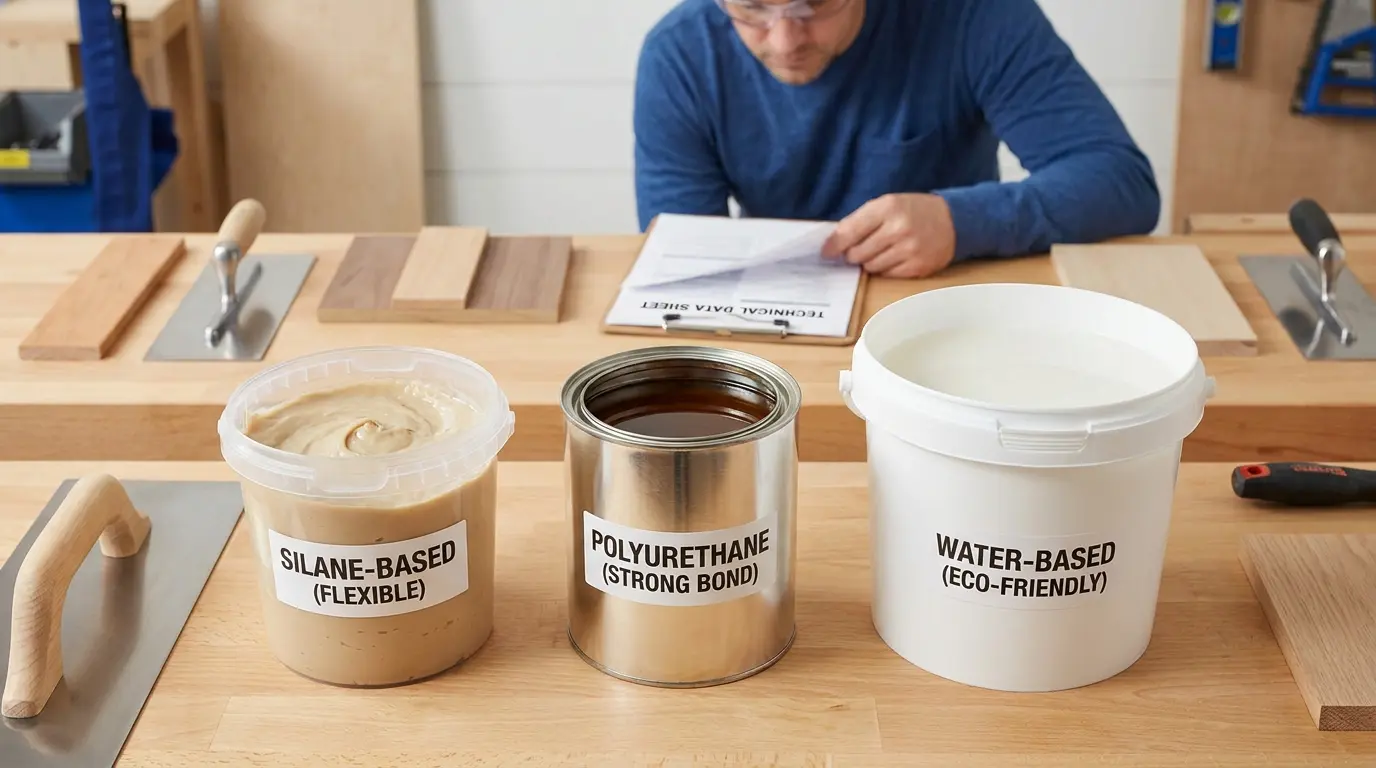
Choosing the right parquet adhesive comes down to four main factors: the type of parquet, the subfloor, moisture conditions and how much movement the flooring needs to accommodate. For most modern installations, flexible polyurethane or hybrid/MS polymer adhesives are the strongest starting points because they combine reliable bonding with enough flexibility to handle natural timber movement.
However, there is no single adhesive that is best for every floor. Engineered parquet, solid timber, concrete slabs, plywood and heated floors can all require different specifications. Before buying, always confirm that the adhesive is approved for your flooring type and installation conditions.
| Project Condition | Recommended Starting Point | Why |
| Engineered parquet | Hybrid/MS polymer | Flexible, easy to work with and widely compatible |
| Solid timber parquet | Polyurethane or approved high-strength hybrid | Strong bond with controlled flexibility |
| Concrete subfloor | PU or hybrid system approved for concrete | Strong adhesion and good moisture resistance |
| Plywood/timber subfloor | Flexible PU or hybrid | Handles minor substrate and timber movement |
| Underfloor heating | Flexible adhesive specifically approved for heated floors | Handles repeated temperature changes |
| Low-VOC priority | Certified low-emission hybrid/MS polymer | Usually a strong option for indoor air quality |
| High-traffic/commercial areas | High-performance PU or hybrid | Higher mechanical performance |
| DIY installation | One-component hybrid adhesive | Generally easier to handle and clean |
Why Choosing the Right Adhesive Matters
As a natural material, parquet flooring adapts to temperature and humidity fluctuations. Timber can warp or shrink and cause stress on the substrate to the flooring and subfloor. The adhesive must also be capable of keeping the parquet firmly in place while allowing normal timber movement without the need for any additional measures.
Using an unsuitable adhesive may eventually contribute to loose blocks, hollow areas, squeaking, gaps or movement. The fixing and subfloor conditions/movement are also addressed as a component of the whole flooring system, rather than a stand-alone matter in the Australian Timber Flooring Association guidance.
This is especially important when installing high quality parquet or solid timber flooring which Melbourne homeowners will want to last for decades. If the flooring eventually requires lifting and repair, it could be a poor value to save a little money on the adhesive.
Factors to Consider Before Choosing a Parquet Flooring Adhesive
The type of parquet flooring.
The first step to figuring out what type of parquet you have is to determine if it is engineered or solid timber.
The layering of engineered parquet makes it less prone to change sizes, making high-quality flexible hybrid adhesives appropriate for parquetry flooring. You may need an adhesive with a higher shear and bond strength when using solid parquet as it produces more movement forces.
Be sure to read the glue down instructions from the flooring manufacturer before selecting the product.
Subfloor Material
Different surface properties for concrete, plywood, structural timber and existing tiles. This may necessitate a primer or moisture-control system, or other surface preparation, for an adhesive to be effective when applied over concrete.
The modern polyurethane and hybrid types of flooring adhesives may be used to bond to a variety of suitable substrates, such as concrete, plywood and existing ceramic tiles.
Moisture Levels
One of the key factors in timber flooring installation is moisture.
It is important to note that a concrete slab which is dry on the surface may have a lot of water in it. If the moisture condition is beyond the limits of the flooring or adhesive system, a moisture barrier or an alternate system of installation may need to be used.
Don’t judge by how it looks. Test substrate per the manufacturers’ instructions of the flooring and adhesive.
Room Location
Think about the environment where the parquet is to be used.
The living room is a good place to start, as are slabs, entry areas, and spaces on ground floors that are subject to greater temperature fluctuations.
Parquet is not suitable for use in wet areas unless the overall floor assembly is built to withstand such conditions.
Traffic Level
A mechanical load is very different on a floor in a residential bedroom compared to a busy commercial showroom.
When using adhesives in high traffic areas, look for proven bond strength, durability and compatibility – not the lowest cost general-purpose adhesive.
Indoor Air Quality (Low VOC)
Low-VOC products can help to reduce emissions during and after installation for occupied homes, offices and commercial interiors.
There are low-emission or low-VOC wood-flooring adhesives available for many modern MS polymer and polyurethane product flooring. But, because of the chemistry, it is not a certainty that it will have low emissions, so consult the VOC or emissions certification for the product.

Types of Adhesives Explained
Polyurethane Adhesives
PU adhesive, also known as polyurethane adhesive, has been employed in the industrial field of timber flooring installations for a long time.
It can also be used to withstand the natural expansion and contraction of flooring with good bonding strength. Today, one-component PU flooring adhesives are available for engineered timber, solid timber and parquet use.
Pros
- High bond strength
- Good moisture resistance
- Appropriate for a wide range of timber species.
- Oral care products come in a variety of ways to suit your needs.
- Works with many concrete and plywood substrates
- A few products are certified to use for underfloor heating.
Cons
- May be more difficult to clean after curing.
- Installations can be dirtier than some hybrid systems
- Not all PU adhesives contain the same amount of VOCs.
- Premium formulations can be rather costly
Best applications
The application of polyurethane is especially beneficial for solid timber, demanding installations, larger timber elements, and projects requiring a high degree of mechanical performance.
Hybrid (MS Polymer) Adhesives
MS polymer, SMP or similar silane-modified adhesives are widely used in hybrid adhesives.
These are widely used in the professional flooring market thanks to their good application properties, elasticity, and adhesion. Many formulations are also free of additional water or conventional solvents that can also minimize moisture-induced distortion of sensitive timbers.
There are some existing MS polymer parquet adhesives that are perfectly formulated to stay elastic, have very low emissions and are suitable for underfloor heating.
Pros
- Excellent flexibility
- Strong adhesion
- Covers the area easily and levelly.
- Many low-emission options
- Good suitability for engineered parquet
- There are numerous products that can be used with underfloor heating.
- Options come in one component design to make installation easier.
Cons
- Can be more costly than simple adhesives
- There are differences in performance between manufacturers.
- Some products have limits on solid-board width or thickness
- Not all hybrid products offer moisture protection.
Best applications
The hybrid/MS polymer adhesives are generally good for all-around applications such as engineered parquet, residential projects, and renovations and installations requiring flexibility and low emissions.
Water-Based Adhesives
Unlike traditional organic solvent based products, water-based floor adhesives incorporate water into their product’s formulation but do not rely on organic solvents to a large extent.
Timber is moisture sensitive, but modern products can perform in the right applications. The type of flooring and the adhesive used is therefore crucial.
Pros
- Generally low odour
- The process of cleaning is more convenient while the fish is still alive (fresh).
- Reduce the potential for solvents (as emissions)
- Can be cost-effective
Cons
- Allow for moisture to be added during installation
- Does not recommend for use with moisture prone timber
- Can have limitations with certain parquet dimensions
- Formulation is a critical factor that influences performance.
Best applications
Whereas parquet products have been approved for water-based adhesive, it can be suitable over a suitable absorbent substrate. It should be used because it is compatible with the complete system and not just water based.
Solvent-Based Adhesives
This is much more common in the past than the solvent-based parquet adhesives.
While they can offer very good initial ‘grab’ they are not found in many residential projects, due to developments in modern polyurethane and hybrid systems.
Pros
- Strong initial tack
- A long track record of successful flooring installations.
- Is able to operate successfully in some dedicated systems
Cons
- Stronger odour
- Higher VOC concerns
- More difficult working environment
- Not very pleasing for occupied interior spaces.
When they’re still appropriate
A solvent-based adhesive may still make sense where an existing flooring specification, restoration system or specialist manufacturer specifically requires it. It should not automatically be selected for a new installation simply because it has traditionally been used for parquet.

Adhesive Comparison Table
The following comparison provides a practical starting point. Individual product specifications should always take priority.
| Adhesive Type | Bond Strength | Flexibility | Moisture Resistance | VOC | Best For |
| Polyurethane | Excellent | High | Excellent | Low to moderate depending on product | Solid timber, demanding installations |
| Hybrid/MS Polymer | Excellent | Excellent | Very good | Often very low | Engineered parquet, residential projects, heated floors |
| Water-Based | Moderate to high | Moderate | Moderate | Generally low | Compatible parquet and absorbent substrates |
| Solvent-Based | High | Moderate | Good | Usually higher | Specialist or traditional applications |
For most contemporary homes, hybrid/MS polymer and polyurethane adhesives are the two categories worth comparing first.
How to Choose the Right Adhesive for Your Flooring Project
Rather than asking, “Which adhesive is the strongest?,” you should ask, “Which adhesive is the best for creating a flooring system?
Check:
- If the adhesive is approved for your particular parquet.
- If it is made of hardwood, it should be treated with a wood preservative.
- Whether the moisture of the substrate is within its range.
- Use of moisture barrier or primer.
- The ability of the adhesive to allow movement of the timber.
- If underfloor heating is used or not.
- If VOCs are a concern for the project.
- If the working and curing time is appropriate for installation.
If you are installing a floor for a large area, or on a high dollar parquet floors melbourne project, it is best to have a timber flooring installer evaluate these factors before ordering materials, to avoid making expensive compatibility mistakes.

Choosing Adhesive Based on Your Subfloor
Concrete
Moisture testing and preparation of concrete must be carefully performed.
Surface should be generally clean, sound and free from dust, oil, old coatings or soft material. Depending on slab moisture and adhesive system, a moisture control membrane or moisture control primer may be necessary also.
Correctly prepared concrete is usually directly bonded with polyurethane and hybrid/MS polymer adhesives.
Timber
Before starting to install parquet, timber subfloors need to be structurally stable, firmly secured and flat.
A flexible flooring adhesive should be used as both the parquet and the timber substrate can change in response to environmental alterations.
Plywood
When plywood is installed, clean, dry and structurally sound, it is a good substrate in which to glue.
Adhesives frequently used include polyurethane and hybrid. Always check if the type of plywood and surface treatment are suitable for the adhesive.
Existing Tiles
The installation of parquet over tiles is possible but the existing floor needs to be securely bonded and adequately prepared.
Tiles that are very smooth or dirty may need mechanical preparation or an appropriate primer. There are flexible wood-flooring adhesives that are specially formulated to adhere directly to existing ceramic flooring.
Heated Floors
Flexibility is important with underfloor heating as this produces repeated temperature cycles.
Use an adhesive that is specifically recommended for heated flooring systems – not take any chances with any flexible adhesive. For radiant or underfloor heating, there are two types: polyurethane and hybrid.
The heating system must also be operated according to the flooring and adhesive manufacturers’ installation instructions before, during and after installation.
Common Adhesive Mistakes to Avoid
The quality of the adhesive is not enough if the installation is improper.
Common mistakes include:
- The use of adhesives purely for their price may lead to cost issues if it’s not suitable for the floor type.
- Failure to test for moisture: Moisture should be tested in the subfloor prior to installation.
- Wrong trowel: Errors in notch size alters adhesive coverage and transfer.
- Over-application of adhesive: This will not necessarily result in a stronger bond.
- Using products that are out of date: An out of date product might not cure or function properly.
- Adhesive application: For some substrates, priming is a requirement prior to adhesive application.
- Failure to provide open time: Failing to allow open time after adhesive application can cause the flooring to fail to bond.
- Incompatible systems: Check to ensure that mixing primers, moisture barriers and adhesives is compatible.
- Installing before acclimatisation: Timber needs to reach suitable installation conditions.
Not read manufacturer guidelines: The manufacturer’s instructions are specific and take precedence over the generic guidelines.
How Much Adhesive Do You Need?
The parquet size, subfloor surface and trowel notch are the primary factors that influence the consumption of adhesive.
For most full-spread parquet systems, consumption can be expected to be approximately 0.8–1.4 kg/m², but this is only a guideline and should not be used as a definitive figure. Manufacturers’ instructions indicate that consumption varies significantly, depending on flooring dimensions and trowel type.
To determine the amount of your order:
The specified adhesive consumption x Floor area = Estimated amount of adhesive required.
Then add a reasonable waste allowance for the quality of the soil and installation difficulty. Do not assume that the size of the room will determine the number of buckets needed based on the advertised maximum use of the bucket; the amount of bucket used may be greater if the substrate is not of good quality or if the bucket is used with a large trowel.

Professional Tips for Better Adhesion
Test Moisture First
Test timber and appropriate substrate conditions prior to opening the adhesive. Moisture issues should be addressed prior to installing flooring.
Properly prepare the surface to receive the coat.
The subfloor should be solid, level, dry and clean. Clean off dust, loose material, grease, wax and any old adhesive residue that might affect adhesion.
Check Temperature Requirements
Excessive cold, hot or humid conditions affect the curing of adhesives. Maintain room temperature, floor surface, adhesive and floor substrate within the manufacturer’s recommended installation limits.
Allow Proper Acclimatisation
Before installing parquet, store it in accordance with the manufacturer’s instructions for the flooring. Acclimatisation can help to minimize excessive dimensional movement after the floor has been installed.
Use the Correct Trowel
Make sure to hold the recommended notched trowel the same way to ensure the adhesive creates uniform ridges. It is more important to get a good “transfer” between the adhesive and the back of the parquet than to apply a thick adhesive surface.
Respect Curing Time
Don’t assume that all floor mats dry to the floor instantly!
The cure time will depend on the type of adhesive, temperature, humidity and thickness of the adhesive. Some systems can be accessed relatively quickly, others require a much longer time until sanding, heavy traffic or furniture placement.
Maintain Expansion Gaps
Use of adhesive does not override the need for an expansion allowance. Parquet still requires flooring manufacturer specified perimeter and structural movement requirements.
Are Premium Adhesives Worth the Extra Cost?
Sometimes but not automatically.
When the extra cost of the adhesive is justified by the extra performance benefit it offers, such as flexibility, bond strength, moisture control, lower emissions, acoustic performance or compatibility with underfloor heating.
It is not beneficial to pay for features that the project isn’t using, though. An adhesive that is properly specified and installed over a properly prepared substrate can be more effective than an expensive adhesive used incorrectly.
The real question is:
Does the added expense mitigate a true installation risk?
The extra cost may be easily justified if the premium system is able to remove the need for separate moisture control operations, enhance compatibility with the high cost of timber or mitigate movement risk. It may not be needed if it only provides features that are not relevant to the project.
Final Recommendations
The best adhesive for parquet flooring depends on the complete installation rather than the adhesive name alone.
| Scenario | Recommended Adhesive Category |
| Best for engineered parquet | Flexible hybrid/MS polymer |
| Best for solid timber | High-strength polyurethane or approved high-performance hybrid |
| Best for DIY projects | One-component hybrid/MS polymer |
| Best for commercial spaces | High-performance PU or hybrid |
| Best for underfloor heating | Flexible PU or hybrid specifically approved for heated floors |
| Best low-VOC option | Certified low-emission hybrid/MS polymer |
| Best for concrete | PU or hybrid system approved for concrete and the measured moisture condition |
For a typical engineered parquet installation over a properly prepared residential subfloor, a reputable one-component hybrid/MS polymer adhesive is often the most practical starting point.
For thicker solid parquet, demanding commercial conditions or floors with higher movement stresses, polyurethane or a high-performance hybrid system may be more appropriate.
Most importantly, treat the flooring, adhesive, primer, moisture protection and subfloor as one system. Where conditions are uncertain, having an experienced timber flooring installer inspect the project before installation is far less expensive than repairing a failed parquet floor later.
Frequently Asked Questions
What is the best adhesive for parquet flooring?
Flexible polyurethane and hybrid/MS polymer adhesives are generally the strongest options for modern parquet installations. The final choice should depend on the parquet type, subfloor, moisture conditions and manufacturer requirements.
Should I use polyurethane or hybrid adhesive for parquet flooring?
Polyurethane is an excellent option when high bond strength and demanding performance are required. Hybrid/MS polymer adhesives provide a strong combination of flexibility, workability and low-emission options, making them particularly attractive for engineered parquet and residential installations.
Can I use construction adhesive for parquet flooring?
Standard general-purpose construction adhesive should not replace a proper full-spread timber flooring adhesive unless the flooring and adhesive manufacturers specifically approve the installation method. Parquet requires consistent support and controlled movement across the floor.
What adhesive is best for engineered parquet flooring?
A flexible one-component hybrid/MS polymer adhesive is often an excellent choice for engineered parquet. Flexible polyurethane flooring adhesives can also perform very well.
What adhesive works best on concrete subfloors?
Polyurethane and hybrid/MS polymer flooring adhesives are commonly used over properly prepared concrete. Moisture testing remains essential because excessive slab moisture may require additional moisture protection.
Do I need a primer before applying parquet adhesive?
Not always. Some adhesives can be applied directly to suitable prepared substrates, while others require a primer on porous, weak or specialised surfaces. Follow the adhesive manufacturer’s substrate preparation instructions.
How long does parquet flooring adhesive take to cure?
It varies significantly. Some modern flooring adhesives allow light access within approximately a day, while complete curing can take longer. Temperature, humidity, adhesive thickness and product chemistry all affect curing, so always follow the product data sheet.
Which adhesive has the lowest VOC emissions?
Low-emission hybrid/MS polymer adhesives are commonly among the best choices, but adhesive chemistry alone is not enough to determine emissions. Look for verified low-VOC or recognised emissions certification on the actual product.
Can parquet flooring adhesive be used with underfloor heating?
Yes, provided the adhesive is specifically approved for use with underfloor heating. Flexible polyurethane and hybrid/MS polymer flooring adhesives are widely available for these applications.
How much adhesive do I need per square metre?
Many full-spread parquet adhesives use approximately 0.8–1.4 kg/m², but actual consumption depends on the flooring, trowel and substrate. Use the coverage figure and trowel specification supplied by the adhesive manufacturer rather than relying on a universal rate.


