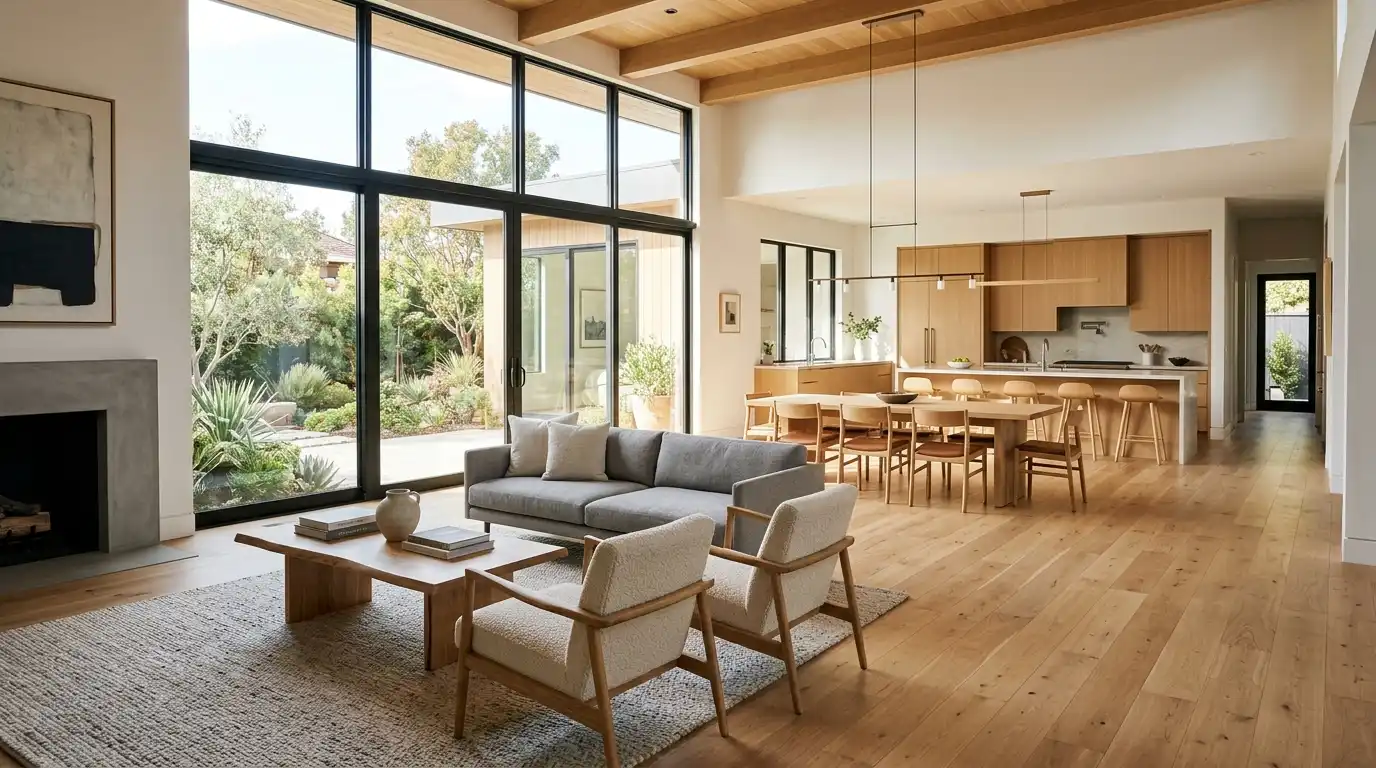
Choosing the Best Flooring for Open-Plan Homes Australia is more important than it may seem. In an open-plan home, the kitchen, dining and living areas are visually connected, so the flooring needs to create continuity while also handling traffic, spills, furniture movement and daily wear.
For most homes, engineered timber and hybrid flooring are the strongest all-round choices. Engineered timber offers a more natural, premium finish, while hybrid flooring is easier to maintain and provides better water resistance for busy households.
| Flooring | Main Advantage | Main Limitation | Best For |
| Engineered Timber | Natural premium appearance | Moderate moisture resistance | Stylish homes |
| Hybrid | Durable and water resistant | Less natural than timber | Families and pets |
| Luxury Vinyl | Affordable and practical | Lower premium appeal | Budget renovations |
| Solid Timber | Long-lasting and natural | Expensive | Luxury homes |
| Laminate | Low-cost timber look | Limited water resistance | Dry areas |
| Porcelain Tile | Very durable | Hard underfoot | Kitchens and high traffic |
| Natural Stone | Premium finish | High maintenance and cost | Luxury projects |
| Bamboo | Hard-wearing natural look | Quality varies | Eco-conscious homes |
What Makes Flooring Different in an Open-Plan Home?
Open plan flooring has to deliver on a number of fronts. A lounge, dining area and kitchen can be located on the same floor and should be designed to accommodate furniture, foot traffic, food spills, moisture, and more.
There are fewer walls between rooms, so alterations to the floors are recognisable too. The best open plan flooring Australia products should, therefore, be durable and look the same throughout the entire space.

Key Factors to Consider Before Choosing Flooring
The right floor depends on how the home is used. Families, pet owners and people who use the kitchen frequently usually need stronger moisture and scratch resistance than low-traffic households.
| Factor | What to Consider |
| Lifestyle | Daily traffic and overall use |
| Children | Spills, toys and frequent cleaning |
| Pets | Claws, dirt and accidents |
| Kitchen Usage | Moisture and food spills |
| Budget | Supply, installation and long-term costs |
| Maintenance | Cleaning and future repairs |
| Natural Light | How scratches and colours appear |
| Resale Value | Appeal to future buyers |
Comparison Table: Which Flooring Is Best?
Each flooring type suits a different combination of budget, lifestyle and design preference. For most open-plan homes, engineered timber offers a premium balance, while hybrid flooring is better where practicality comes first.
| Flooring | Durability | Water Resistance | Maintenance | Cost | Best For |
| Engineered Timber | High | Moderate | Moderate | $$$ | Premium interiors |
| Hybrid | High | Very High | Low | $$ | Families and kitchens |
| Luxury Vinyl | High | Very High | Low | $–$$ | Budget renovations |
| Solid Timber | Very High | Low–Moderate | Moderate | $$$$ | Luxury homes |
| Laminate | Moderate–High | Low–Moderate | Low | $ | Affordable projects |
| Porcelain Tile | Very High | Excellent | Low | $$–$$$ | Wet and high-traffic areas |
| Natural Stone | Very High | High | Moderate | $$$$ | Architectural homes |
| Bamboo | High | Moderate | Moderate | $$–$$$ | Natural interiors |
Engineered Timber
Engineered timber is a real timber surface overlaid with a layered base and offers improved dimensional stability over many traditional timber floors. This can be quite effective in open plan residences which require a welcoming natural look.
Great for space with family and friends, but will not be as water resistant as hybrid, vinyl or tile so spill up must be cleaned up promptly.
Pros
- Real timber surface
- Premium appearance
- Available in wide planks
- More stable than solid timber
- Strong resale appeal
- Comfortable underfoot
Cons
- Slightly more expensive than laminate or vinyl.
- Needs moisture care
- Each product is unique and will not be the same in quality.
- Thinner wear layers mean limited refinishing in the future.
Best for
Engineered timber is a product that is suitable for homeowners who are looking for the ultimate natural flooring in their home with an excellent long-term value and appearance.
Hybrid Flooring
Hybrid flooring is one of the most functional options for Australian family homes. It also provides good durability, water resistance and easy maintenance and is ideal for kitchens, dining rooms and living rooms that are connected.
It seems the only downside is that it doesn’t feel quite as real as real wood. But for homes with pets, kids or lots of daily usage, this drawback may not be the most important.
Perfect for: hectic families, pets, kitchens and easy homes.

Luxury Vinyl Flooring
Luxury vinyl is both functional and water-proof, and quite affordable. Today, modern designs can replicate the look of wood but are more pliable and convenient to clean up than tile.
While not as marketable as timber, it is a good option for cost-conscious home renovations or for homes where comfort, and ease of cleaning are concerns.
Ideal for: holiday lets, young families and cost-effective open-plan interior refurbishment.
Solid Timber
Solid timber will provide true character, longevity and multiple refinishings. It is still one of the most coveted options for luxury interior design.
It is however, more susceptible to moisture and movement than many modern systems of flooring. When thinking about solid timber floors in Melbourne, it’s essential to leave space available for the professionals to install it, for expansion gaps and for long term maintenance.
Ideal for: high-end upgrades, historic homes and homeowners.
Laminate Flooring
Laminate is one of the most budget friendly materials to achieve a timber finish in a big area. It provides good resistance to scratching and comes in many different colours and patterns.
It is weakest when it gets wet. It’s more appropriate for dry living spaces than for areas where spills or standing water are likely to occur.
Ideal for: economical remodeling, apartments and dry open spaces.
Also Read: Top Wood Laminate Flooring for Your Melbourne Home
Porcelain Tiles
Porcelain tiles are very hardy, waterproof and easy to clean. They are particularly good for kitchens, busy rooms and houses with a close relationship to the outdoors.
The drawback is that tile will be harder and colder to walk on than other flooring types and can be noisier in large areas. Large format tiles are suitable for open plan spaces, typically working to minimise grout lines.
Ideal for: kitchens, warm weather and active families.
Natural Stone
Natural stone gives a luxurious appearance to the architecture, and is suitable for spacious open-plan homes. Stonework like limestone, travertine and marble can give great visual sense to connect indoor and outdoor areas.
But stone is costly and certain types need to be sealed periodically. Also, the installation and maintenance are more challenging than hybrid or porcelain.
Ideal for: luxury renovations and architect-designed homes.
Bamboo Flooring
The bamboo is a naturally sourced substitute for wood. High quality woven bamboo can be quite durable, and appropriate to use in moderate-to-heavy home applications.
Quality is more important than getting the cheapest product as performance differs between products.
Ideal for: environmentally friendly homes and natural decor.
Also Read: Bamboo Flooring vs Hardwood

Should You Use the Same Flooring Throughout an Open-Plan Home?
In most cases, yes. A single type of flooring in the kitchen, dining and living rooms frequently creates a sense of scale and unity.
Transitions are still logical at bathrooms, laundries, bedrooms or well defined areas. When patterned timber is employed as a characteristic, parquet flooring melbourne can make an intentional design statement without altering the feeling of the space.
Benefits
- Better visual flow
- Larger-looking rooms
- Fewer transition strips
- Easier furniture coordination
- Cleaner overall design
Where Transitions Make Sense
The best places to use transitions are where there is a clear architectural boundary like a doorway, change in level or separate wet area.
As realestate.com.au explains, “Open-plan living is all about consistency and one flooring type for the entire space is the way to go.”
How Flooring Affects the Look and Feel of Your Home
The colour of the floor, the direction and size of the planks have a big impact on the size and brightness of an open-plan space. These should be taken into account with cabinetry, walls and natural light.
Wide Planks
Wide planks will result in a more streamlined and spacious appearance particularly in larger rooms.
Light Colours
Light flooring will provide natural light and can help to create a larger space in smaller homes.
Dark Floors
Dark floors can impart a superior, high-end feel, but can be more prone to picking up dust and pet hair and scratching.
Matte vs Gloss
Generally matte finishes are more functional as marks and reflections will be less visible than on glossy surfaces.
Plank Direction
Placing planks down the longest sight line can enhance the sense of length, and open up the room.
Indoor–Outdoor Continuity
A cohesive colour palette for the interior and exterior flooring can help to seamlessly integrate the spaces.
Also Read: Matte vs Gloss Finish on Wood Floors
Common Flooring Mistakes in Open-Plan Homes
One common error is using different types of floors in various spaces without taking into account the design as a whole. If you have too many finishes, you will likely create a less organized and smaller open plan home.
A lack of proper installation might also lead to issues in extensive regions. The correct leveling, expansion allowances and professional fitting are particularly important, and is why it is recommended that a timber flooring installer is used for the timber based systems.
Common mistakes include:
- Excessive use of various flooring types
- Narrow planks can only be used in very large rooms.
- Ignoring expansion gaps
- Describing the look of shiny finishes for busy residences
- Purchasing items from a small sample of a product.
- Failure to respect repeating patterns when laying synthetic flooring
- Installing the cheapest option for an affordable price
- Eliminate the need to remember the work required for the subfloor.
Maintenance Tips
Regular sweeping or vacuuming will get rid of the grit which may scratch the floor. Wash up spillages immediately and furniture pads can be used under chairs and dining tables.
Over water timber, laminate and bamboo. Stone and tile should also be treated with appropriate cleaners, and, if necessary, grout and sealers should be repaired every few years.

Expert Recommendations Based on Your Situation
Your lifestyle should determine your shortlist before colour or style.
| If You Have… | Best Choice | Alternative | Why |
| Dogs | Hybrid | LVP | Durable and easy to clean |
| Young children | Hybrid | LVP | Handles spills well |
| Large entertaining space | Engineered Timber | Porcelain | Premium and durable |
| Small open-plan home | Light Engineered Timber | Light Hybrid | Makes the area feel larger |
| Luxury renovation | Solid or Engineered Timber | Natural Stone | Strong premium appeal |
| Limited budget | Laminate | LVP | Lower upfront cost |
| Busy kitchen | Hybrid | Porcelain | High moisture resistance |
| Indoor-outdoor lifestyle | Porcelain | Hybrid | Easy transition between zones |
Decision Matrix
Use the following questions to quickly narrow down the right floor.
| Question | If Yes | Recommended Flooring |
| Is your budget limited? | Yes | Laminate or LVP |
| Do you have pets? | Yes | Hybrid or LVP |
| Do you have young children? | Yes | Hybrid or LVP |
| Is water resistance essential? | Yes | Hybrid, LVP or Porcelain |
| Do you want real timber? | Yes | Engineered or Solid Timber |
| Is luxury appeal important? | Yes | Timber or Natural Stone |
| Do you want low maintenance? | Yes | Hybrid, LVP or Porcelain |
| Is traffic very high? | Yes | Hybrid or Porcelain |
| Do you prefer a natural alternative? | Yes | Bamboo |
| Do you want indoor-outdoor continuity? | Yes | Porcelain or coordinated finishes |
Quick Decision Guide
Need strong water resistance?
Choose Hybrid, LVP or Porcelain.
Want genuine timber?
Choose Engineered Timber for a practical premium option or Solid Timber for maximum authenticity.
Working with a limited budget?
Choose Laminate or LVP.
Have pets or young children?
Choose Hybrid or durable LVP.
Planning a luxury renovation?
Choose Engineered Timber, Solid Timber or Natural Stone.
Final Verdict
For most households looking for the Best Flooring for Open-Plan Homes Australia, engineered timber and hybrid flooring offer the best overall balance. If you’re considering timber flooring Melbourne options, engineered timber can be an excellent choice for achieving a natural, premium look while maintaining practical performance.
Choose engineered timber if natural appearance and premium design matter most. Choose hybrid flooring if water resistance, children, pets and easy maintenance are the priorities.
Frequently Asked Questions
What is the best flooring for an open-plan house in Australia?
Engineered timber is one of the best premium choices, while hybrid flooring is usually the strongest practical option for busy family homes.
Is hybrid or engineered timber better for open-plan living?
Engineered timber is better for a natural, premium finish. Hybrid is better for moisture resistance, pets and low maintenance.
Should the kitchen and living room have the same flooring?
Usually, yes. Continuous flooring creates better visual flow and can make the entire open-plan area feel larger.
What flooring makes an open-plan home look bigger?
Light colours, wider planks and fewer transitions generally make open-plan areas appear larger.
What is the most durable flooring for an open-plan home?
Porcelain tile is one of the most durable options, while hybrid flooring offers an excellent balance of durability, water resistance and comfort.
Is solid timber suitable for an open-plan home?
Yes. Solid timber works particularly well in premium homes, but it needs more moisture management and maintenance than hybrid or vinyl.


2 Responses
I have an open-plan kitchen, dining and living area, but the kitchen gets quite a lot more wear and moisture. Is it still a good idea to use the same flooring throughout the whole space?
Using the same flooring throughout an open-plan space can create a more seamless and cohesive look, and timber can work well across kitchens, dining areas and living rooms when the product and installation are suitable for the conditions.
The main consideration is that timber isn’t waterproof, so the kitchen needs extra attention around sinks, dishwashers and other potential sources of moisture. A suitable finish, correct installation and prompt clean-up of spills are important. If the kitchen has significantly higher moisture exposure, it may be worth discussing whether a different flooring material or a transition zone would be more practical while still keeping the overall design cohesive.