
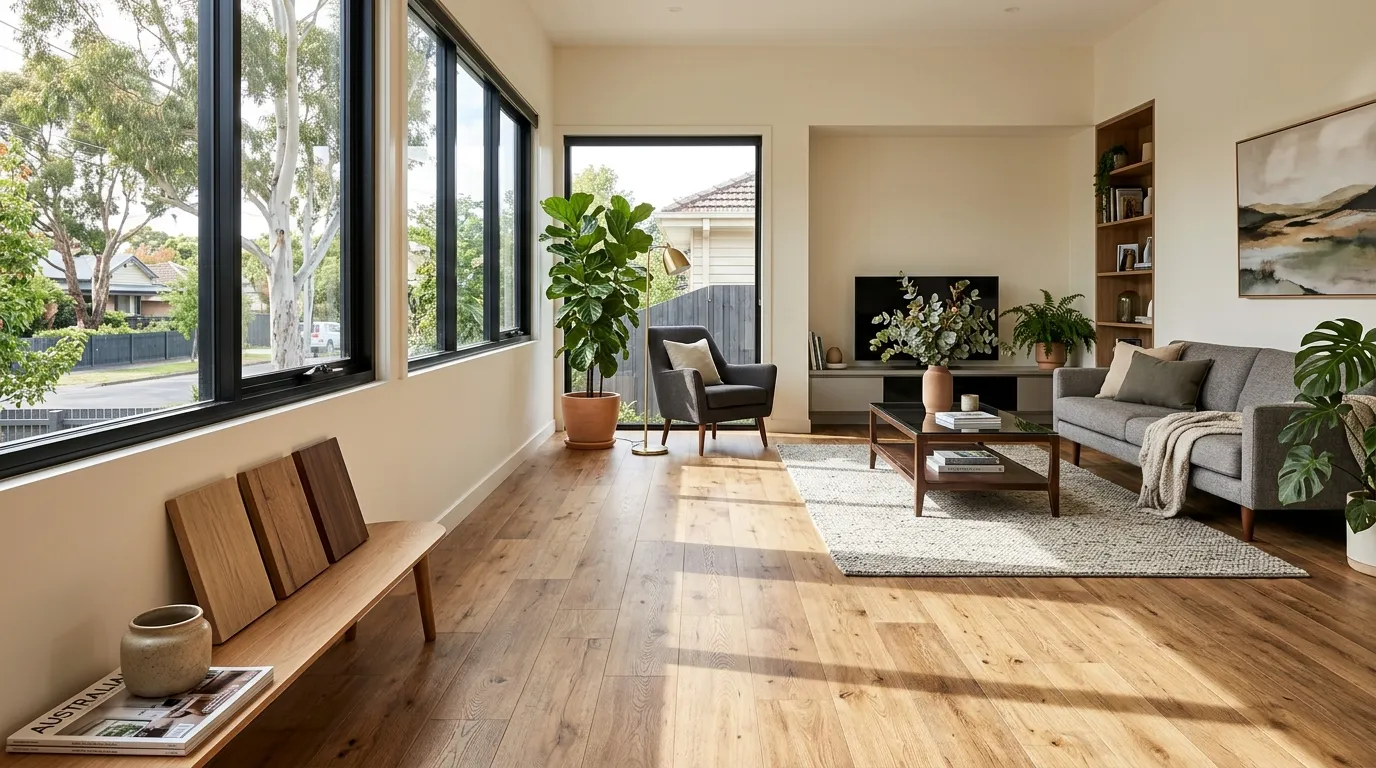
Choosing laminate flooring is about more than finding a colour that looks like timber. The right floor needs to suit how the room is used, how much traffic it receives, the condition of the subfloor and the moisture conditions of the property.
For many Melbourne homes, an AC4 laminate flooring can be a practical option for busy living areas, hallways and active family spaces, while AC3 laminate flooring can be suitable for lower-traffic rooms. However, the AC rating is only one part of the decision. Thickness, board construction, water resistance, the locking system, underlay and installation requirements should all be considered together.
Melbourne properties also vary considerably. A modern apartment on a concrete slab has different flooring requirements from a Victorian-era home with an existing timber subfloor. This guide explains what to look for when comparing laminate flooring and what to check before installation.
| Specification | What to Look For | Why It Matters |
|---|---|---|
| AC rating | AC3 for lower-traffic residential areas; AC4 for busier spaces | Indicates resistance to surface abrasion and wear |
| Thickness | Commonly 8mm–12mm, depending on the product | Affects the board construction, feel and floor height |
| Core | Quality HDF construction | Contributes to board stability and joint performance |
| Water resistance | Product-specific water-resistant construction where required | Helps manage everyday spills and moisture exposure |
| Locking system | Manufacturer-approved click or locking system | Supports reliable installation and joint performance |
| Underlay | Flooring-system compatible underlay | Can affect acoustics, moisture management and underfoot feel |
| Warranty | Clear manufacturer warranty and installation conditions | Helps you understand product limitations and requirements |
There is no single laminate specification that is right for every Melbourne home. The correct choice depends on the property, the room and the flooring system as a whole.
What Is Laminate Flooring?
Laminate flooring is a composite product of flooring that gives the look of timber covered with a laminate surface instead of a solid wood surface.
A typical laminate plank is made up of several layers. The upper surface is protected with a wearing surface over a decorative pattern intended to simulate timber. Below this, there is a thick layer of “HDF” (dense fibreboard) and an additional backing material used to help the construction of the board.
The result is a flooring that can be made to look like a variety of timber colours, grains and patterns and can offer a hard-wearing floor surface for everyday use.
It is important to note that laminate is not engineered timber. Engineered flooring is made with a true wood top and laminate is made from a decorative layer over a composite core. This difference has an impact on maintenance, refinishing, and floor damage.
For a detailed comparison, see our guide to Engineered vs Laminate Flooring.
Understanding Laminate AC Ratings
AC stands for Abrasion Class and is used to describe the resistance of a laminate floor’s wear surface to abrasion.
The rating is useful when comparing products, but a higher number does not automatically make one flooring product the right choice for every room.
| AC Rating | General Use | Typical Application |
|---|---|---|
| AC1 | Light residential | Low-use areas |
| AC2 | General residential | Lighter household traffic |
| AC3 | Heavy residential | Bedrooms, living rooms and normal household use |
| AC4 | Higher-traffic residential and light commercial | Hallways, busy living areas and active households |
| AC5 | Heavy commercial use | Commercial and very high-traffic environments |
For a typical Melbourne home, AC3 and AC4 are the ratings most worth considering.
AC3 may be appropriate where traffic is relatively moderate, such as bedrooms and other lower-use spaces. AC4 can provide a greater wear margin in busy areas such as entryways, hallways and living spaces used by children and pets. For homeowners comparing AC4 laminate flooring Melbourne options, this higher wear rating can be particularly suitable for active household areas that experience regular foot traffic.
The important point is to match the specification to the room rather than selecting the highest rating simply because the number is higher.

8mm vs 10mm vs 12mm Laminate Flooring
Another specification often used to compare laminate products is thickness, although the thicker it is does not necessarily mean the better it performs in every category.
Laminate comes in various thickness such as 8mm, 10mm and 12mm. The thickness of the board can affect the feel of the floor underfoot, and can even change the overall finished floor height, but should always be factored into the construction of the plank and the manufacturer’s installation guidelines.
Also look at thickness when comparing:
- Core density and construction
- Locking system
- Surface wear specification
- Underlay compatibility
- Existing floor levels
- The space that must be left at the side of the door or cabinet.
- Install heights between adjacent rooms.
It is not always going to be the right plank for the room, a 12mm plank isn’t necessarily right for a space, and an 8mm is not necessarily wrong. Thickness is not the only part of the product specification.
Water-Resistant vs Waterproof Laminate Flooring
When purchasing laminate flooring, an essential difference to know is between a water resistant and a waterproof.
Some laminate products are waterproof, and water resistance has many different levels among different products and manufacturers.
There are some modern laminate systems that have been developed to offer increased resistance to accidental spills, by enhancing board and joint protection. This can make them more useful in places where they might have a little moisture at times.
But this doesn’t mean it can be used as a completely waterproof surface.
Always check:
- The manufacturer’s water-resistance rating
- The amount of time the product will retain moisture-resistant functionality
- If the joints need special treatment for installation or not.
- Which rooms that the manufacturer approves
- The warranty does not cover any damage caused by water.
For example, don’t assume that laminate that is labeled “water resistant” is appropriate for a bathroom, laundry or continuously wet space.
When choosing a spill cleanup product for kitchens or other locations where spills may occur, choose only one approved for this purpose by the manufacturer.

Which Laminate Flooring Is Best for Different Rooms?
The most appropriate laminate flooring specification depends on how each room is used.
| Room | Main Considerations | What to Prioritise |
|---|---|---|
| Living room | Daily traffic and appearance | Suitable AC rating, durable surface and suitable finish |
| Hallway | Concentrated foot traffic | Higher wear resistance and reliable joints |
| Bedroom | Lower traffic and comfort | Suitable AC rating, appearance and underlay |
| Home office | Chair movement and concentrated wear | Surface durability and furniture protection |
| Dining area | Spills and repeated chair movement | Easy maintenance and suitable water resistance |
| Kitchen | Moisture and spills | Manufacturer-approved water-resistant product |
| Apartment | Impact noise and floor height | Approved acoustic system, underlay and transitions |
| Pet household | Scratches, dirt and spills | Wear resistance, textured finish and easy cleaning |
This is why choosing laminate flooring should begin with your lifestyle and the room rather than with a colour sample alone.
Choosing Laminate Flooring for a Melbourne Home
The conditions found in Melbourne homes are diverse, and it is important that they are taken into account as much as the laminate.
A concrete slab acts as a barrier to moisture
Newer houses, apartments and extensions around Melbourne are typically constructed using concrete. Prior to installation of a floating floor over concrete, the condition and moisture content of the concrete slab should be evaluated according to the flooring manufacturer’s specifications.
A slab can be dry on the surface and have moisture conditions that are not suitable for a specific flooring system.
Moisture content evaluation is especially crucial when:
- The slab is new
- There has been previous water damage
- The property is at ground level
- Existing floor is damp and wet.
- The flooring specification has strict moisture requirements
Another factor in determining the appropriate method of moisture control is the type of flooring system. The underlay or vapour-control layers should not be chosen just because they are the ones that are often used; they should be compatible with the product and installation method.
The Melbourne experience of seasonal change
There are large variations in temperature and humidity throughout the year in Melbourne. While laminate offers many benefits in terms of dimensional stability compared to natural timber, it is still essential to adhere to the product’s installation guidelines.
Appropriate perimeter clearance, site conditions and manufacturer’s recommended installation instructions prevent movement, joint issues, or buckling.
No single measurement of the expansion gap can be used for all types of laminate products. Always refer to manufacturer’s installation directions for the required clearance.
Apartments and Acoustic Requirements
Planning the flooring for an apartment is more complicated than the floor of a home that is on the ground floor.
The flooring system must be evaluated as an entire system and not by the thickness of the underlay or its cost alone, as hard flooring can impact impact sound transmission between apartments.
There are sound-insulation requirements in the National Construction Code (NCC) for relevant Class 2 and Class 3 buildings, including the specification for floors between sole-occupancy units.
NCC 2025 began on 1 May 2026 in Victoria (the code version used for a particular project may vary depending on the timing and circumstances of the project).
If you’re looking to renovate your apartment, look for:
- Owners Corporation requirements
- Building-specific flooring rules
- Acoustic documentation
- Underlay performance
- Existing floor construction
- Completed floor height and transitions
Note that any underlay sold as “acoustic” is not necessarily going to meet the needs of an apartment.
Older and Heritage Melbourne Homes.
Homes that are older in Melbourne may have other installation challenges.
Victorian and Edwardian properties may have timber subfloors in place, but may be uneven, have old floor coverings and a very different finished floor height between adjoining rooms.
Prior to installation, it may be appropriate to evaluate:
- Existing timber boards
- The structural condition of the sub-floor.
- Surface flatness
- Moisture
- Door clearances
- Skirting boards
- Transition details
- Finished floor height
It’s not just about laying new boards. The new flooring system must be compatible with the existing structure of the house.

Can Laminate Flooring Be Installed Over Existing Tiles?
Sometimes laminate can be laid over worn-out tiles, depending on the situation, but, before that, a thorough evaluation of the tiles should be done.
The surface must be sufficiently stable, flat and dry, and the laminate manufacturer’s installation directions must permit installation over the existing surface.
When applying tiled floors, think about:
- Tiles that are loose or broken.Broken or loose tiles.
- Uneven areas
- Moisture
- Grout lines and surface profile.
- Overall floor height
- Door clearance
- Switching between adjacent rooms
- The ability to fit into the desired laminate system
It is possible that a tile floor may appear fine from a distance, but may be sufficiently uneven when a floating floor is installed.
The answer is then not a simple “yes, no” question, but one that depends on the specific condition of the current floor in question.
For more information about working with existing tiled floors, see our guide to Timber Flooring Over Tiles.
How to Prepare the Subfloor for Laminate Flooring
The subfloor preparation is one of the most important steps in a successful laminate floor installation.
No amount of laminate can make up for a poor surface preparation job. If the subfloor has significant high and low areas, the floating floor may move underfoot, place additional stress on the locking joints or produce unwanted noise.
Prior to installation the surface should be evaluated for:
- Flatness
- Moisture
- Cleanliness
- Previous water damage
- Loose materials
- Existing flooring
- Transitions
- Finished floor height
If necessary, the best method of preparation depends on the substrate. It is important to not treat all of the concrete, existing tiles and timber subfloors the same.
When determining if the surface is suitable, the manufacturer’s installation tolerances should be used.
Choosing the Right Underlay
Underlay is a component of the flooring system, and is not just an add-on under the boards.
The proper underlay can affect:
- The impact and airborne acoustic performance will be assessed
- Avoidance of moisture problems if applicable
- Underfoot feel
- Floating-floor behaviour
- Works well with the locking system.
Acoustic performance can be critical in the case of apartments.
On the other hand, it is not necessarily better to install thicker or softer underlay. The flooring manufacturer may list, recommend, or require a specific type, density or thickness of underlay to provide support for the locking system’s performance.
Therefore, choose the underlay along with the laminate and not separately.

Laminate Flooring and Pets
Laminate can be a viable choice for households that have pets, especially if cleanliness and surface durability are important aspects.
No laminate floor is, however, 100% scratch-proof.
If you have pets, consider:
- AC rating
- Surface texture
- Colour variation
- Water resistance
- Ease of cleaning
- Furniture protection
- Nails should be removed from pets and regular cleaning should be performed.
Also, natural looking textured finishes might be more forgiving aesthetically than extremely dark and even finishes because daily dust, hair and minor marks are less conspicuous.
Using furniture pads and cleaning up spills promptly can minimize the amount of unnecessary wear on surfaces.
Common Mistakes When Buying Laminate Flooring
EBA is a strategy for selecting the most visually appealing solution.
A floor can be a great fit in a showroom and not work in the room it will be in at home.
Think about traffic, moisture, pets, cleaning routines, natural light and the existing floor before making the final decision.
Ignoring the Subfloor
Even the best laminate product requires a suitable installation surface.
If there is any irregularity, dampness or existing floor issues, these should be determined prior to laying the boards.
The assumption that every laminar is waterproof
Water resistance is a characteristic of a product.
Do always read the technical data and the warranty of the manufacturer.
Choosing Underlay Separately
The wrong underlay can impact the acoustic performance, floor movement and locking system performance.
Use an underlay that is approved for the particular flooring system.
The Universal Treatment of Expansion Requirements
There are various types of flooring systems that may have various installation needs.
A perimeter clearance should be determined by manufacturer’s instructions and not by copying the clearance from another product.
Having too much emphasis on thickness
Thicker does not necessarily mean better!
Compare and provide details for the whole specification such as core, AC rating, locking system, water resistance and installation requirements.
When Should You Hire a Professional Laminate Flooring Installer?
Laminate is generally considered to be a relatively simple floating floor product, but there are occasions where the installation is more challenging due to an uneven subfloor, multiple levels, existing tile, awkward doorways or apartment acoustic requirements.
Professional assessment is helpful when:
- Subfloor must be prepared
- There is uncertainty about moisture
- The existing floor is tiled.
- The rooms have different levels on the floor.
- Space must be provided for doors or cabinetry.
- Acoustic requirements apply
- Installing the flooring requires the manufacturer’s instructions, which are complicated.
Installing it is just the beginning. All site evaluation, preparation, layout, spacing for future expansion, transitional and finishing elements will make a difference.
With over 20 years expertise in the industry, Boss Timber Flooring has a wealth of experience across Melbourne with flooring installation and restoration, as well as sanding and polishing projects.
With a laminate floor, the same rules are in place: The product has to be appropriate to the specific property, not a “formula.
What to Expect Before Laminate Flooring Installation
The professional flooring assessment should consider the property as a whole.
It could involve the following:
1. Assessing the Existing Floor
The installer inspects the existing flooring, existing substrate, floor levels and any existing visible defects.
2. Assessing the condition of the entry point(s)
Moisture and substrate are tested as per flooring manufacturers’ requirements where applicable.
3. Designing Floor Levels and Transitions
Doorways, skirting, cabinetry and adjoining flooring can all affect the final installation height.
4. Understanding the type of underlay you have.
The underlay should be compatible with the flooring and appropriate for the room and building type.
5. Installing the Laminate
Boards are installed in accordance with manufacturer’s approved installation practices, including perimeter clearances and board joints.
6. Completing and Inspecting the Floor
Before the project is completed, the transitions, edges, door clearances and visible finishing details are checked.
Frequently Asked Questions
Is laminate flooring suitable for Melbourne homes?
Yes, laminate can be suitable for many Melbourne homes when the product is appropriate for the room and installed according to the manufacturer’s requirements. Traffic, moisture, subfloor condition, acoustic needs and product specifications should all be considered.
What AC rating should I choose for laminate flooring?
AC3 can be suitable for lower-traffic residential areas, while AC4 is commonly considered for busier spaces such as hallways, living areas and active households. The appropriate rating depends on the room and the product’s overall specification.
Is 12mm laminate better than 8mm?
Not automatically. Thickness is only one specification. Compare the board construction, core, AC rating, locking system, underlay requirements and finished floor height before choosing between products.
Is laminate flooring waterproof?
Not all laminate flooring is waterproof. Water resistance varies between products, so the manufacturer’s technical documentation should be checked before using laminate in areas exposed to moisture.
Can laminate flooring be installed over tiles?
It can be possible when the existing tiles are stable, sufficiently flat, dry and compatible with the manufacturer’s installation requirements. Floor height, door clearance and transitions also need to be checked.
Can laminate flooring be used in a kitchen?
Some laminate products are approved for kitchen use, particularly products with enhanced water-resistance properties. Always confirm the manufacturer’s application requirements and clean up spills promptly.
Is laminate flooring suitable for apartments?
It can be, but apartment projects require additional attention to acoustic performance, underlay selection, floor height and building requirements. Owners Corporation rules and applicable building requirements should be checked before installation.
Is laminate flooring suitable for homes with dogs?
A quality laminate product can work well in homes with dogs because the wear surface is designed for everyday use and is generally easy to clean. However, no laminate is completely scratch-proof, so wear resistance, texture and maintenance should all be considered.
Can damaged laminate flooring be sanded?
No. Laminate does not have a solid timber wear layer that can be sanded and refinished like solid timber flooring. Severely damaged boards generally need to be replaced.
For more information, read our guide on how to replace a damaged laminate floor board.


4 Responses
I like the way you explained the pros and cons of laminate flooring without making it sound like the perfect solution for every home. One thing I’m curious about is how modern laminate flooring performs in busy family homes with kids and pets. Has the scratch resistance improved enough over the last few years to make it a reliable long-term option, or would engineered timber still be the better investment?
Hi Harrison, Modern laminate flooring has come a long way and many premium products offer excellent scratch and wear resistance, making them a practical choice for busy households. However, if you’re looking for the natural appearance of real timber, the ability to refinish the floor in the future, and added long-term value, engineered timber is often the better investment. The right choice ultimately depends on your budget, lifestyle, and long-term plans for your home.
Hi Boss Timber Flooring,
We’re renovating our home in Glen Waverley and are considering laminate flooring for the living room, hallway and kitchen. One thing I’m still unsure about is whether laminate is actually durable enough for a family with two young kids and a medium-sized dog. I’ve also heard mixed opinions about installing laminate over existing tiles. Is that generally possible, or do the tiles usually need to be removed first?
Thanks in advance.
Thanks for your question.
Laminate flooring can be an excellent choice for busy family homes when the right product is selected. We generally recommend choosing a quality laminate with an appropriate AC wear rating for areas that receive heavy daily foot traffic, especially if you have children or pets.
Regarding existing tiles, removal isn’t always necessary. If the tiled floor is structurally sound, level and meets the manufacturer’s installation requirements, laminate can often be installed over it using the correct underlay. However, every property is different, so we always recommend assessing the existing subfloor first to determine whether any preparation work is required before installation.
Factors such as floor level, moisture, doorway clearances and transitions between rooms should also be checked to ensure the finished floor performs properly over the long term.
We appreciate your question and hope this information helps with your renovation planning.