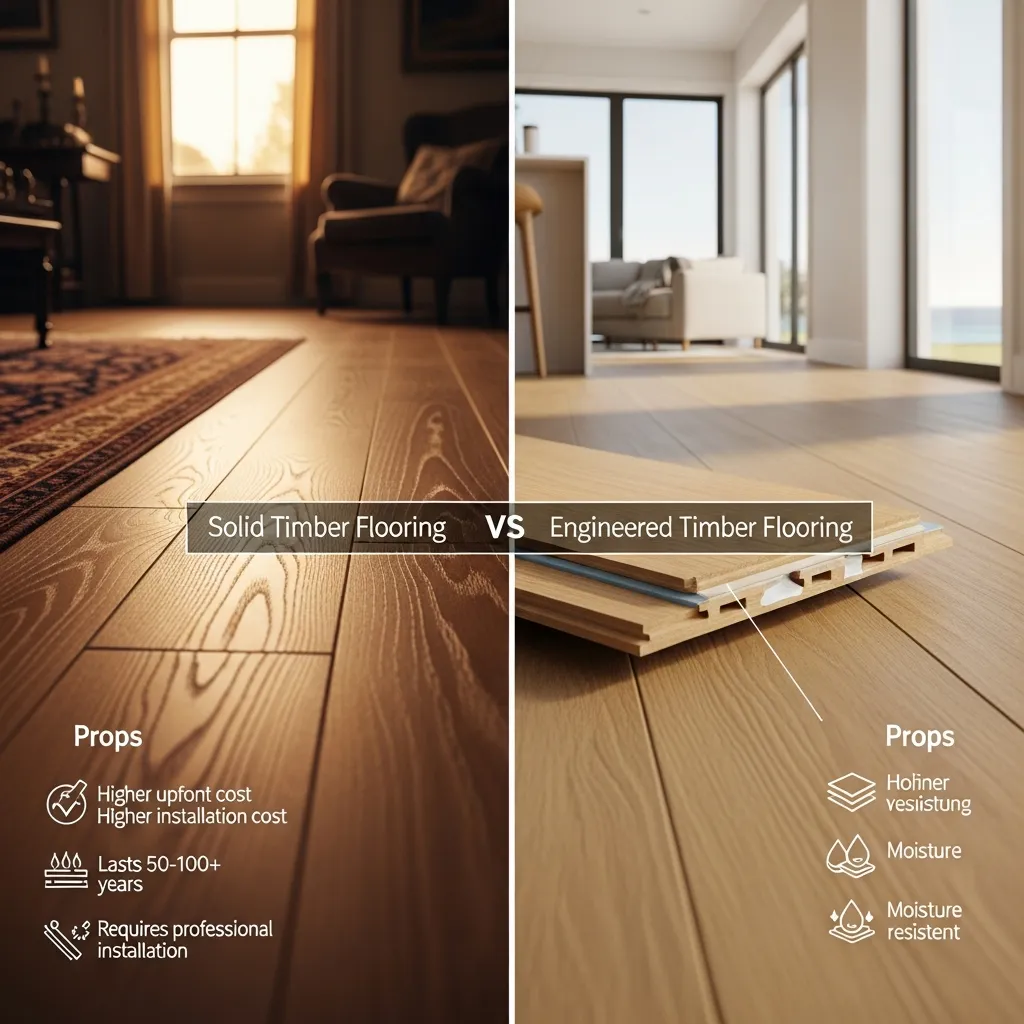
Choosing between solid and engineered timber flooring comes down to the construction of your home, the subfloor, moisture conditions, installation method and how long you want the floor to remain in service.
For most modern Melbourne renovations, engineered timber is often the more practical option over concrete slabs, in apartments and where greater dimensional stability is required. Solid timber remains particularly suitable for homes with suspended timber subfloors, heritage properties and homeowners who prioritise a long service life with repeated sanding and refinishing.
Quick answer: Choose engineered timber for concrete slabs, many apartment renovations, underfloor heating systems approved for timber flooring, and projects where dimensional stability is a priority. Choose solid timber for suitable suspended timber subfloors, heritage homes and projects where repeated future sanding is important. In Melbourne, the subfloor, moisture conditions and installation requirements should guide the decision.
Solid Timber vs Engineered Timber Flooring table
| Feature | Solid Timber Flooring | Engineered Timber Flooring |
|---|---|---|
| Stability & Movement | More prone to expansion and contraction due to humidity and temperature changes | More stable due to layered construction; less movement |
| Best for Climate | Better in controlled indoor environments | Ideal for areas with fluctuating humidity (e.g. coastal homes) |
| Installation | Usually nailed or glued; requires professional installation | Can be floated, glued, or clicked; often DIY-friendly |
| Installation Time | Slower; requires acclimatisation | Faster and more flexible installation |
| Lifespan |
50+ years with appropriate installation and maintenance |
20–50 years, depending on product construction, wear layer and maintenance |
| Refinishing | Can be sanded and refinished multiple times | Limited refinishing depending on veneer thickness |
| Appearance Over Time | Develops natural patina and character | Maintains a more consistent, uniform look |
| Authenticity | 100% solid hardwood throughout | Real wood surface with engineered core |
| Upfront Cost | Higher material and installation cost | More affordable initial investment |
| Long-Term Value | High long-term value due to durability | Good balance of cost and performance |
| Best For | Long-term homeowners, heritage properties | Renovations, apartments, budget-conscious buyers |
Understanding the Basics: What Are You Really Comparing?
To understand the difference between Solid Timber vs Engineered Timber Flooring, let’s first consider what each option is and what they have in common – though they look similar, they are constructed very differently.

What Is Solid Timber Flooring?
As the name implies, solid timber flooring is made from solid pieces of hardwood timber. Like oak, blackbutt, spotted gum, or jarrah – sawn, planed and surfaced into planks.
Each plank is:
- 100% natural wood
- Typically 18–22 mm thick
- Can be sanded and re-finished
This is the traditional choice. The flooring you see in older homes, often standing up for many years.
What Is Engineered Timber Flooring?
In contrast, engineered timber flooring is made up of layers.
It usually consists of:
- An outer layer (or veneer) of real wood
- Several layers of plywood or high-density fibreboard
This makes it stable, and still looks like timber. On the face of it, it may look like solid timber, but structurally it’s not.
Installation method should always be selected according to the flooring product, subfloor and manufacturer’s instructions.
Engineered timber is commonly available for floating, glue-down or other manufacturer-approved installation systems, while solid timber is more commonly mechanically fixed or bonded to a suitable timber-based or prepared subfloor.
For Australian projects, site conditions such as moisture, seasonal humidity, subfloor condition, installation environment and expansion requirements should be assessed before installation.
Source: ATFA
Solid vs Engineered Timber: Technical Specifications
| Specification | Solid Timber Flooring | Engineered Timber Flooring |
|---|---|---|
| Construction | One solid timber board | Real timber wear layer over a multi-layer core |
| Typical total thickness | Around 19mm for common solid flooring profiles | Product-specific; Boss systems vary by product |
| Wear layer | Solid timber throughout the board | Product-specific genuine timber wear layer |
| Core | Solid hardwood | Usually multi-layer plywood or other engineered core construction |
| Board width | Product and species dependent | Product dependent; wider formats are commonly available |
| Installation | Commonly secret-nailed, mechanically fixed or glued where approved | Floating, glue-down or other manufacturer-approved methods |
| Sanding | Can generally be sanded and refinished multiple times | Depends on wear-layer thickness and manufacturer requirements |
| Concrete slab | Requires a suitable prepared system | Commonly suitable with an approved glue-down or floating system |
| Underfloor heating | More restrictive and product-specific | Many products are suitable when specifically approved |
Wood Types & Finish Options (Raw vs. Prefinished)
Useful information on Raw vs. Prefinished and Choosing the Right Wood Species when selecting wood flooring are important.
Hardwood floors provide a better density and durability and use Australian hardwoods such as Spotted Gum, Blackbutt or Ironbark.
On the other hand, non-hardwood like Cypress Pine is cheaper and eco-friendly as it grows much faster.
Raw timber flooring may require acclimatisation before installation, but there is no single acclimatisation period that applies to every timber floor.
The correct approach depends on the timber species, product construction, moisture content, site conditions, expected in-service environment and the manufacturer’s installation instructions.
Before installation, the building should be appropriately enclosed and the flooring should be assessed against the moisture and environmental conditions expected after installation.
Prefinished solid timber is also easier to use as it is sanded and sealed at the factory.
The factory applied coatings provide a great level of uniformity and durability, and installation is possible without any delay.
Most engineered timber flooring products are factory-prefinished, although installation and finishing options vary by product and manufacturer.
difference between engineered timber and solid timber

Stability and Movement
Wood is an organic material – it will expand and contract with changes in the weather.
- Natural timber is more susceptible. It can expand in the summer and contract in the winter.
- Engineered timber’s cross-laminated structure helps to minimise this.
Timber Flooring in Melbourne: What Changes the Decision?
Melbourne homes are not built to one standard. A heritage property with a suspended timber floor can require a very different flooring approach from a modern home or apartment built on a concrete slab.
Victorian and Edwardian Homes
Older Melbourne homes often have suspended timber subfloors supported by joists and bearers. In these properties, the condition of the existing timber structure, airflow beneath the floor, moisture and existing board movement should be assessed before installing or replacing flooring.
Solid timber can be a natural fit for suitable suspended timber construction, particularly where a traditional appearance and future refinishing are important.
Modern Homes and Concrete Slabs
Newer homes, extensions and many apartments use concrete slabs. In these situations, moisture, flatness and the suitability of the slab for the selected flooring system need to be checked before installation.
Engineered timber generally offers more installation flexibility over prepared concrete than traditional solid timber.
Melbourne’s Seasonal Conditions
Timber responds to changes in moisture and humidity. Melbourne’s seasonal variation means flooring should be installed with appropriate moisture assessment, expansion allowance and environmental conditions in mind.
The goal is not to eliminate all natural movement. It is to select and install a flooring system that accommodates the movement expected in service.
Installation Flexibility
Here’s where the debate between DIY renovators starts.
Solid timber:
- They will usually be nailed or glued down
- Requires professional installation
- Becomes acclimatised to the room
Engineered timber:
- Can be floated, glued or clicked together
- Often DIY-friendly
- Faster installation
If you have a short time-frame to complete your home renovation, then engineered timber is faster and less costly to install.

Moisture Resistance
Both solid and engineered timber respond to moisture and changes in humidity because timber is a natural, hygroscopic material.
The difference is in how each product is constructed.
Solid Timber Flooring
Solid timber is made from a single piece of wood, so changes in moisture content can cause greater expansion and contraction across the board. If environmental conditions are poorly controlled, this movement can contribute to gaps, cupping, swelling or distortion.
This does not make solid timber unsuitable for Melbourne homes. It means the subfloor, installation conditions, expansion allowance and indoor environment need to be managed correctly.
Engineered Timber Flooring
Engineered timber generally moves less than solid timber because its layered construction reduces movement through the board.
This makes engineered flooring particularly practical for projects where the subfloor or environment creates greater movement risk, including many concrete-slab renovations and some apartments.
However, engineered timber is not waterproof. It has better resistance to moisture-related movement than solid timber, but the actual moisture performance depends on the product’s construction, finish, installation system and manufacturer’s requirements.
For kitchens, laundries and entry areas, select only a product approved for that application and clean up spills promptly.
Acoustics and Comfort Underfoot
The acoustic performance of timber flooring depends on more than the board itself. Subfloor construction, installation method, underlay and the building structure can all influence how the floor sounds and how much impact noise is transmitted.
A floating engineered timber floor can produce a different sound underfoot from a directly bonded or mechanically fixed timber floor. In apartment buildings, the choice of underlay and the performance of the complete flooring system can be particularly important.
For this reason, neither solid nor engineered timber should be described as universally quieter. The most suitable system depends on the subfloor, installation method, acoustic requirements and the manufacturer’s specifications.
For apartment projects, check the Owners Corporation requirements and any required acoustic documentation before selecting the flooring system.
Lifespan and Longevity
Solid timber has a long service life when it is correctly installed and maintained. Because the entire board is made from solid timber, it can generally be sanded and refinished multiple times throughout its life.
A well-installed solid timber floor can last 50 years or more, with the actual service life depending on timber species, installation conditions, maintenance and how often the floor is refinished.
Engineered timber can also provide decades of service, but its refinishing potential depends heavily on the thickness of the genuine timber wear layer.
For many engineered floors, a realistic service life is around 20 to 50 years, although higher-quality products with thicker wear layers and appropriate maintenance can remain serviceable for longer.
The key difference is not simply how many years the floor remains in the home. Solid timber generally offers greater potential for repeated sanding, while engineered timber’s future refinishing depends on the specific product.

Appearance and Authenticity
Let’s be honest, it matters what it looks like.
Both have solid wood on the face, so are very similar. However:
- Solid wood will age and patina
- Engineered timber has a uniform appearance
Some like the colour of solid wood. But other prefer the consistency of engineered.
Plank Sizes, Widths, and Visual Seams
Engineered timber flooring is generally available in a wider range of plank widths than traditional solid timber flooring. Its layered construction allows manufacturers to produce wider boards while reducing the amount of seasonal movement associated with a solid timber plank.
The exact width depends on the flooring range and manufacturer, so homeowners should compare the actual board dimensions rather than relying on a generic maximum width.
Wider engineered boards can create a more open, contemporary appearance and can be particularly effective in larger living areas and open-plan Melbourne homes.
Cost Considerations
Cost is a consideration.
Solid timber:
- Higher upfront cost
- Higher installation cost
- Long-term savings due to longevity
Engineered timber:
- More affordable initial cost
- Lower installation expenses
- Cost effective balance of performance
Engineered timber is extremely popular with budget-conscious buyers, and can be thought of as the “best of both worlds”.

Which Timber Flooring Suits Your Melbourne Home?
| Situation | Often More Suitable | Why |
|---|---|---|
| Concrete slab | Engineered timber | More installation flexibility and greater dimensional stability |
| Suspended timber subfloor | Solid or engineered | Both can be suitable when the subfloor is sound and the installation system is appropriate |
| Heritage or period home | Solid timber | Traditional appearance and strong future refinishing potential |
| Apartment renovation | Engineered timber | More flexible installation options and easier integration with acoustic underlay systems |
| Underfloor heating | Engineered timber | Many products are designed for heated floors, subject to manufacturer approval |
| Maximum future sanding | Solid timber | More timber is available throughout the board for repeated refinishing |
| Wide plank appearance | Engineered timber | Layered construction allows wider formats across many product ranges |
| Kitchen or laundry | Product-specific | Choose only a product approved for the area; neither timber type should be treated as waterproof |
| Home with pets | Either, depending on product | Consider finish, species, surface hardness, maintenance and household traffic |
| Investment property | Depends on project priorities | Balance product durability, installation requirements, maintenance and replacement considerations |



2 Responses
Great comparison of engineered timber flooring vs solid timber flooring. I was leaning towards solid timber at first, but after reading this article I can see why engineered timber can be a better choice for homes with changing humidity. The practical points about durability and installation were especially useful. Thanks for putting together such a balanced guide!
Thank you for your thoughtful feedback! We’re glad the comparison helped you make a more informed decision. Both solid and engineered timber flooring have their strengths, but choosing the right option really depends on your home’s environment and your long-term needs. We’re pleased you found the sections on durability and installation useful. Thanks again for taking the time to share your thoughts!