
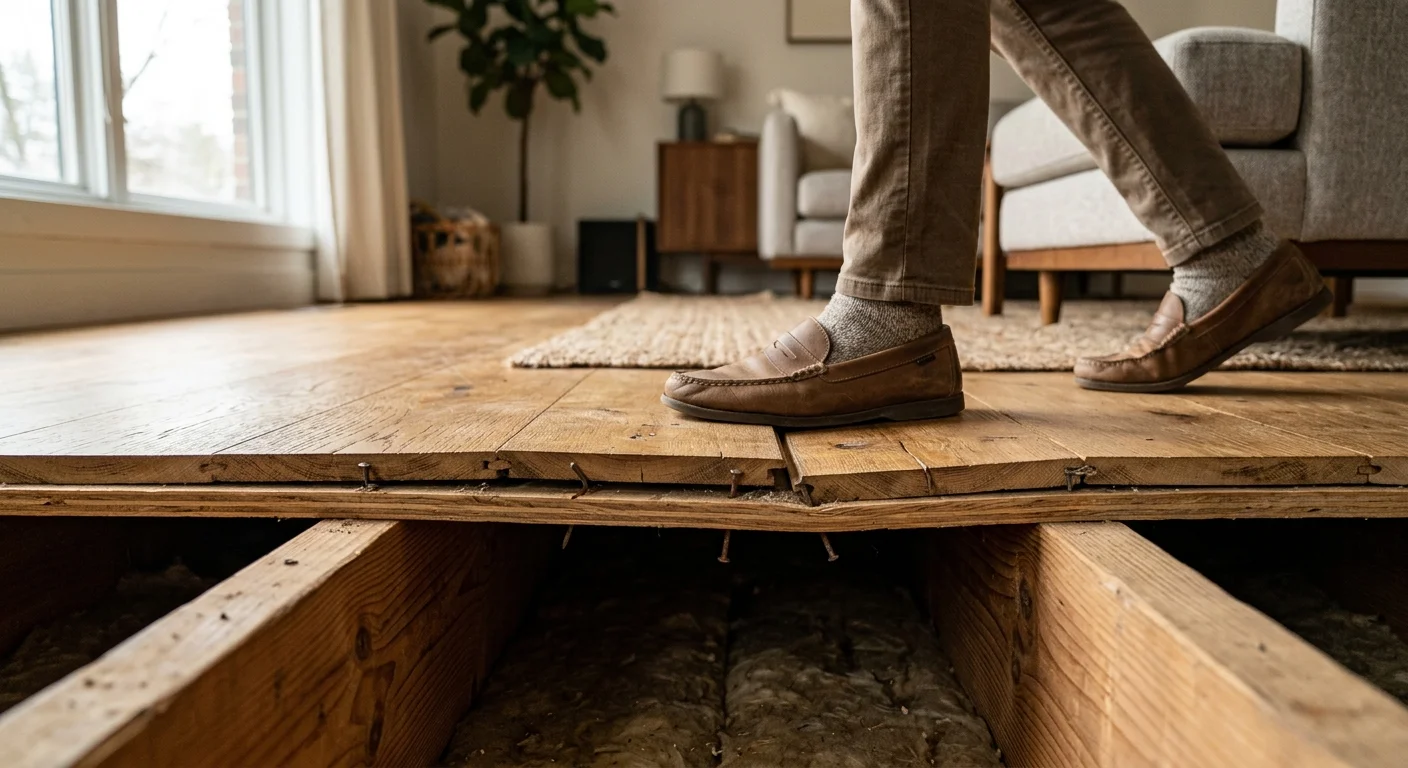
Squeaky timber floors are one of the most common complaints homeowners have, especially in older properties and busy family homes. The sound may be minor and occasional, or it may become a daily frustration in hallways, bedrooms or living areas.
In many cases, a squeak is not a sign that the whole floor has failed. It usually means that one part of the floor system is moving slightly against another. That movement creates friction, and friction creates noise.
The good news is that some squeaks are straightforward to reduce. The more important question is what is causing the movement in the first place.
| Cause | What It Means | How Serious It Is | Typical Fix |
|---|---|---|---|
| Natural timber movement | Boards expand and contract with seasonal change | Usually low to moderate | Assess moisture, stabilise conditions, inspect installation |
| Loose boards | Boards move slightly under foot traffic | Moderate | Re-secure boards professionally |
| Subfloor movement | The issue is below the surface, not only in the timber | Moderate to high | Inspect joists, battens or substrate |
| Gaps between board and subfloor | The board flexes when stepped on | Moderate | Refixing or targeted repairs |
| Poor installation | Inadequate fixing, spacing or preparation | Moderate to high | Corrective flooring work |
| Moisture-related changes | Swelling, shrinking or distortion affects fit | Moderate to high | Identify moisture source first |
| Age and wear | Older materials loosen over time | Low to moderate | Localised repair or restoration |
| Structural problems | Movement in framing or support system | High | Building and flooring inspection required
|
What Causes Timber Floors to Squeak?
A squeak occurs when two parts are subjected to pressure and rub, move or compress against one another. For a timber floor, it can mean:
- board against board
- board against fixing
- board against subfloor
- subfloor against joist
- Older floor systems
Squeaking floors are most commonly caused by loose elements. The sound is just the symptom; the root cause is mobility.

Natural Seasonal Movement in Timber Floors
Why Timber Moves
Timber is sensitive to the environment. When humidity increases, boards may expand. They can shrink when they become dry. Movement can be created even if it’s a minor change.
The reason This can create squeaks is because
Boards may start to rub against each other, fasteners or subfloor if the boards move slightly. This is particularly noticeable in:
- changing seasons
- Buildings equipped with effective cooling or heating systems.
- Buildings with effective cooling or heating systems.
- rooms with a window facing the sun
- Buildings that do not have uniform ventilation.Buildings that have uneven ventilation.
Does this always cause a problem?
Not necessarily. If a squeak comes up seasonally, it does not necessarily indicate serious damage. If the noise is generalised and/or the movement and/or gaps/unevenness are visible, it should be assessed.
Loose Floorboards
How Boards Become Loose
Repeated use can loosen the floor boards or cause the boards to loosen from the floor over time. This is particularly a problem in older homes.
If the problem is on the board, mark this.
- squeak in just the right place.
- Lacks, 2015, underfoot, slight bend or bounce.
- made out noise from a single room instead of moving across the area of the room.
- There is a visible gap or slight lift at the edges of boards.
Best Way to Fix It
A professional will be able to pinpoint the exact cause, and reconnect the board in the correct position, without causing any unnecessary cosmetic damage. Self-repair, sometimes, can temporarily remedy the sound but may make the situation look worse or not cure the actual problem.
Subfloor Problems and Structural Movement
In some cases the problem doesn’t lie with the timber floor. The noise could be due to movement in the support structure underneath.
Common Problems with Subfloors
- loose joists
- uneven supports
- minor settlement
- worn fixings
- inadequate bracing
- The free movement of sheeting and joists
Why are subfloor issues significant?
Where the problem is located below the finished floor, treating just the surface may not solve the problem. In this instance, the squeak may be a first indicator of a problem.
What to do next
If the squeaks are accompanied by:
- floor bounce
- uneven sections
- visible sagging
- Cracks around walls or near skirting.
- Doors not closing correctly
“if the subfloor isn’t prepared properly, it could lead to issues like squeaking.”
National Wood Flooring Association – Avoid DIY Woes, Hire a Pro

Poor Installation Can Lead to Squeaking
There’s not only an age-related squeak. Others occur when the floor is installed incorrectly.
Common Installation Mistakes
- insufficient fixing
- poor subfloor preparation
- inadequate expansion allowance
- uneven substrate
- using the wrong installation method for the product
- The moisture conditions have not been checked prior to fitting.
The answer is that problems can manifest themselves at later stages
The floor may appear to be in good condition at first, but later squeak when it is used on a daily basis and when seasons change. That’s why it’s important to adhere to installation standards from the get-go.
The True Cost of Noisy Floorboards
It could be tempting to turn a blind eye to a squeak and think it is a quaint feature of an old house. But, knowing and fixing squeaky timber floors cause is important for a number of key reasons.
Safety and wellbeing of the community and standard of living.
Your daily comfort is the first and foremost. When the floor squeaks, it can be very disruptive. Can make eating snacks in the kitchen at night a challenge and could awaken sleeping babies and/or sleeping partners. The mental aggravation of walking at a crouch around your own house over the years can greatly reduce the charm of your home.
The meaning of property valuation and the perception by users.
Creaky floors will be a big turn-off for any prospective buyers if you are thinking of selling your Melbourne property at some point in the near future. You may be aware that it’s a loose nail, but the buyer hears structural issues, termites or high repair costs. A silent solid floor floor will give you quality, care and structural integrity and therefore will directly enhance your asking price.
Symptoms of potential injury.
At times, the house is crying out for help with a squeak. If the floor suddenly begins to sound very loud, it may be a sign of serious problems.
- Moisture Damage: A leaky pipe under the floor boards may be causing the wood to warp.
- Structural Damage: Termites or borers damage structural timber, reducing the strength of joists and making the overlying floor sag and squeak.
- Foundation Issues: If the house has settled severely or stumps are rotting (which is a common problem with older houses in Melbourne), the floor assembly will be misaligned.
If you are able to resolve the noise problem, you could find yourself with a huge structural problem that can be financially expensive even if you don’t find out right away.
Can You Fix Squeaky Timber Floors Yourself?
Some homeowners resort to do-it-yourself solutions like screws, powders, wedges or adhesives. These can be effective in isolated instances but can also result in obvious damage or a more serious issue being concealed.
When DIY Might Help
- a very minor isolated squeak
- easy access to the underside of the floor is provided
- No signs of structural or moisture damage.
When doing it yourself is dangerous?
- Completed visible flooring where cosmetic damage is important
- Parquetry or high-quality wood floors.
- Recurring squeaks with movement of the floor.
- Any indications of moisture or issues with the underlying flooring.
The question is why is professional assessment often better?
A professional will be able to find out if the problem is:
- surface related
- board related
- subfloor related
- moisture related
- structural
The squeak is not the diagnosis, the diagnosis is important.

Conclusion
Why do timber floors squeak more in some seasons?
Because timber naturally responds to changes in humidity and temperature, which can create slight movement and friction.
Are squeaky timber floors dangerous?
Not always. Many squeaks are minor, but if they come with bounce, sagging, visible movement or signs of moisture, they should be inspected.
Can moisture cause squeaky timber floors?
Yes. Moisture can change the shape and fit of boards, which may lead to rubbing, flexing and noise.
Should I worry about squeaks in a new timber floor?
Yes, a new floor that squeaks should be checked, as installation issues, moisture conditions or subfloor preparation may be involved.
Can sanding and polishing fix squeaky floors?
Not by itself in most cases. If the squeak is caused by movement below the surface, the underlying issue must be fixed first.
Are squeaky floors a structural problem?
Not usually. In most cases, squeaky floors are caused by normal movement between floorboards, subflooring, or fasteners rather than a serious structural issue. However, if the squeaking is accompanied by noticeable sagging, bouncing, or visible damage, it’s a good idea to have the floor inspected by a professional.


