
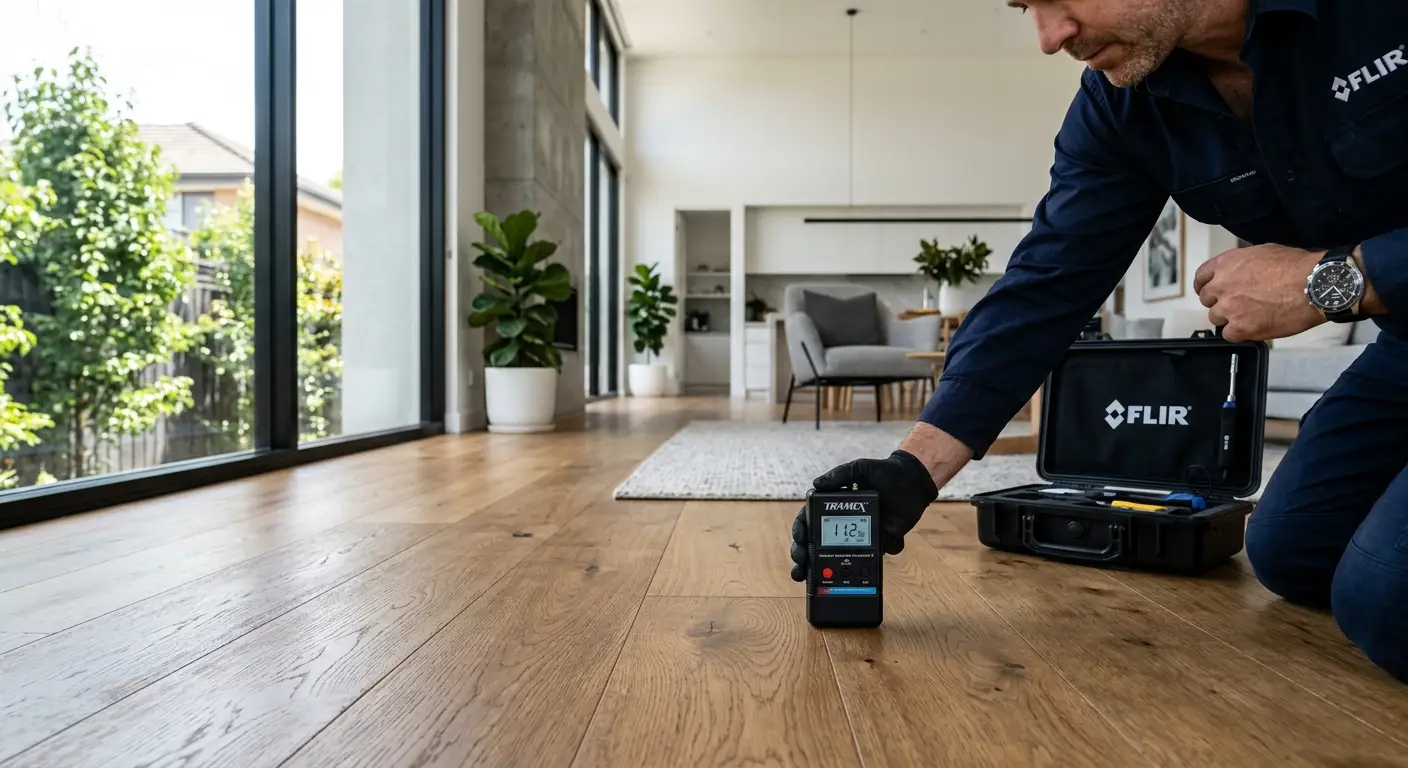
Timber flooring moisture problems occur when wood absorbs excessive humidity or liquid, leading to unsightly issues such as cupping, crowning, or severe buckling. Because wood is a naturally hygroscopic material, controlling indoor moisture levels and ensuring proper subfloor preparation is absolutely essential to prevent permanent structural and aesthetic damage.
Understanding the root causes of water damage is vital because it protects the longevity of your investment and maintains a healthy indoor environment free from mould. Whether you have newly laid floorboards or a historic home, recognising the early warning signs of Moisture Problems in Flooring can save you thousands of dollars in replacement costs. Below, we have outlined a quick reference table to help you identify and address these problems before we explore the detailed preventative measures.
| What you see | Possible indication | What to investigate |
|---|---|---|
| Board edges are higher than the centre | Cupping | Moisture from below, subfloor humidity, leaks or ventilation |
| Centre of boards is higher than the edges | Crowning | Previous cupping, surface moisture or moisture imbalance |
| Boards are lifting from the subfloor | Buckling | Severe expansion, flooding, inadequate expansion allowance or significant moisture |
| Boards are raised at their joints | Peaking | Expansion pressure, installation conditions or board movement |
| Large or irregular gaps | Timber shrinkage | Dry conditions, moisture loss or installation moisture content |
| Swollen or distorted boards | Moisture uptake | Water exposure, high humidity or moisture from below |
| Dark staining or discolouration | Possible moisture exposure | Plumbing leaks, spills, condensation or subfloor moisture |
| Problem concentrated near an external wall | Local moisture source | Rainwater, drainage, rising damp or building-envelope issues |
| Problem concentrated over concrete | Possible slab moisture | Subfloor moisture and vapour migration |
| Problem concentrated above a crawlspace | Possible subfloor moisture | Ventilation, ground moisture and drainage |
The appearance of a timber floor can provide useful clues about where moisture may be coming from, but the visible symptom does not always identify the exact cause.
Cupping, crowning, buckling, swelling and gaps can result from different moisture conditions, installation factors and environmental changes. A proper assessment should therefore consider both the floor and the conditions underneath and around it.
The Important Distinction
The visible shape of the boards is only the starting point.
For example, cupping can be associated with moisture from beneath the floor, while crowning can occur under different moisture conditions or after a previously cupped floor has been sanded before it has fully stabilised. WoodSolutions identifies moisture from beneath the floor, dry conditions above the floor and other installation-related factors among the potential causes of cupping and crowning.
For this reason, sanding or replacing the floor before identifying and correcting the moisture source can result in the problem returning.
A proper diagnosis should consider:
- Moisture content of the timber
- Moisture conditions below the floor
- Relative humidity
- Subfloor ventilation
- Concrete slab moisture where applicable
- Plumbing or appliance leaks
- Recent spills or flooding
- Installation method
- Expansion allowance
- Age and history of the flooring
Cupping vs Crowning vs Peaking vs Buckling: What’s the Difference?
Though grouped together, moisture-related timber floor problems can be deduced by the shape and the behaviour of the boards from the moisture problem.
Cupping
Cupping is when the edge of a board is raised up above the centre of the board, giving it a concave shape along the length of the board.
One recognized cause is moisture from below the floor; especially in areas where subfloor humidity or poor ventilation causes the underside of the boards to absorb moisture. Other contributing factors may also be involved and need to be investigated before repairs are made, but the moisture source.
Crowning
The inverse image profile is the so called “crowning,” with the middle of the board being raised above the sides.
It may be associated with moisture movement and it may be developed when a previously cupped floor is sanded while it is still under abnormal moisture condition.
Peaking
Peaking is when adjacent boards are raised at the edge of the joint.
It’s not just another word for cupping. ATFA differentiates between peaking and cupping and points out that pressure-related movement and board tolerances and installation conditions can cause peaking.
Buckling
Buckling is a more extreme type of movement that occurs when clusters of boards are lifted up and down much more than they are from the subfloor.
It may be related to over expansion, moisture, lack of expansion space, poor installation conditions, or ventilation.
Why the Difference Matters
Sanding should not be automatically considered to be the best treatment for these.
The type of repair depends on the cause of moisture, the existing moisture condition of the timber, the construction of the floor and if the floor has stabilised.
Solve the moisture problem first, then solve the floor problem.
Cupping vs crowning vs buckling: how to tell them apart
| Defect | What you see | Usual cause | First step |
|---|---|---|---|
| Cupping | Board edges higher than the centre, ridged look in side light | Moisture reaching the underside faster than the top: damp slab, blocked subfloor vents, leaks | Find and stop the source; let the floor dry; do not sand yet |
| Crowning | Board centre higher than the edges | Top-side moisture, or a cupped floor sanded flat before it had dried | Wait for stable moisture readings, then assess sanding |
| Buckling | Boards lift away from the subfloor, often in a ridge | Flooding, heavy moisture, or expansion gaps that are too small | Call a professional; boards may need lifting
|
All three are moisture movement. Cupping is the most common and, if the source is fixed early, often the most reversible.
The Core of Timber Flooring Moisture Problems

Engineered Timber is built from the individual layers of wood that are plied together in a cross-grain configuration; this makes Engineered Timber much more dimensionally stable than solid wood, but not waterproof. Standing water and excessive subfloor moisture will, over time, lead to delaminating of the top veneer or swelling of the core board. So, regardless of the kind of wooden surface you have, the basic principle of timber floor care is controlling surface water as well as humidity in the environment.
Water damage under floorboards: what to do first
Act in the first day or two. Stop the source (a leak, a blocked drain or a wet slab), remove standing water, lift rugs and furniture, and ventilate and dehumidify the room. Photograph the damage and check your insurance policy. Then monitor the floor with a moisture meter instead of guessing by eye. Do not sand or reseal a cupped floor while it is still wet. Many cupped floors flatten once they dry, and sanding too early leaves the board edges low and the centre high when they do (crowning). Drying can take weeks to months, depending on the damage and the season.
Where Can Moisture Come From?
There are several ways that moisture can get into a timber floor. Knowing the source is critical because fixing the damage in the visible floor doesn’t resolve the moisture issue if the source is not addressed.
1. Plumbing and Appliance Leaks
Concentrated moisture can be caused by leaking dishwashers, washing machines, sinks, toilets, pipes or heating systems on the floor.
2. Concrete Slab Moisture
Concrete can hold moisture and moisture vapour can travel into the above flooring. This is particularly important when installing timber over concrete.
3. Subfloor Moisture
Moisture may be from damp ground, poor drainage, flooding or lack of air flow in the subfloor in a home that has a ventilated subfloor.
Often poor subfloor ventilation will cause moisture to absorb into wood flooring, says WoodSolutions.
4. High Indoor Humidity
Timber is always gaining and losing moisture to the atmosphere. High humidity for extended periods of time can lead to an increase in timber moisture content, which can lead to expansion.
5. Surface Water
Regular wet cleaning, spills and standing water can cause unnecessary moisture on the surface and joints.
6. External Moisture
Water infiltration from rain, drainage issues, leaky doors, windows and changes in exterior grade can all result in moisture in the building or subfloor.
7. Construction Moisture
Moisture can enter a flooring system before and/or during installation from new concrete, wet building materials or inadequate dried substrates.
The Key Principle
Avoid considering a problem as moisture damage.
The source, path and time of exposure to moisture are all important.
Subfloor moisture: causes and testing
Moisture reaches a timber floor from below far more often than from above. Common sources are a new slab that has not dried, no vapour barrier over concrete, blocked or buried subfloor vents in older Melbourne homes, poor drainage around the house, and plumbing leaks. A professional checks the timber and the subfloor with a moisture meter, and tests concrete with in-slab relative humidity probes. A slab reading of 75% relative humidity or below is the figure most often quoted before laying timber, but moisture-barrier and flooring makers set their own limits, so work to the product data sheet.
Why Addressing Moisture Matters for Your Property
It’s a risky game to play and one that can have serious consequences if you don’t pay attention to some of the early signs of dampness. Taking timely action to solve timber floor moisture issues is not just about aesthetics; it is a key property maintenance issue with tangible benefits.
Above all, these problems are solved and your investment is saved. High quality timber floors make and are a high value addition to any home. Sometimes a cup can be salvaged if it is detected early, such as by repairing a leaking dishwasher or by taking measures to increase subfloor ventilation, allowing the wood to dry out and become flat. Without correction, however, the cell structure that is present in the wood will be permanently altered, and a complete tear-out and replacement will be necessary, which will be expensive. Being proactive can save you thousands of dollars.
Secondly, controlling moisture levels is critical to protecting your home and timber floors. Damp, poorly ventilated subfloor spaces can support mould growth, so fix the moisture source and ventilation. By keeping your floors dry and addressing moisture problems promptly, you can help maintain the condition of your timber flooring and indoor air quality.
Last but not least, uncontrolled moisture degrades structural integrity. Water can also get in through the floor boards, leading to rotting of the joists and bearers under the floor, or to the loss of adhesive between the floor and a concrete slab. This will lead to uneven surfaces and trip hazards, which will reduce the property’s resale value.

Common Timber Flooring Moisture Problems in Melbourne Homes
Property owners can be dealing with different environmental issues in Victoria. The notorious “four seasons in one day” weather conditions can make Melbourne timber floor moisture issues extremely prevalent unless proper precautions are taken. Extreme winter weather conditions with lots of cold and wet rain, then hot and dry weather in summer, cause timber to continuously expand and contract.
A common renovation Melbourne error is the installation of floorboards on an unsealed concrete slab. New concrete continues to emit up moisture vapour upwards for months. A suitable moisture barrier (such as a builder’s plastic membrane or a liquid epoxy retarder) should be applied before the timber is laid to prevent the floor from absorbing this vapour and cupping in only a few weeks.
The other is the city’s older, Victorian homes. These often have timber floors with crawlspace underneath. External ground levels may build up over time or the garden beds may cover up the subfloor air vents. The air close to the ground is damp and will not circulate with the house if no cross-ventilation is provided, thus heavily saturating the underside of the floorboards.
In addition, householders frequently make matters worse by improper cleanings. String mops that are soaked in hot water buckets are very damaging and especially problematic for intricate styles such as Parquetry Flooring. Geometric parquetry tiling uses many joints, which create small channels that pull the standing water into the subfloor, swelling and causing the small blocks to pop out.
What We See in Melbourne Homes
In Boss Timber Flooring moisture related flooring issues don’t always stem from one cause.
Common areas in Melbourne houses that are typically assessed include areas of visible movement over concrete slabs, poorly and ventilated subfloors, plumbing leak areas, laundromat areas and kitchens.
An important takeaway from the evaluation of moisture-affected floor surfaces is that the defect seen is not always the source.
For instance, a cupped floor can cause a homeowner to think that the floor needs to be sanded. If moisture is still flowing in from underneath the floor, however, then sanding the surface won’t cure the problem.
Thus the first step in our assessment is to locate and determine the amount of moisture before deciding whether or not the flooring can be repaired, left to dry out, sanded and refinished or replaced completely.
What We Check
In a moisture related flooring evaluation we take into account:
- Timber moisture content
- Subfloor conditions
- Ventilation
- Moisture in concrete slabs (if applicable)
- Leaking pipes or appliances
- Movement and distortion of the floor.
- Existing coating condition
- Installation method
- Expansion allowance
- The extent and location of affected area
How to Prevent Timber Flooring Moisture Problems
To reduce the risk of water damage, follow the installation procedures and practice good daily maintenance habits. The following are some of the expert floors maintenance tips you should take into account if you want to have your floors perfectly maintained.
- Follow the manufacturer’s acclimatisation instructions: Do not assume timber flooring can be installed immediately after delivery or that every product requires the same acclimatisation period. Follow the manufacturer’s guidance for the specific flooring product and site conditions, ensuring the boards meet the recommended moisture requirements before installation. This helps reduce the risk of excessive expansion or contraction after the floor has been installed.
- Keep the humidity in the house at a steady level: The objective is to maintain the indoor relative humidity within a relatively narrow range, in this case, 40% to 60%. . A humidifier may be necessary during the driest part of the summer. If it’s a wet winter with a lot of rain, using your air conditioning or a dehumidifier that you have set up yourself will draw out excess moisture from the air, which will help to flatten and stabilize your boards.
- Maintain Good Expansion Spaces: Wood requires air. Minimum gap required when installing is 10mm – 15mm must be left around the whole perimeter of the room (this is hidden by skirting boards). If the floor is flush with the brickwork then the boards will expand to crush against the brick wall and buckle upward with any increase in humidity.
- Quickly respond to spills: Water cannot be avoided, but should not be allowed to accumulate on the surface of the ground. Use a dry soft cloth to clean up any spills right away. Avoid steam mops, because the steam under increased pressure is highly destructive to the protective finishes.
Expert Insight on Water Damage:
Reputable home improvement sources widely agree on the destructive nature of water on wood.
When to Hire a Professional Timber Floor Installer in Melbourne
While wiping up a spilled glass of water is an easy DIY fix, true timber flooring moisture problems almost always require professional intervention. If you notice your floorboards beginning to ripple, if sections feel spongy underfoot, or if you detect a musty smell emanating from the skirting boards, it is time to call in the experts.

Attempting to fix severely cupped or buckled floors yourself is risky. For example, a common DIY mistake is sanding down the raised edges of a cupped floor before the wood has completely dried. Once the subfloor eventually dries out months later, the board will shrink back, resulting in a concave, permanently ruined floor. Professionals use highly calibrated moisture meters to measure both the surface wood and the subfloor beneath to diagnose the exact source of the dampness.
When you need an accurate assessment and a permanent solution, you must rely on specialists. As premier Timber Floor Installers Melbourne, the experienced team at Boos Timber Flooring has the technical expertise to diagnose moisture issues, repair damaged subfloors, apply industrial-grade moisture barriers, and restore your floor’s structural integrity safely.
FAQs
What causes timber flooring to cup?
Cupping can be associated with moisture conditions that create a difference in moisture exposure between the upper and lower surfaces of the boards. Moisture from beneath the floor is one recognised cause, but other factors can contribute. The source should be investigated before repair.
Is cupping always caused by moisture underneath the floor?
No. Moisture from beneath is a common cause, but cupping can have more than one contributing factor. Installation moisture content and differences in environmental conditions can also influence floor movement.
What is the difference between cupping and crowning?
Cupping occurs when the board edges are higher than the centre. Crowning is the opposite profile, where the centre is higher than the edges. The two conditions can have different causes and should not automatically be treated in the same way.
Can moisture-damaged timber flooring be repaired?
Sometimes. The repair depends on the source and duration of moisture exposure, the degree of distortion, the flooring construction and the condition of the timber after drying and stabilisation.
Should I sand a cupped timber floor?
Not before identifying and controlling the moisture source. Sanding a floor while abnormal moisture conditions remain can result in further problems and may produce an incorrect finished profile.
Can engineered timber flooring suffer from moisture damage?
Yes. Engineered timber can still be affected by excessive moisture. Its dimensional behaviour varies with board construction, wear-layer characteristics, installation method and moisture exposure.
How do I know if moisture is coming from underneath my floor?
Signs can include localised cupping, persistent dampness, high subfloor humidity, moisture around crawlspaces or abnormal moisture readings. However, the visible appearance alone cannot reliably identify the source.
Can a concrete slab cause timber flooring moisture problems?
Yes. Residual moisture in a concrete slab can migrate toward timber flooring and contribute to cupping, poor adhesion and expansion-related problems if the slab is not sufficiently dry or the flooring system is not correctly specified.
How long does moisture-damaged timber flooring take to dry?
There is no universal drying time. It depends on the timber species, thickness, amount of moisture, ventilation, environmental conditions and extent of exposure. WoodSolutions notes that drying time can vary considerably between timber products and conditions.
When should I call a professional?
Professional assessment is appropriate when boards are severely cupped, crowned or buckled, when moisture continues to enter the floor, when the source is unclear, or when the floor has been exposed to significant flooding or prolonged moisture.
Can a cupped floor flatten on its own?
Often yes if the moisture source is fixed and the floor dries; wait for stable readings before sanding.
What is the difference between cupping and buckling?
Use the table above.
How long does a water-damaged timber floor take to dry?
Weeks to months; monitor with a moisture meter.
What humidity should a timber floor sit in?
The existing 40-60% line; keep it.


