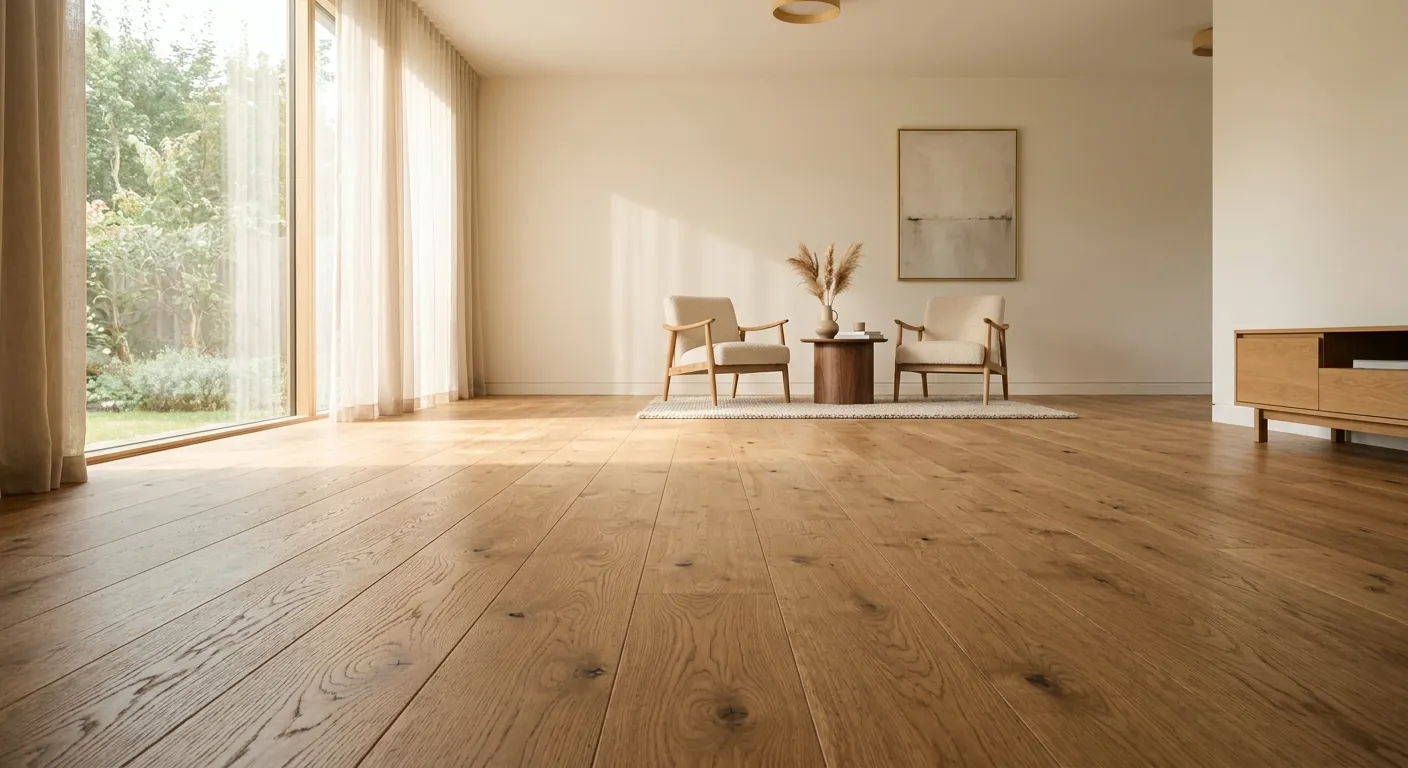
Oak is one of the most popular timber floors in Melbourne, but “oak” covers three different timbers here: European oak, American oak and Tasmanian Oak, which is not a true oak. Each performs differently, and so does solid versus engineered. This guide sets out the advantages and disadvantages of oak flooring so you can decide whether it suits your home.
| Factor | Potential advantage | Potential limitation |
|---|---|---|
| Appearance | Natural grain, warm colour and strong design versatility | Colour and grain vary between species, grades and products |
| Hardness | Many oak flooring products offer good resistance to everyday wear | Oak is not scratch-proof and harder timbers are available |
| Staining | Oak generally accepts stains well, allowing a wide range of colours | Final colour depends on species, grade, stain and finish |
| Engineered options | Widely available as engineered flooring, providing greater product and installation flexibility | Performance depends heavily on construction and wear-layer thickness |
| Maintenance | Relatively straightforward when correctly finished and maintained | Scratches, dents and finish wear still require ongoing care |
| Refinishing | Some oak flooring can be sanded and refinished | Refinishing potential depends on whether the floor is solid or engineered and on the remaining wear layer |
| Design flexibility | Works with traditional, contemporary and minimalist interiors | Natural variation may not suit buyers seeking a completely uniform appearance |
| Cost | Offers a wide range of product and grade choices | Premium grades, imported products and high-quality engineered flooring can be expensive |
| Availability | Oak is widely represented in modern flooring ranges | “Oak” covers multiple species and constructions, so product specifications need to be checked carefully |
Advantages and disadvantages of oak flooring at a glance
| Advantages | Disadvantages |
|---|---|
| Wide range of looks, from pale Scandinavian to smoked and dark | Higher upfront cost than laminate or hybrid |
| Takes stains and oils well | Medium hardness, so it dents and scratches |
| Can be sanded and refinished (solid several times; engineered depends on wear layer) | Solid oak moves with humidity |
| Stable engineered forms suit concrete slabs | Not waterproof |
| Long service life with care | Hard surface that carries footstep noise |
What Does “Oak Timber Flooring” Actually Mean?
Before comparing the pros and cons of oak timber flooring, it is important to clarify what “oak” means in the Australian flooring market.
Oak flooring can refer to different timber species and product categories, and they do not all have the same properties.
Tasmanian Oak
Tasmanian Oak is an Australian hardwood trade name covering three closely related eucalypt species:
- Eucalyptus delegatensis
- Eucalyptus obliqua
- Eucalyptus regnans
It is commonly used for interior applications including flooring and is known for its light colour, natural variation and ability to accept stains and finishes. (WoodSolutions)
European Oak
European Oak generally refers to oak species from the Quercus genus grown in Europe. It is widely used for flooring and is particularly popular in engineered timber flooring.
American Oak
American Oak can refer to several Quercus species, including American White Oak and American Red Oak. The properties, colour and performance vary between species and products. (WoodSolutions)
Why the Difference Matters
These timbers should not automatically be treated as interchangeable.
They can differ in:
- Hardness
- Density
- Grain structure
- Colour
- Dimensional movement
- Appearance
- Staining behaviour
- Availability
- Product construction
- Price
For this reason, the question is not simply whether “oak” is a good flooring material.
The more useful question is:
Which type of oak flooring is suitable for your home, climate, design requirements and intended use?
The Complete Oak Timber Flooring Pros and Cons
When investing in your home, you need all the facts. Although oak is a common feature in fine homes throughout Europe and Australia, and remains one of the most popular choices for oak flooring Melbourne homeowners, like all building products, it has very specific properties that determine the types of homes it is suited for and where it can be used. Let’s measure the major benefits and drawbacks so you can make the best decision relating to your home in Melbourne.

The Benefits: Why Oak Remains a Top Choice
- Excellent Longevity and Hardness. One of the key advantages of oak is its exceptional durability and ability to withstand the demands of everyday life. Oak is a dense hardwood, so tolerant of the humdrum of everyday life. With energetic kids, dropping heavy objects, or an active family, oak is great to deal with. In particular, white oak is extremely resistant to dents and gouges thanks to its closed cell structure.
- Timeless Aesthetic Appeal The classic look of oak is forever, while trends come and go. It has a striking and nice grain pattern which adds warmth and texture to any room. Oak can be used for a Victorian style terrace house in Fitzroy or in an ultra modern and contemporary architectural home in Brighton. Super absorbent, can get anything from pale Scandinavian whitewash to deep, moody espresso finish to it.
- Comprehend the concept of outstanding longevity and value addition. The most important benefit of oak is the longevity of the wood. A good oak floor can be expected to last more than 100 years. As it can be sanded and refinished more than once, you can have your floors completely transformed or even made into a different colour decades later. Every Melbourne real estate agent will say it straight that a true timber floor is one of the top selling points they can highlight that boosts the value and desirability of a real estate property.
- Fungi and Pest Resistance Oak wood has naturally occurring tannins which give a natural protection against some insects and fungal attack. Oak is not completely resistant, even to termites, but due to its density, it is much less conducive to the survival of pests than softer wood.
The Drawbacks: What You Need to Consider
- Premium Price Tag The expense is the most apparent obstacle that many renovators have to face. Oak is a slow growing tree and the milling procedure is precise. As a result, the initial cost of materials and installation is much more expensive than laminate, vinyl or hybrid options. It’s a product that will give you a lifetime of use, but the cost of this initial investment does call for a realistic budget.
- Moisture and humidity sensitivity, Oak is structurally sound, wood is hygroscopic and will absorb moisture or release moisture depending on the environment. Rapid changes in Melbourne’s weather cause solid oak to expand and contract. The boards may cup, warp or gap if installed in very wet places such as bathrooms without extreme care taken, or if they are not acclimatised first before installation.
- Susceptibility to Scratches Oak isn’t very dent-resistant, but it is still prone to scratches. Dog nails that are not clipped, stiletto heels, and heavy furniture dragged on hard floors without felt pads will create a mark. Many folks appreciate the “lived in” look that wood offers with age, but if you’re looking for a spotless and glass-like finish that will never lose its shine, you’ll have to keep an eye on it.
-
Tannins and staining : Oak is rich in tannins. When wet oak touches iron, such as steel wool, loose nails or metal furniture feet, the tannins can react and leave black marks. Some water-based stains and finishes can also react, so test the finish on an offcut first. Ask your installer which fasteners and finish system they use.
How Hard Is Oak Timber Flooring?
Oak is often described as a hard and durable flooring timber, but hardness should be interpreted carefully.
The Janka hardness rating provides an indication of a timber’s resistance to indentation. It can therefore be useful when comparing timber species for applications where dents and concentrated loads are a concern.
However, Janka hardness is not a direct measurement of how resistant a finished floor will be to scratches.
A finished timber floor is a system made up of:
Timber species + surface finish + coating + construction + installation + maintenance
This means that a floor with a higher hardness rating can still develop scratches from grit, furniture movement, pet claws or other abrasive contact.
Oak should therefore not be marketed as “scratch-proof”. Its suitability depends on the specific product and how the floor will be used.
| Species | Approx. hardness (Janka, kN) | Note |
|---|---|---|
| Tasmanian Oak | about 5 | Eucalypt, not a true oak. Durability class 3 |
| European oak | about 5-6 | Quercus |
| American white oak | about 6 | Quercus |
| Blackbutt | about 9 | Australian hardwood |
| Spotted Gum | about 10-11 | Australian hardwood |
Exploring Your Options: Solid vs. Engineered vs. Parquet
To really consider all the pros and cons of oak timber flooring, you ought to realize that there are several types of oak flooring, and they are appropriate to various structural requirements and finances. Whether you’re considering premium engineered boards or solid timber options, Melbourne oak flooring solutions come in a range of styles to suit different homes, budgets, and performance needs.
If you are an enthusiast of the traditional floor, then Solid Timber Flooring has a plank milled from a single piece of oak. This will last the longest since it can be sanded down an infinite number of times. But it must be firmly underlaid (such as with plywood or bearers and joists) and is the most subject to temperature fluctuations.
If you’re working with a concrete slab (most modern Melbourne apartments and suburban construction) then you should consider Engineered Timber Flooring. This is a solid oak bonded with a thick top layer (lamella) and a multi-ply core. The cross directional construction dramatically minimises the natural right to expand and contract, resulting in the wood being far more stable in Melbourne’s variable weather conditions and yet appearing from the surface to be solid wood.
If you’re looking for a statement design, Herringbone or chevron patterns of oak Parquet Flooring are enjoying a renaissance. It adds an element of sophistication and European style to an area, and creates geometric interest in large open-plan living spaces.
Oak flooring and underfloor heating
Engineered oak is the usual choice over underfloor heating because its layered core moves less than solid timber. Check the manufacturer’s maximum floor surface temperature (often around 27 degrees C) and the heating system’s controls. See our guide to engineered timber over underfloor heating
Common Mistakes When Choosing Oak Floors
- Bypassing the Acclimatisation Period
Before wood is attached to the floor, it should be allowed to acclimatize to the humidity and temperature of your residence. Installing boards when they arrive on the day of their delivery will ensure they will warp up or gap later. - Selecting an inappropriate finish for your lifestyle
The kind of protection you’ll put on your floor will determine the way your floor will act. Oil finish will give a beautiful matte natural appearance and can be repaired locally but needs regular re-oiling. Polyurethane finish is a hard-wearing and tough finish that sits on the top of the wood and is ideal for active homes; however, if the finish scratches too deeply the floor may need to be sanded at some time in the future. - Ignoring UV Protection
Australia’s sun is harsh. Oak will fade or color over time if exposed to direct sunlight in large windows or sliding glass doors, especially if the windows are facing north. Another mistake that is frequently made is to not install UV filtering blinds in the room or to fail to treat the blinds with an UV finish, which changes the look of the room.

Our Experience With Oak Timber Flooring in Melbourne Homes
At Boss Timber Flooring we use oak flooring in a variety of Melbourne residential projects.
When we recommend oak, we have to take into account a number of qualities of the timber species, but above all, the end product is not determined by the species of the wood.
The flooring product, grade, construction, existing or proposed finish, subfloor and conditions of the home are all assessed prior to recommending an installation system.
In actual use, homeowners should realize that natural oak isn’t designed to be completely uniform. Changes in grain, colour, knots and other natural characteristics may be a part of the character of the floor based on the selected grade.
In the case of renovation work, we also take into account the condition of the existing floor and whether the sanding or refinishing should be part of the long term maintenance plan.
Before we recommend Oak Flooring, we consider the following factors:
- The building is solid or engineered
- Oak species and origin
- Grade and expected natural variation
- Board dimensions
- Existing subfloor
- Moisture conditions
- Installation method
- Surface finish
- Expected traffic
- Long-term maintenance and refinishing needs
Oak Flooring Grades: Select, Natural or Character?
Depending on the level of quality, oak is available in a variety of grades, which can significantly influence the look and cost of an oak flooring product.
Select / Clear Appearance
Contains fewer natural features and is less natural looking.
Best for:
Simple, modern and consistent interior designs.
Natural / Standard Grade
Tolerates more variation of colour, grain and features.
Best for:
Homeowners preferring a more modern look, but with natural wood.
Character / Rustic Grade
Includes more conspicuous knots, grain variation and other natural features.
Best for:
Rural, traditional or character interior – one that embraces the natural variation.
Grades may also be referred to differently by the supplier and the type of flooring product and the exact grade should always be specified prior to purchase.
Higher-featured grade does not mean lower quality. It just gives it a different look.
Maintenance Tips to Keep Your Oak Floors Pristine
To ensure the long-term performance of your flooring, you should take the right care of the floor. Solid oak timber flooring Melbourne homeowners choose is renowned for its durability and timeless appeal, but like all natural timber products, it benefits from regular maintenance. Consistency is the key to maintaining oak, but it is not difficult.
Sweep or vacuum (using a hard floor attachment, no beater bar) often. Dirt and grit is like sandpaper under traffic, and will wear the shine over time.
- Remember the Moisture: Do not use a wet mop or steam mop on oak timber. Over heating and watering causes moisture to penetrate the grain causing irreparable damage. Rather, employ a microfiber mop that has been wrung out and is just damp, and use a wood floor cleaner that is neutral on the pH.
- Preventative Protection: Sanding is more expensive. Use quality dirt catching mats at doorways to the outside. Use thick felt floor protectors under legs of any heavy furniture, dining chairs and tables.
- Wipe up liquids at once: From dropped glass of wine to pet mishaps, liquids should be wiped up at once. This is a bit kind of Oak, but eventually there will be seepage into the seams of standing liquid.
Who Is Oak Timber Flooring Best Suited To?
Oak flooring may be a strong option if you:
- Want a natural timber appearance with strong grain character
- Prefer a wide range of colours and stains
- Want a flooring material that works across traditional and contemporary interiors
- Are considering engineered timber flooring
- Want the option of selecting different visual grades
- Are prepared to maintain the floor correctly
- Prefer a natural material that can develop character over time
Oak may be less suitable if you:
- Need a completely waterproof floor
- Want a completely scratch-proof surface
- Require zero maintenance
- Need a highly uniform appearance with no natural variation
- Are choosing flooring solely on the basis of maximum hardness
The best flooring decision comes from matching the characteristics of the product to the requirements of the home.
When to Hire a Professional Floor Installer
Doing it yourself is a favorite method of renovation, but it’s not the right time to practice in the world of oak flooring. To achieve a flawless finish, sub floor levelling must be exact, the concrete slab moisture content must be carefully tested, door jambs must be undercut and expansion gaps must be meticulously controlled around the edges. This is especially important when installing oak floorboards Melbourne homeowners choose for their premium appearance and long-term performance.
Even if the sub-floor is just a little bit uneven, the new boards won’t be stable, they will bounce and squeak, or they will crack over time. In addition, if the glue mixtures are not correct or the acoustic underlayment is incorrect, the manufacturer’s warranty may be canceled altogether.
If you’re thinking of investing in your home’s future, you can rely on the professionals at Boss Timber Flooring. They have extensive knowledge and experience installing high quality timber throughout Melbourne, and can guarantee that your sub-floor preparation, acclimatisation and finishing is done with perfection, providing you with the peace of mind and an extraordinary finish.
FAQs
Is oak a good choice for timber flooring?
Yes, oak can be an excellent flooring option when the species, product construction, finish and installation system are appropriate for the project. However, there is no single oak specification that is ideal for every home.
Is oak timber flooring durable?
Oak can provide good long-term flooring performance, but durability depends on the species, construction, finish, maintenance and level of use. Hardness alone does not determine overall floor performance.
Does oak flooring scratch easily?
Oak is not scratch-proof. Grit, furniture movement, pet claws and everyday traffic can create scratches. The finish and surface characteristics can influence how visible those marks become.
What is the difference between European Oak and Tasmanian Oak?
They are different timbers. European Oak generally refers to oak species from the Quercus genus, while Tasmanian Oak is an Australian trade name covering three eucalyptus species.
Is Tasmanian Oak real oak?
No. Tasmanian Oak is not a Quercus species. It is a trade name for three closely related eucalyptus species: Eucalyptus delegatensis, Eucalyptus obliqua and Eucalyptus regnans.
Is engineered oak better than solid oak?
Neither is universally better. Engineered oak can provide installation and dimensional-stability advantages in certain applications, while solid oak can provide greater solid-timber thickness and potentially greater refinishing scope. The right choice depends on the building and product specifications.
Can oak flooring be sanded and refinished?
Many solid oak floors can be sanded and refinished, subject to their condition and remaining material. Engineered oak may also be refinished, but this depends heavily on the thickness of the real timber wear layer and the manufacturer’s specifications.
Is oak suitable for homes with dogs?
Oak can work well in homes with dogs, but it should not be considered pet-proof. Timber hardness, finish, maintenance and the amount of pet traffic all affect how the floor performs.
Is oak flooring suitable for bathrooms?
Timber flooring requires careful consideration in areas exposed to frequent moisture. Oak should not be treated as waterproof, and the specific product and installation system should be checked before use in moisture-prone areas.
Does oak flooring increase property value?
Timber flooring can contribute to the overall presentation and appeal of a home, but the effect on property value varies by property, market, floor quality and buyer preferences. There is no universal dollar value that can be attributed to installing oak flooring.


4 Responses
We were comparing oak with a few Australian hardwood options for our renovation and initially assumed that all oak flooring was basically the same. The explanation about European Oak, American Oak and Tasmanian Oak was really helpful. I also found the section about engineered versus solid oak useful because we hadn’t considered how much the construction can affect future sanding and refinishing.
That’s a good point. Oak flooring can vary quite a bit depending on the species, origin, grade and construction, so European Oak, American Oak and Tasmanian Oak shouldn’t be treated as interchangeable options.
The construction is also important when thinking about future maintenance. Solid oak generally provides more material that can potentially be sanded and refinished, while engineered oak has a real timber wear layer over a more stable core, with the number of future sanding options depending on the thickness of that wear layer. Checking the board specifications before choosing can help avoid surprises later.
I’m considering oak flooring for a fairly busy living area. Does the natural variation in oak tend to hide everyday scratches and marks well, or are they still quite noticeable over time?
Yes, oak’s natural grain, colour variation and character can help disguise minor scratches and everyday marks, particularly compared with very uniform or highly polished flooring. However, scratches can still become noticeable over time, especially in high-traffic areas.
The finish also makes a difference. A lower-sheen finish tends to be more forgiving of small marks, while regular cleaning and felt pads under furniture can help minimise wear. If the floor eventually develops more widespread surface wear, oak can also be sanded and refinished, which is one of its practical advantages.