
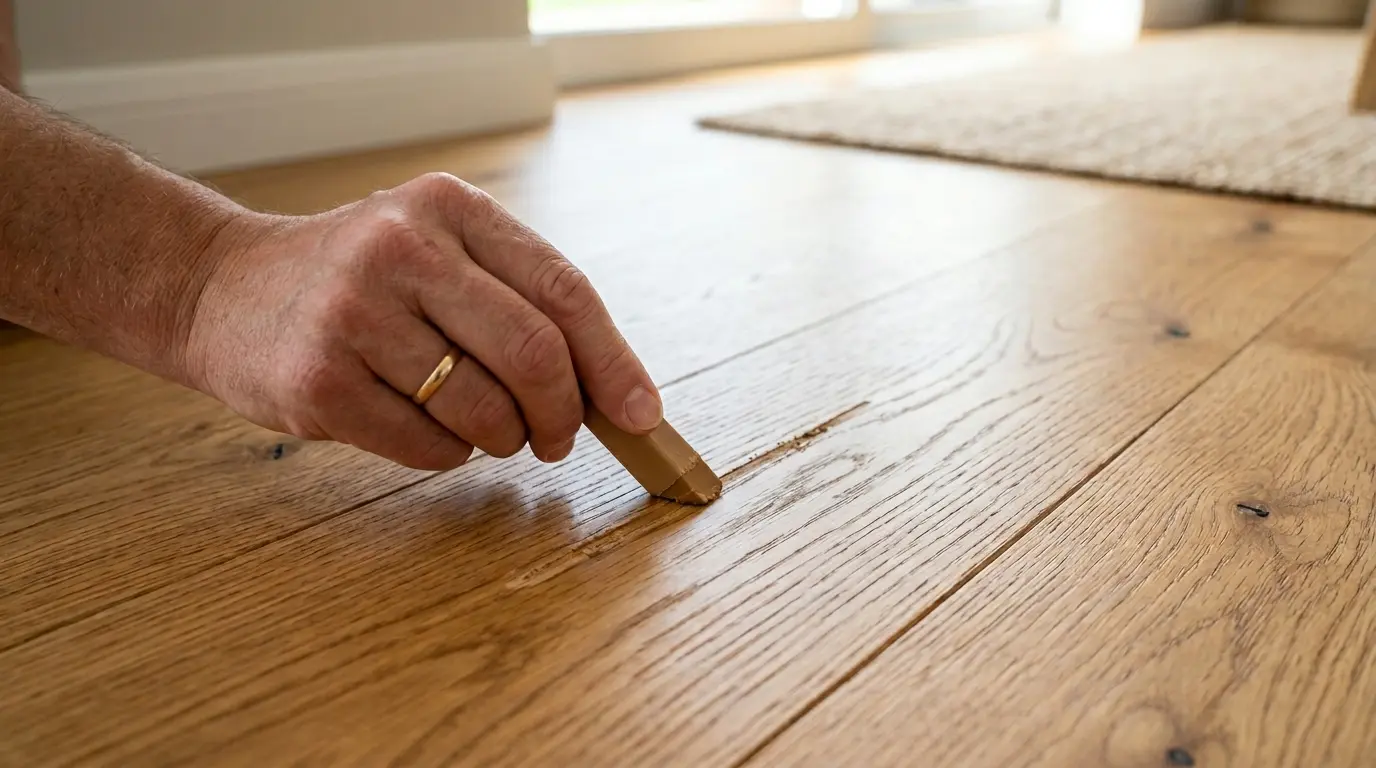
Fixing scratches on hardwood floors is entirely achievable without a full floor replacement, depending on whether the damage sits purely on the surface protective coat or penetrates deep into the natural wood tissue. Minor surface scuffs can usually be buffed out or disguised with specialized touch-up pens, while deep, structural gouges require timber fillers, precision sanding, and localized recoating.
For busy Melbourne households experiencing the daily wear and tear of pets, sliding furniture, and heavy foot traffic, timber scratch repair is vital for maintaining both immediate visual elegance and long-term property valuation. This comprehensive guide and quick-reference matrix outline the most reliable methods to address everything from superficial marks to severe gouges safely and effectively.
| Damage level | What it looks like | Repair method | ||
|---|---|---|---|---|
| Micro-scuff | Faint surface mark; wood colour unchanged beneath | Floor polish or reviver product; buff with microfibre cloth | ||
| Clear-coat scratch | Visible line through topcoat; no raw wood exposed | Wax crayon or touch-up marker in matching shade; blend with fingertip | ||
| Surface gouge | Bare wood visible; light or white line on stained floors | Flexible timber putty → hand-sand along grain → spot-seal with matching topcoat | ||
| Deep structural gouge | Frayed wood fibres, void in board surface, possible splintering | Clean valley → flexible polymer filler → flush scrape → hardwax colour blending | ||
| Oxidised / black stain | Grey or black discolouration around an old, unsealed scratch | Full board sand required to remove oxidised fibres; cannot be spot-treated | ||
| Widespread scratching | Dull, uneven sheen across a large area; multiple overlapping marks | Professional full-room sand, refinish, and recoat service |
How to Master Timber Floor Scratch Repair for Different Damage Levels
To do scratched floorboards repair correctly, you should be acquainted with the multi-layered anatomy of your floorboards. The topcoat for modern timber floors, typically made of water-based or oil-based polyurethane, or natural oil penetrating finishes, is clear. The initial diagnostic question when a scratch happens is whether the scratch has merely rubbed through this clear outer shield or has penetrated down through the hardwood fibre.
For homeowners looking for timber floor repair Footscray services, micro-scuffs are only cosmetic, where the underlying wood colour remains unaffected (such as from sliding boxes or soft pet claws). Such minor imperfections can often be covered using a light wood floor touch up with a specific wood floor polish or reviver, which will temporarily swell the area of clearcoat around the scratch to conceal the reflection of the scratch.
When the heaviest objects such as a refrigerator or a steel-legged chair are pulled across the floor, however, it leaves a deep, penetrating gouge. These deep scratches show bare unsealed wood, which may reveal a light line of bright white wood below stained floors or dark with frayed edges on wood floors.
The treatment of these deep wounds involves a systematic process: scraping out the dirt in the valley, filling the void with a matching polymer timber putty that matches the colour of the floor, scraping over the putty until it is flush with the floor’s surface, and then using a tiny artist’s brush dipped in a matching coloured hardwax that is also a polymer, to restore the uniform level of gloss.

The Long-Term Benefits of Timely Wood Floor Touch Up and Maintenance
Having the wood floor touch up as soon as there’s damage is not only an important factor in restoring the interior appearance of your home, but also crucial to preventing irreparable damage to your wood floor from the environment. If the scratch penetrates the transparent protecting polyurethane coating, the natural hygroscopic cells under the surface are left completely exposed to the open air. In a humid environment with changing humidity throughout the year, these exposed channels attract moisture continuously from the regular mopping, spilled liquid or from environmental humidity.
When considering floorboard scratch repair, this localized moisture absorption results in the timber fibers near the scratch being oxidized, which changes the color of the wood to an ugly grey or black color that can’t be easily wiped off. If wood fibers have been oxidized and stained to a deep shade, it’s not possible to touch-up the stain; the entire board should be aggressively sanded to remove the deep stain set in the fibers.
Protective coatings applied to the surface of the cars will combat surface scratches as soon as they occur, so you are essentially creating a new waterproof barrier along the floorboards. This preventative care keeps the timber in good condition structurally, avoids edge fraying/splintering, and saves property owners thousands of dollars by postponing the time when a full-room mechanical sanding overhaul is necessary.
“Most scratches in wood flooring will occur in the finish, not the wood itself.”
National Wood Flooring Association – Homeowner’s Handbook to Real Wood Floors
Common Pitfalls to Avoid When Repairing Damaged Timber Flooring
When homeowners try to fix damaged wood floors on their own without knowledge of the chemistry of products, there are some common mistakes. The most common error is the use of non-flexible hardware store wood putties that are specifically for fixed timber furniture or skirting boards. Timber floors are dynamic surfaces, which expand and shrink over time, as a result of temperature fluctuations and from the weight of people and their activities. When a non-flexible filler is used in a floor scratch it will cause the putty to crack within weeks of the installation, causing it to crumble into loose powder that will be lost in the regular vacuuming of the floor.
Another common error is to sand a spot in the opposite direction of the wood grain. When sanded perpendicular to the grain of the wood the delicate wood fibers are cut, and when a topcoat is added, it creates a series of ugly and dark horizontal marks that are permanently highlighted.
Also, in cases of complex geometric designs (like high-quality Parquetry Flooring Melbourne designs), the process of scratching the surface demands utmost care. In a mosaic or herringbone pattern, the grain alternates from board to board, making that any aggressive sanding that is directional will cut across the adjacent grain and will cause the design to lose all optical clarity for good.
Finally, using steel wool to level off spot repairs on the floors that have been finished with the new water-based polyurethanes is a bad idea; small bits of steel dislodge and get embedded in the floor and will rust and grow in size with exposure to moisture, resulting in hundreds of tiny black spots all over the beautiful wood surface.

Pro Hardwood Floor Repair Tips for Flawless DIY Results
If you’re doing minor wood floor scratch repair on your hardwood floor on your own, there are a few hardwood floor repair tips from professionals that you should follow so your home repairs will match the rest of the floor area. First, make sure to thoroughly clean the scratched area with either mineral spirits or a special wood cleaner and a soft, microfiber cloth before applying any fillers or waxes. When a scratch is filled and the dust or grit or oily residue is still present, the repair material will not bond properly to the wood cells and will rise out of the wood in no time at all.
When performing hardwood floor scratch repair using a wax repair stick, it is highly recommended to be sure you have two or three shades of colour that are lighter and darker than your overall floor colour. Real wood is not always one consistent colour, but has natural colour variation, knots, and grain patterns. The variation of timber grain can be achieved with a careful mix of various wax shades in the scratch channel, simulating the natural variation of timber grain and making the repair completely invisible to the casual eye.
If you’re sanding or applying coats in an already busy suburban home like a wood floor property in Burwood, it’s important to use a quality painter’s tape to define precisely the outline of the scratch before you begin, so that the rest of the floor surface is not accidentally marked with the sanding machine or coating, and your home improvement project is kept to the strictest limits and works well.

Correct Spot Repair Alignment:
Sanding / Scraping Motion
═══════════════════════════════► (Always Move Parallel to Grain)
┌───────────────────────────────┐
│ ░░░░░░ Scratch Area ░░░░░ │ ◄─── Isolate with Painters Tape
└───────────────────────────────┘
═══════════════════════════════►
Natural Timber Grain
Widespread Floor Scratches: When to Call the Melbourne Experts
While resolving an isolated scuff mark is a straightforward afternoon task, handling extensive scratch damage across a large living area or hallway requires specialized mechanical equipment. If your floor has suffered widespread scratching from years of unrestrained pet movement, dragging heavy timber dining chairs, or tracking in coarse outdoor grit, attempting localized patch repairs will result in an uneven, blotchy finish that compromises the aesthetic balance of the space. In these scenarios, trying to fix each scratch individually is no longer practical or visually effective.
When extensive surface wear dulls the uniform luster of your home, securing a professional Floor Sanding & Polishing Service Melbourne is the safest and most efficient path forward. Professional trade crews use commercial-grade belt sanders and orbital trio machines equipped with integrated dust-containment systems to evenly shave away a micro-layer of worn timber across the entire floor plane. This process removes all surface scratches, deeper gouges, and uneven discoloration in a single pass, restoring the timber to a completely flat, raw, pristine state.
Investing in a comprehensive refinishing service allows you to update your home’s look with modern, eco-friendly finishes, ensuring a durable, crystal-clear barrier that easily handles daily lifestyle demands for another decade.
FAQs
Can you fix scratches on hardwood floors without sanding the whole room?
Yes, isolated scratches can be easily repaired without sanding the entire room. Minor scuffs can be hidden using wax fill sticks, touch-up markers, or localized blending oils, while deeper gouges can be filled with color-matched timber putty, lightly hand-sanded along the grain, and spot-sealed with a matching topcoat.
What is the best tool for an immediate wood floor touch up?
For superficial scratches that haven’t penetrated the raw wood, a premium wax-based timber crayon or a specialized wood touch-up marker matching your floor’s stain level is the best tool. It quickly fills the clear coat abrasion and restores uniform color in seconds.
Why do some timber floor scratch repair putties crack and fall out?
This occurs when DIYers use rigid wood fillers designed for fixed furniture rather than flexible timber floor putties. Because floorboards naturally expand, contract, and flex under foot traffic, any non-flexible filler will quickly crack and crumble under the physical movement.
How do I prevent future pet scratches on my hardwood floors?
To minimize pet scratches, keep your dog’s or cat’s claws neatly trimmed, place high-quality rugs or runners in high-speed traffic zones, use specialized felt pads under all movable furniture legs, and choose high-durability, scratch-resistant water-based polyurethanes during your next floor refinishing cycle.


