Choosing between bamboo flooring and hardwood is not simply a matter of deciding which material is harder or more durable. The better choice depends on how the floor will be used, the conditions of the home, how much maintenance you are prepared to do, and whether you want the option to repair and refinish the floor in the future.
High-quality strand-woven bamboo can provide excellent resistance to dents and a clean, consistent appearance. Hardwood, on the other hand, offers natural variation, a more traditional timber character, and particularly with solid boards the ability to be sanded and refinished as the floor ages.
For Melbourne homes, there is another important consideration: moisture and installation conditions. Timber and bamboo flooring can both respond to changes in moisture and temperature, so the quality of the product, subfloor preparation, installation method and ongoing care can be just as important as the material itself.
In this guide, we compare bamboo and hardwood across durability, maintenance, moisture behaviour, refinishing, appearance, sustainability, installation and everyday use. We also explain what we consider important when helping Melbourne homeowners choose a flooring system for their property.
| Feature | Solid Hardwood | Engineered Timber | Strand-Woven Bamboo |
|---|---|---|---|
| Material | Solid natural timber | Real timber wear layer over a multi-layer core | Compressed bamboo fibres bonded into a dense flooring product |
| Appearance | Natural grain, colour variation and character | Natural timber appearance with greater construction stability | More consistent and uniform appearance |
| Dent Resistance | Depends heavily on timber species and finish | Depends on the timber species, wear layer and finish | Generally very high for quality strand-woven products |
| Moisture Behaviour | More sensitive to moisture and environmental changes | Generally more dimensionally stable than solid timber | Product-dependent; moisture management is still important |
| Refinishing | Can often be sanded and refinished multiple times | Depends on the thickness of the wear layer and product specification | More limited and product-dependent |
| Long-Term Repairability | Strong advantage where sufficient timber remains for sanding | Depends on construction and wear-layer thickness | Generally more limited than solid hardwood |
| Maintenance | Regular cleaning and protection from excess moisture | Similar routine care, according to manufacturer instructions | Similar routine care, with particular attention to moisture and surface protection |
| Best Suited To | Homeowners prioritising natural character and long-term repairability | Homes where dimensional stability is a priority | Homeowners wanting a hard, consistent and contemporary surface |
| Installation | Professional installation recommended | Professional installation recommended | Professional installation recommended |
Bamboo Flooring vs Hardwood
When comparing bamboo or hardwood flooring, it’s important to understand that these two popular options come from entirely different botanical sources. Traditional hardwood is milled from slow-growing trees, such as Australian eucalyptus, oak, or walnut. These timbers take decades to mature, developing rich character and unique grain patterns that make every board distinctive.
When considering bamboo wood flooring durability, it’s important to understand how the material is made. Bamboo is not a tree; it’s a fast-growing perennial grass. The manufacturing process involves slicing or shredding raw bamboo stalks, removing their natural sugars through a special treatment, and then compressing the fibres under high hydraulic pressure using durable resins. The result is strand-woven bamboo, a flooring material known for its exceptional strength and durability.
When comparing hardwood floors vs bamboo, it’s worth looking beyond hardness alone. High-quality strand-woven bamboo is extremely dense and can even be harder than many traditional hardwood species. However, hardwood offers a natural warmth, rich colour variation, and unique grain that bamboo cannot replicate. It also provides a more authentic underfoot feel and natural acoustics, while bamboo has a firmer, more uniform surface.
Cleaning & Maintenance
Caring for the bamboo and hardwood flooring is essential for maintaining its appearance and performance. Hardwood floors can be easily cleaned with dry cleaning and occasional polishing and prevented from getting too moist. Repair is frequently possible with sanding and refinishing, particularly on thicker solid wood boards, if they have minor scratches and surface wear.
Furthermore, bamboo flooring is a low maintenance type also, but the dense resin construction makes it more sensitive to maintenance. The surface will become damaged over time due to excess moisture, harsh cleaning products, and long exposure to sunlight. Bamboo is much harder to refinish than hardwood, making it particularly important to take steps to protect your bamboo.
Key maintenance differences:
- Hardwood: Is able to be sanded and refinished more than once to its original appearance.
- Limited refinishing options: bamboo is made of compressed fibres.
- Both: Must be cleaned by dry methods, and must be protected from standing water.
- Hardwood advantage: More easily restored and repaired in the long run.

Installation Difficulty
While both bamboo and hardwood flooring can take a professional touch to be installed correctly, the bamboo needs it more. Ensuring proper subfloor preparation, moisture testing, and correct expansion gaps are crucial to prevent subfloor movement, warping or structural problems post installation.
Installation of hardwoods may be more challenging because they will expand and contract due to differences in humidity. While bamboo tends to be more dimensionally stable, care needs to be taken to ensure moisture management, particularly because of the difficulty in fixing or replacing damaged bamboo boards.
Important installation considerations:
- Hardwood: Needs to be acclimatised and handled with care before installation and needs humidity control.
- For bamboo: requires a flat, dry subfloor and moisture testing to be done correctly.
- Both: Professional installation helps to keep the warranty and increase longevity.
- Professional fitting: Ensures better performance and a cleaner finish.
Aesthetics & Design
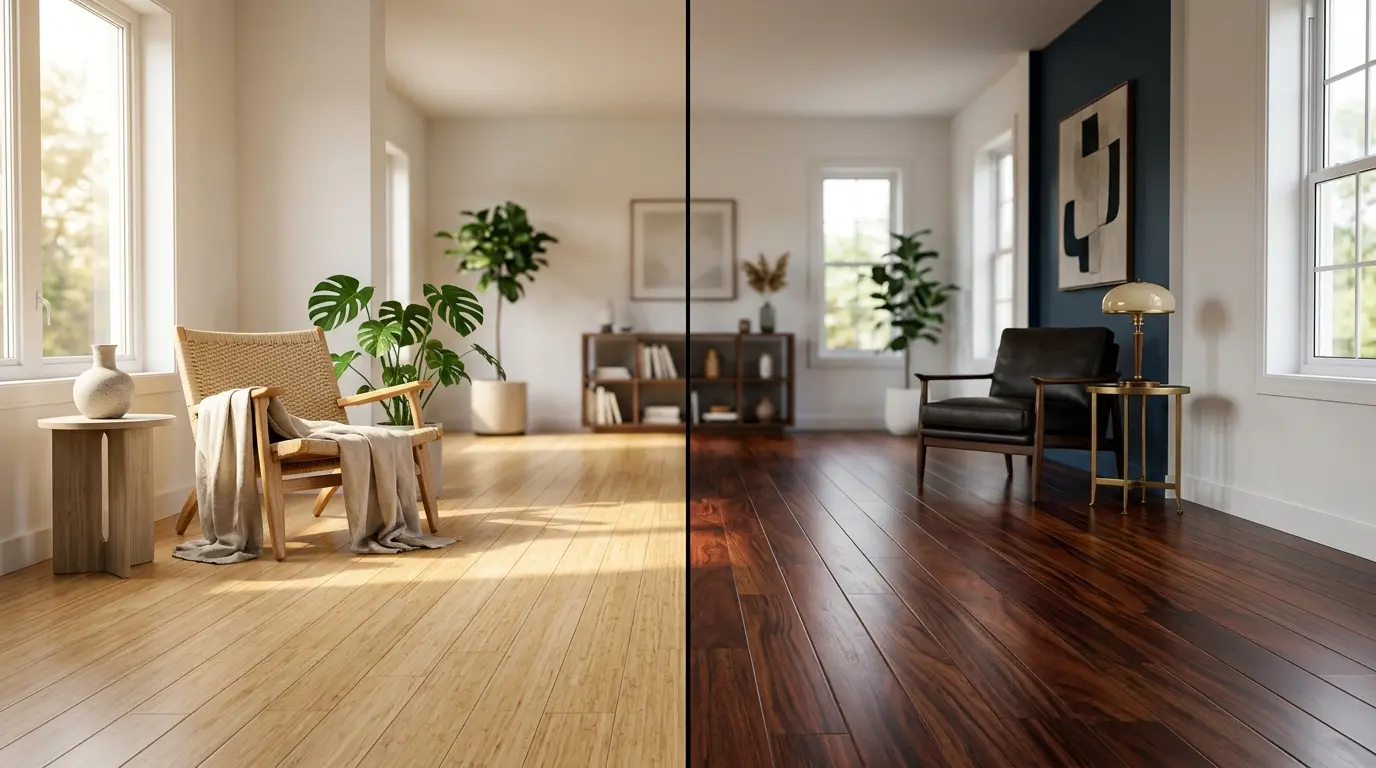
The most significant difference between bamboo floor and hardwood floor is their appearance. Hardwood gives a natural and distinctive look, and varies in grain, colour and texture that adds up more character with time. It has its own natural pattern and is a popular choice for premium and timeless interior choices.
Bamboo provides a cleaner appeal and uniformity and is appropriate for modern, minimalist, and contemporary design. Strand woven bamboo can be as strong as hardwood, but lacks the natural variation, depth and organic warmth found in real wood.
Design differences:
- Hardwood: Perfect for traditional, upscale, heritage and designer interior finishes.
- Bamboo: Fits modern, minimalist and eco-friendly designs.
- Hardwood: Provides distinctive character of the grain and natural ageing.
- Bamboo: Gives uniformity and uniformity.
Our Experience with Timber Flooring in Melbourne
At Boss Timber Flooring, our work is not limited to helping homeowners compare flooring materials online. We have more than 20 years of experience working with timber flooring, including installation, sanding and polishing.
That experience has taught us that choosing a floor is rarely as simple as comparing the hardness of two materials. The condition of the subfloor, moisture levels, installation method, the quality of the flooring product and the way the floor will be used can all influence how it performs over time.
For this reason, we look beyond the headline claims commonly used to market flooring products. When comparing bamboo with hardwood, we consider practical questions such as:
- How well is the product suited to the conditions of the property?
- How will it perform under everyday foot traffic?
- What happens if the surface is scratched or damaged?
- Can the floor be repaired or refinished later?
- How much maintenance will it require?
- What installation and moisture considerations need to be addressed before the floor is laid?
There is no single flooring material that is best for every Melbourne home. Our aim is to explain the practical differences between bamboo and hardwood so that homeowners can make a decision based on the way they actually intend to use their floor, rather than relying on a single durability or sustainability claim.
Engineered Timber vs Bamboo: Why Material Selection Matters
Comparing engineered timber vs bamboo when deciding on modern architectural finishes offers an insightful look at structural stability. Engineered timber is made from a high quality real wood veneer which is glued to a number of layers of cross-directional plywood or high-density fibreboard. This is a special cross ply construction which helps to resist the natural expansion and contraction of wood associated with varying relative humidity.
The bamboo is also structurally sound because of the high resin content that bonds the fibers together in a tightly woven manner, but is not necessarily multi-layered, or veneered, as it is in engineered timber. If you want an unmatched prestige and classic look, then Premium solid timber flooring can add a strong sense of quality and character to a home, but its impact on property value depends on the property, location, design and buyer preferences. Tricky environments can be made more feasible with engineered timber than solid timber, as you can incorporate higher quality timber species.
When comparing bamboo vs engineered hardwood, it’s important to consider long-term maintenance and restoration. Engineered hardwood with a thick wear layer can be sanded and refinished to repair surface scratches, extending its lifespan and appearance. In contrast, strand-woven bamboo is extremely difficult to sand due to its dense, resin-bound structure. Refinishing is more expensive, requires specialised equipment, and many flooring professionals do not offer the service. If long-term flexibility and easy restoration are priorities, engineered hardwood has the advantage.
“Solid hardwood floors can typically be sanded and refinished multiple times over their lifespan, depending on the thickness of the wear layer and the condition of the floor. This makes them a long-term flooring option that can be restored rather than replaced when surface wear occurs.”
Bamboo Flooring Pros and Cons: What Homeowners Should Know
Before embarking on a major home improvement project, it’s important to consider all the bamboo floor pros and cons. Marketing materials often declare that compressed grass surfaces are near-indestructible, but in the real world, it is important to understand how the floor will react over time.
The Benefits
- Superb resistance to superficial dents: Strand-woven variants have incredible resistance to superficial dents, making them extremely functional for busy homes with active indoor pets or even heavy tracking foot traffic.
- The sleek, uniform design plays well in contemporary, minimalist, Scandinavian and modern industrial interior designs.
- Cost Efficiency: It offers a durable surface alternative that offers the effect of a solid floor floor but doesn’t require as much capital investment in the beginning.
The disadvantages and typical errors
- Moisture Sensitivity: Bamboo is sensitive to changes in ambient humidity over time, and to subfloor moisture; it is OK however, for light surface spills if cleaned promptly. If over-exposed to excessive dampness, permanent swelling or edge checking can occur.
- Adhesive Content Quality: Lower quality bamboo products that are not certified may contain lower quality resin and release volatile organic compounds (VOCs). Choosing products which comply with stringent emission limits is essential.
- Unlike traditional oak or jarrah, bamboo floors can’t be sanded down over and over to remove deep gouges and alter the stain colors down the track.
One common error that property owners make when caring for bamboo and timber flooring in Melbourne is that they manage bamboo just as they do synthetic laminate or vinyl tile. Moisture saturated mops or lack of proper window protection from the strong afternoon sun can cause premature fading, entrance of moisture into the plank and localized buckling between plank seams.

Sustainable Flooring Options: Tips to Choose Right for Your Property
Both materials have strong environmental benefits for consumers considering sustainable flooring, so long as you check for the source of both. The ability of bamboo to regenerate naturally, without replantation, and to be fully matured, structurally and hard, within a few years is noted. It is a very efficient raw material because of its fast growth rate.
The opposite side of the equation is that traditional timber is an amazing carbon sink, trapping CO₂ for the life of the floor. Timber is a resource that can be sourced from strictly managed and certified forests and is a highly sustainable, cyclical resource. When you are upgrading a heritage property or a modern townhouse, you can get a decent quality Timber Flooring Kew and have the peace of mind that your material will meet the local architectural standards – and that you are helping to support responsible, certified supply chains.
To make sure that you can choose flooring that is in line with the real-world best practices of environmental stewardship, here are some useful tips:
- Check Certifications: Confirm that the timber or bamboo is from a legal and non-endangered source by checking for a global forestry standard certification.
- Make sure to request formal laboratory test results of low VOC to safeguard indoor air quality.
- Consider the Total Lifespan: A solid timber floor that will last for 80 years may ultimately have a lower ‘net environmental impact’ than a cheaper alternative that will need to be replaced totally every 15 years.
Special Use Case Considerations
When applying to the Special Use Case, it is important to carefully consider the following factors:
Depending on the use and location of the flooring, the best type of floor may vary. Underfloor heating and high traffic spots are two situations to note.
1. Underfloor Heating
Some bamboo and hardwood floor products may be suitable to use with underfloor heating, but it depends on the type of bamboo and hardwood flooring and the type of underfloor heating system.
Therefore, it is not recommended to select a floor for underfloor heating for any general statements that bamboo or hardwood is suitable. Please check the installation requirements of the floor manufacturer and the characteristics of the heating system before installing.
For improved dimensional stability, engineered timber may be needed, but a desired product specification is important. Solid hardwood may be more sensitive to temperature and moisture fluctuations that require careful consideration of installation circumstances and the need for constant control of the environment.
2. High-Traffic Areas
If you want a hard flooring in your home, you need to know that there is more to it than just selecting the most durable option.
Strand woven bamboo may offer high denting and surface impact resistance making it an appealing choice for more active, busy families. But, don’t use only initial resistance to indentation when deciding on hardwood. Factors that affect performance include the species, finish, construction and maintenance; and the capacity to sand and refinish a solid hardwood floor can offer a significant repair benefit.
If the house has children, pets or heavy daily use, you should look at the durability, as well as the practicality of what you will have to deal with if the surface does become worn after a number of years.
What We Look For When Comparing Bamboo and Hardwood
We’re more than 20 years in the game of timber flooring and we’ve learned that it’s not all about the flooring. There are a number of practical issues that must be taken into consideration before making a recommendation as to the type of flooring to use.
1. The condition of the subfloor.
While a good flooring product can make a poor subfloor look good, it can never make a bad subfloor look good. The surface must be properly prepared, be flat enough and suitable for the type of installation.
2. Moisture conditions
Along with other elements, moisture may impact the performance of timber flooring. The flooring product and subfloor should be evaluated, prior to installation, based on the manufacturer’s specifications and the property’s conditions.
3. How the floor will be used
A quiet bedroom isn’t the same as a family home with pets. When selecting a material, foot traffic, furniture, pets, cleaning habits and exposure to sunlight must be taken into account.
4. What if there’s an issue with the floor?
This is one significant distinction that is not always appreciated. The ability of a floor to resist dents should not be the only criterion. Also, consider how easily serviceable will be any repairs, refinishes or replacements of any damaged sections several years from now.
5. The manufacturer’s requirements
Installation, moisture, cleaning, temperature and refinishing needs may vary from one type of flooring product to another. Instead of one rule for all bamboo or hardwood floors, we suggest consulting the technical documentation for each particular product.
We therefore prefer the best flooring option for the property, installation conditions and homeowners’ long-term expectations, rather than just the hardness rating.
When to Hire a Professional
Whether it’s bamboo or hardwood, the quality of installation can make a significant difference in the quality of the floor you get.
Professional installation starts before the first plank is installed. The subfloor should be evaluated and treated accordingly, moisture should be determined based on flooring manufacturer’s specifications, and installation procedures and expansion should be used.
Special attention should be given to professional installation where the floor has a concrete subfloor, where moisture conditions are unusual, where there is underfloor heating, significant changes in temperature and humidity or where there is a specific requirement for the installation of the flooring product.
Our services at Boss Timber Flooring include timber floor installation, sanding and polishing. We have over two decades of experience in timber flooring, and spend our time preparing the timber floor to perfection and implementing a suitable installation method for the property and the timber floor product.
The objective is not just to lay a floor that will look nice at the end of the project. It’s about designing a floor system that is appropriately suited to the home and will be maintained and cared for throughout the years.

FAQs
Is strand-woven bamboo flooring harder than traditional hardwood?
Yes, high-quality strand-woven bamboo undergoes an intense manufacturing compression process that gives it a higher density than many standard domestic hardwoods. However, traditional premium hardwoods still offer superior long-term refinishing flexibility and natural structural depth.
Can you easily sand and refinish a bamboo floor?
Unlike classic hardwood, bamboo is highly fibrous and contains dense bonding resins, making it significantly more difficult to sand down. While some specialized thick profiles can be lightly abraded and coated, they generally cannot undergo the multiple deep sanding and re-staining cycles that solid timber accommodates.
What are the main bamboo floor pros and cons for high-traffic homes?
The primary pro is its excellent resistance to superficial impact dents from busy foot traffic and pets. The main cons include its strict sensitivity to subfloor moisture, risk of fading under direct UV sunlight, and the fact that it cannot be easily resurfaced to fix deep gouges.
Why should I consider engineered timber vs bamboo for areas with changing weather?
Engineered timber features a specialized cross-ply construction layer underneath a real timber veneer, designed specifically to minimize movement during seasonal humidity changes. While bamboo is also dense and stable, engineered timber provides a more predictable structural response alongside a classic, authentic wood grain aesthetic.


4 Responses
We’re currently renovating our home in Melbourne and have been going back and forth between bamboo and hardwood flooring. One thing I hadn’t really considered was the ability to refinish the floor later on. If we have a busy household with two kids and a dog, would you generally recommend hardwood over bamboo for the long term?
For a busy household, the ability to refinish the floor is certainly worth considering. Hardwood can generally be sanded and refinished multiple times, depending on the species, board thickness and construction, so it can be a practical long-term option when the floor eventually shows wear from kids, pets and everyday traffic.
Bamboo can also be very durable, particularly quality strand-woven products, but its ability to be refinished depends heavily on the product and thickness of the surface layer. It’s therefore worth checking the manufacturer’s specifications rather than assuming all bamboo flooring can be sanded in the same way.
For your situation, I’d compare the specific hardwood and bamboo products on hardness, finish durability, maintenance requirements and refinishing potential before making the decision.
I’m deciding between bamboo and hardwood flooring for a family living area. How do they compare when it comes to durability and how well they hold up to everyday scratches and foot traffic?
Both can be durable choices for a busy family living area, but their performance depends heavily on the specific product, construction and finish. Quality hardwood can handle everyday foot traffic well and has the advantage of being sanded and refinished when the surface becomes worn.
Bamboo can also be very hard-wearing, particularly high-quality strand-woven products, but not all bamboo flooring performs the same way. For scratches and dents, the finish is just as important as the material itself. Using protective pads under furniture, keeping grit off the floor and choosing a suitable finish can make a noticeable difference with either option.