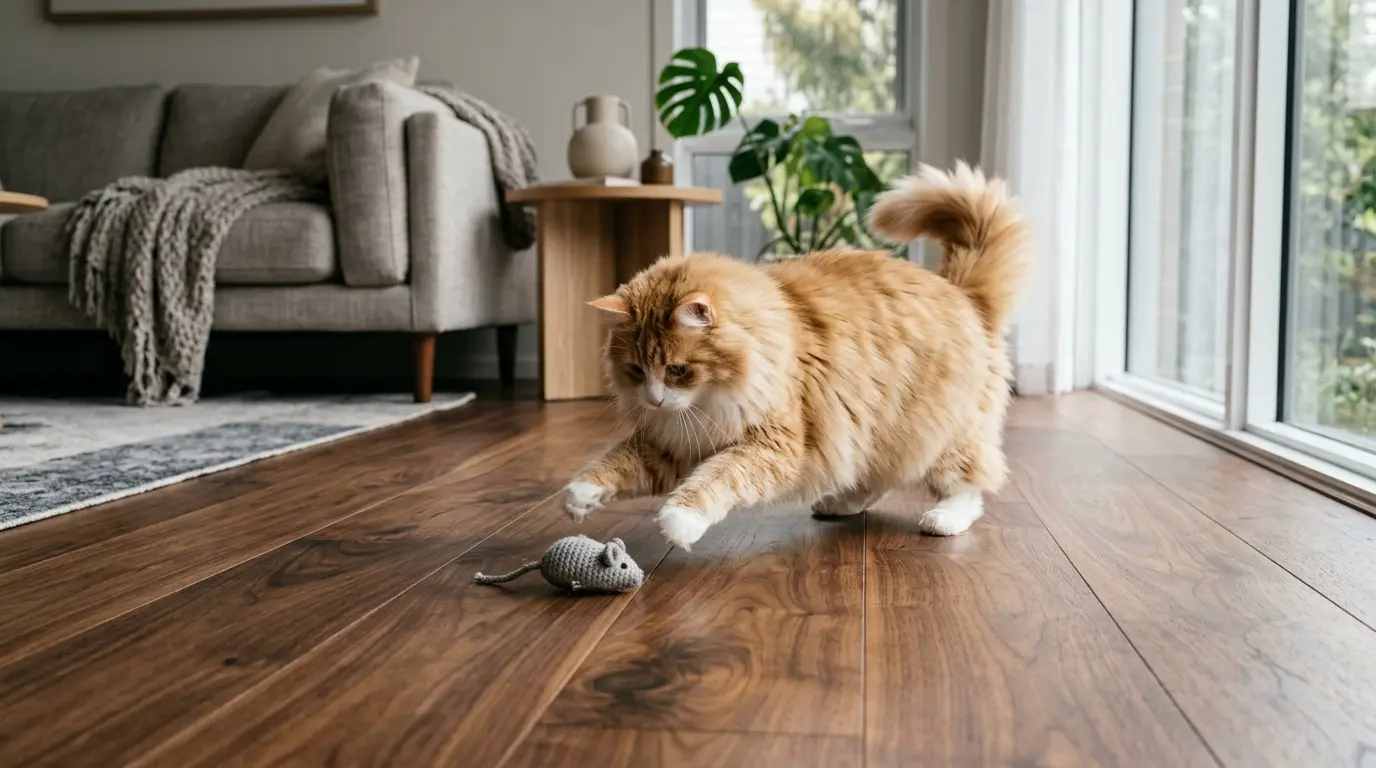
Dogs and cats do not automatically rule out timber flooring. The right floor can work very well in a pet-friendly home, but choosing the right option involves more than simply selecting the hardest timber species.
Timber species, floor construction, surface finish, coating, texture and maintenance all influence how a floor responds to scratches, dents, dirt and everyday pet traffic.
In this guide, we compare popular timber flooring options for homes with dogs and cats, explain what the Janka hardness rating can — and cannot — tell you, look at the role of different finishes, and cover practical ways to reduce scratches, moisture damage and everyday wear.
If you already have timber flooring, we also explain how to identify common types of pet-related damage and when maintenance may be enough versus when professional repair or refinishing may be appropriate.
| Flooring option | Timber hardness / construction | Pet-related wear considerations | Key advantages | Important limitations |
|---|---|---|---|---|
| Spotted Gum | Hard Australian hardwood | Good resistance to indentation; surface finish remains important | Dense timber, durable and well suited to high-traffic areas | Can still develop scratches from grit, claws and furniture movement |
| Blackbutt | Hard Australian hardwood | Good resistance to everyday indentation and wear | Durable Australian hardwood with a relatively hard surface | Finish and maintenance still influence visible wear |
| European Oak | Moderate hardness; available in solid and engineered formats | Can perform well in pet homes when appropriately finished and maintained | Attractive grain can help disguise some minor surface variation | Generally less hard than some Australian hardwood species |
| Engineered Timber | Performance varies by wear layer and construction | Depends heavily on product construction and finish | Stable construction; wide range of finishes and styles | Sanding and refinishing options depend on the product’s wear layer |
| Strand-Woven Bamboo | Often high hardness, depending on product | Can provide good resistance to indentation | High hardness and consistent appearance in many products | Performance varies significantly between manufacturers, coatings and products |
Hardness should not be treated as a complete measure of pet resistance.
A harder timber may be more resistant to dents and indentation, but scratches can still occur from grit, pet claws, furniture movement and other abrasive contact.
Similarly, a flooring product with a softer timber species may still perform well in a pet household if it has a suitable protective finish, appropriate surface characteristics and good maintenance.
The most suitable choice therefore depends on the complete flooring system rather than one specification alone.
What Makes a Timber Floor Suitable for Homes With Pets?
When it comes to selecting timber flooring for a home that has dogs and cats, it is more than just about picking the more durable timber species. A pet-friendly floor should be able to withstand a variety of common foot traffic, from scratches and dents to surface abrasion, dirt, moisture and repeated foot traffic.
The most significant factors to take into account are:
1. Timber Hardness
The harder the timber species, the greater the resistance to indentation and dents. The Janka rating can be helpful when comparing species of timber, but must not be used as a direct indicator of scratch resistance.
2. Surface Finish
The coating serves as a sheathing that protects the wood and greatly influences the overall performance of the floor. The finish type and condition can impact how quickly scratches and scuffs are apparent and pet marks are visible.
3. Surface Texture and Sheen
Scratches and paw marks can be more noticeable on a highly reflective and smooth surface. Sometimes a lower shine or textured surface can better play up to the small day-to-day wear.
Do not be misled by the term “matte” or “textured” as it does not imply that the floor cannot be scratched. This will mean that certain forms of wear will not be as obvious.
4. Floor Construction
The two types of floors, solid and engineered, are built differently. The engineered flooring’s real timber wear layer, and its thickness and construction, are especially significant if the flooring is to be sanded or refinished in the future.
5. Maintenance
Grit, sand and dirt walked across the surface of even a hard timber floor will cause visible wear to the floor surface. Avoidable abrasion can be greatly minimized through regular cleaning, appropriate entrance mats and furniture protection.
6. Your Pet and Your Home
The type of floor use is another factor that will influence which flooring is best.
A house that has a big dog that’s active will wear differently than a house with an indoor cat. Other high traffic areas, such as entrance areas or feeding stations, may experience increased wear as well, compared to bedrooms or less frequently used areas.
There is therefore no one perfect type of timber for all homeowners who have pets.
It is better to compare the flooring system as a whole:
Timber species + construction + finish + surface characteristics + maintenance + household use
What is the Best Timber Flooring for Pets?
When looking for pet friendly flooring Melbourne homeowners can rely on, the best way to determine the best timber floor for pets is by the Janka Hardness Scale. This test is used to determine the resistance of a species of wood to denting and wear in an industrial setting. If you have four-legged family members, you’re better off choosing a hardwood rather than softer species, such as pine or the more familiar cedar, as they can reveal deep claw marks within weeks. Instead, turn to the very dense Australian native hardwoods or to the best engineered products.

The most resistant species are at the top.
True scratch resistance of hardwood flooring is found in species that are rated at the higher end of the hardness scale:
- Spotted Gum: A high quality option as it has approximately a Janka rating of 11.0 kN. It has natural color variations from light grey to deep chocolate brown which are particularly effective at concealing dirt, pet hairs and small scuffs.
- Ironbark (Hardness 5): Slightly softer than its predecessor, but still pretty durable, Ironbark is available in a more consistent deep red-brown colour.
- Blackbutt: A beautiful, traditional Australian timber that has a honey colour. At 9.1 kN, it strikes a wonderful medium between structural strength and lightness and airiness of design palette.
Engineered wood is made from a mix of wood fibers.
When looking for the best engineered hardwood for dogs, engineered timber floors are recommended over traditional solid timber and are especially suitable for pet owners. Engineered boards are made by bonding two or more layers of plywood or high-density fibreboard together with a thin layer of real timber veneer. The clever design allows the floor to be exceptionally structurally stable and resist buckling, warping, or cupping due to normal changes in humidity or even a water bowl spill.
However, if you are looking for a more refined and traditional pattern, you can also consider high-quality alternatives such as the Parquetry Flooring Melbourne companies have to offer. The geometric patterns of the parquetry care for the visual sightlines, making any superficial paw scuffs totally unseen by sight.
The Real Story on Bamboo Flooring and Pets
When hunting for the ultimate scratch-resistant surface, looking beyond traditional hardwoods often brings up the debate around bamboo flooring and pets. Strand-woven variations are exceptionally dense, sitting right at the top of the hardness scale. For highly active households, a premium bamboo flooring pets configuration offers an incredibly tough, bulletproof barrier that stands up to heavy foot traffic and rough play without showing immediate wear or micro-scratches.
If you are dealing with larger breeds or high-energy puppies, opting for bamboo flooring and dogs can be a brilliant, budget-friendly move to prevent deep claw gouges. However, keep in mind that since bamboo is technically a grass rather than wood, it lacks the classic, high-end architectural grain pattern of authentic Australian timber. It can also be slightly more sensitive to Melbourne’s fluctuating seasonal humidity if not sealed perfectly. If pure dent resistance on a budget is your absolute priority, it’s a stellar alternative, but for long-term resale value, engineered Spotted Gum or Blackbutt still holds the crown.
What Does the Janka Hardness Rating Actually Tell You?
The Janka hardness rating is useful when comparing timber species, but it should not be treated as a complete measure of how scratch-resistant a finished timber floor will be.
The Janka test measures the force required to embed a standard steel ball into timber to a specified depth. It is primarily useful as an indication of the timber’s resistance to indentation.
This makes hardness relevant for homes with active pets because claws, furniture and concentrated loads can create dents or indentations.
However, a high Janka rating does not mean that a timber floor cannot be scratched.
Hardness vs Scratch Resistance
These are related but different considerations.
Hardness primarily helps indicate resistance to indentation.
Scratch resistance depends on a wider combination of factors, including:
- Timber species
- Surface coating
- Finish system
- Surface texture
- Grit and dirt
- Pet claws
- Furniture movement
- Traffic levels
- Cleaning and maintenance
For example, a hard Australian hardwood can still develop surface scratches if abrasive grit is repeatedly walked across the floor.
Janka hardness should therefore be used as one factor in the decision, rather than as a simple ranking of which floor is “best” for pets.
What Should Pet Owners Look At?
Instead of asking only:
“Which timber has the highest Janka rating?”
consider:
“Which flooring system provides the right combination of hardness, finish, construction, maintenance requirements and appearance for my home and pets?”
That provides a much more realistic way to compare timber flooring options.
Source: WoodSolutions — Timber Flooring
Our Experience With Timber Floors in Pet Homes
At Boss Timber Flooring we work with timber floors in houses on a regular basis, where dogs and cats are part of day-to-day life.
Through practical flooring experience, we’ve discovered that claw scratches are not the only form of wear and tear caused by pets. The visible wear can be caused by the movement with paws, repeated movement in high traffic areas, furniture moving around or moisture in the home near the feeding areas.
Also, it has been noted that the degree of wear is different for different timber species and in wood where there is an existing coating and surface finish.
For instance, two floors may be used on a daily basis, but due to differences in their finishes (one reflective, the other low sheen or textured) they will wear differently.
This is because we are not recommending a particular timber species for a floor, because it may be hard in isolation, but soft when put together with the rest of the flooring system.
During an assessment, we seek to find out:
If your home is an animal friendly environment, we take into account the following factors when evaluating a timber floor:
- The timber species
- Solid or engineered construction
- Existing finish and coating condition
- Depth and type of scratches
- Areas of concentrated traffic
- Signs of moisture exposure
- Condition around feeding and water areas
- Existing maintenance products
- Whether the floor may require future sanding or refinishing
This will help identify if the floor requires only local repair, recoating or a more comprehensive floor restoration.
Why Choosing Pet-Friendly Hardwood Floors Matters
Investing specifically in pet-friendly flooring Melbourne, including durable pet friendly hardwood floors, is not only about the visual appeal of your property, but also about everyday living, cleaning routines, and the return on your property improvement investments.
Choose health and hygiene over carpeting!
Timber floors simply do not trap pet dander, fur, mud, fleas and dust mites like carpets do and are incredibly hygienic. Don’t catch allergens. If your dog is running in the house after the park after a damp day, cleaning is as simple as a quick wipe down rather than deep cleaning. Carpet to hard floors made of wood: a real game-changer for family members suffering from asthma or allergies.
Long-Term Property Value
Good quality, long-lasting dog flooring means that you won’t need to get a huge price cut when it’s time to sell your home. Scratched, stained or damaged by urination flooring can cost thousands off a house’s appraisal. Your floors retain their high-quality, architectural appearance for years and years when you select a hard-wearing species that’s matte-finished from the beginning.

Pet Claw Damage: Scratches, Dents or Scuffs?
Pet-related floor damage is not always a scratch. Dogs and cats can leave several different types of marks, and identifying the type of damage is important because each may require a different approach.
Scratches
A scratch is a line or abrasion where the surface has been marked or cut through contact with a claw or another object.
Light scratches may affect only the protective finish, while deeper scratches can penetrate into the timber underneath.
Dents
A dent is a depression in the timber caused by pressure rather than a cutting or scraping action.
Large dogs, heavy furniture and concentrated loads can create indentations even when the surface coating itself remains relatively intact.
Harder timber species generally provide greater resistance to indentation, which is one reason timber hardness is relevant when choosing flooring for homes with active pets.
Scuff Marks
Scuff marks are usually surface marks or transfers caused by friction. They may appear as dark or grey streaks but do not necessarily mean that the timber has been physically cut.
A scuff can sometimes be removed through appropriate cleaning without sanding.
Coating Wear
Not all visible deterioration is damage to the timber itself. A worn or damaged protective coating can make the floor appear scratched, dull or uneven even when the underlying timber remains in reasonable condition.
Why the Difference Matters
The correct repair depends on what has actually been damaged.
| Type of damage | What is affected? | Possible response |
|---|---|---|
| Surface scuff | Surface appearance | Appropriate cleaning |
| Light scratch | Finish / surface | Maintenance or local treatment |
| Deep scratch | Finish + timber | Professional repair or sanding may be required |
| Dent | Timber structure | Repair or professional restoration |
| Worn coating | Protective finish | Maintenance or recoating |
| Severe gouge | Timber removed | Filling, repair or board replacement |
A visible mark should therefore be assessed before deciding that sanding is necessary.
Common Mistakes When Buying Wood Flooring for Dogs
For many homeowners, choosing the best finish for hardwood floors with dogs is an important part of their new home renovations, as many projects can fall short of expectations due to common problems while designing the new home. Here are some tips for a stress-free install that will help you avoid these common pitfalls:
- The number one thing wrong that you can do is to select a High-Gloss Finish. Polyurea coatings in high gloss and mirror finish are beautiful in an empty showroom, but act to magnify the pet tracks. Each individual paw print, oily smudge and superficial micro-scratch will reflect light. Opt for matte, satin or extra matte finishes.
- Texture: Smooth, flat surfaces wear out much faster than textured surfaces. A physical grain texture is created in the finish of wire-brushed or hand-scraped finishes. When a dog slips and presses his claw into the floor, the mark merges seamlessly with the texture of the floor, which is already rough.
- No natural timber floor is totally waterproof: Leave Liquids Liquid. Although engineered timber is much more resistant to moisture than solid wood, if you leave a puddle under the leaking water bowl all day or if you forget to clean up a water spill indoors and do not do so for a few hours, the top protective barrier will eventually break down, causing permanent black water-staining in the grain.
- Cheap Finishes: Standard DIY Lacquers are easily worn down by pets and their paws. Whether you’re coating or renewing floors, use a commercial quality multi-coat water-based urethane or high quality UV-cured natural oil.
Crucial Tips for Maintaining Timber Flooring Suited to Homes With Pets
It doesn’t take much effort to keep your surfaces clean – you don’t need to exclude your pets from your home. It only requires a few simple, protecting habits that you add to your home maintenance routine.
1. Nail Maintenance is Key
Have your dog/cat’s claws trimmed and filed. If you are able to hear a clear “click-click-click” sound as your dog walks across the room, nails are too long and they are striking the protective wear layer of the wood.
2. Engaging in Conversation on The Mat.
Install good, breathable rugs or runners in key “launch zones” of your house, like the base of the stairs, the main hallway or right next to the back door where your dogs are likely to break off at once when they see a bird in the garden. Always use non-slip natural rubber underlays, because the price of PVC underlays is low and they will chemically react with timber finishes, causing discolouration.
3. Smart Cleaning Strategies
Daily sweep up pet hair and trailing grit with a static microfiber mop or a vacuum cleaner designed for hard floors (with soft brush bars). When a running pet drags sand or dirt on its paws, it has the same effect as sandpaper on the floor. Use a damp (not wet) mop and pH neutral timber cleaner for mopping.
4. Long-Term Restoration Options
If you have selected a solid timber floor or an engineered floor topped with a thick wear layer (over 3-4mm), keep in mind that your floors can never be damaged. You can literally reset the clock 10 years later. It is easy enough for homeowners to get expert help to sand the top layer of scuffs, repaint the surface with a new matte layer and have the entire area look brand new again.

When to Hire a Professional for Your Melbourne Flooring Project
While DIY videos make floor installation look like a simple weekend project, the reality is far more complex especially when prepping a home for pets. Achieving a truly flat, tightly sealed, resilient surface requires specialized commercial equipment and precise subfloor preparation.
Poorly installed boards leave microscopic gaps between the tongues and grooves. If a pet accident occurs over a gap, moisture seeps straight down into the subfloor core, leading to structural rot, unpleasant lingering odours, and buckling boards that cannot be easily fixed.
When you invest in premium Timber Flooring Melbourne homes deserve, professional installation guarantees:
-
Perfect subfloor leveling to eliminate bouncing or squeaking boards underfoot.
-
Industrial-grade edge sealing to protect against perimeter moisture and spills.
-
Flawless transition profiles around doorways, skirting boards, and open-plan kitchen zones.
-
Comprehensive warranties that protect your financial investment for the long haul.
At Boss Timber Flooring, we specialize in guiding Melbourne pet owners toward the exact wood species, structural builds, and protective matte finishes that stand up to daily paws while elevating the design of your home.
Frequently Asked Questions
Can dogs scratch engineered timber floors?
While engineered timber floors with a high Janka hardness rating (like Spotted Gum) are incredibly tough, no real wood floor is completely scratch-proof. However, choosing a wire-brushed finish with a matte protective coating ensures that superficial micro-scratches from claws blend directly into the natural grain, remaining virtually invisible.
How do you remove pet urine stains from wood floors?
Fresh accidents must be wiped up immediately, followed by a clean with a specialized pH-neutral timber cleaner. If urine has sat for a long period and created a dark, black stain, it means the liquid has penetrated the finish into the wood tannin. These deep stains usually require professional sanding and localized re-coating to completely eliminate.
Is bamboo flooring better for pets than hardwood?
Strand-woven bamboo is incredibly dense and sits exceptionally high on the hardness scale, making it highly scratch-resistant. However, it lacks the classic, premium look of authentic Australian hardwoods and can be more sensitive to prolonged humidity changes. High-density engineered Australian hardwood remains the industry gold standard for visual appeal and structural stability.
Do dog claws ruin parquetry flooring?
Not at all. In fact, premium parquetry is an excellent choice for pet owners. The intricate, geometric patterns and rich natural grain variations of parquetry naturally break up reflected light, making minor paw scuffs and daily pet wear far less noticeable than they would be on long, uniform, smooth planks.


4 Responses
We have two dogs and have been looking at replacing our old carpet with timber flooring, but I was worried about scratches and dents. I didn’t realise that the hardness of the timber and the type of finish were two different things. The section comparing scratches, dents and scuff marks was particularly helpful because it made it much easier to understand what type of damage we might actually be dealing with.
That’s an important distinction, especially in a home with dogs. Timber hardness mainly affects how well the boards resist dents and indentations, while the finish provides protection against surface scratches, scuffs and everyday wear.
Neither will make a timber floor completely scratch-proof, so choosing a suitable species and durable finish is only part of the equation. Keeping dogs’ nails trimmed, removing grit regularly and using mats in high-traffic areas can also make a noticeable difference to how the floor ages.
We have two dogs and are thinking about replacing our flooring with timber. Is there a particular timber species or finish that tends to cope better with scratches from pets and muddy paws?
With dogs, the finish and overall construction of the flooring can be just as important as the timber species. A durable, quality finish can provide better protection against surface scratches, while a harder timber species can help reduce dents from claws and everyday foot traffic.
For muddy paws, a low-sheen or more textured finish can also be practical because it tends to make minor marks less noticeable. Regardless of the species, regular cleaning, keeping dogs’ nails trimmed and placing mats near entrances can significantly reduce wear. It’s worth discussing your pets and lifestyle with a flooring professional before choosing the final timber and finish.