When deciding between tongue & groove flooring and click wood flooring, the direct answer lies in your installation preference and long-term goals. Tongue and groove floors slot together and are glued or nailed down for maximum stability, whilst click lock flooring snaps together to create a floating floor that is fast and cost-effective to install. Choosing the correct profile is essential for your floor’s longevity, especially when dealing with the distinct seasonal climate changes we experience here in Melbourne.
Below is a quick overview to help you understand the core differences before we dive into the details.
| Feature | Tongue and Groove Flooring | Click Lock Flooring |
| Installation Method | Glued or secret-nailed to the subfloor | Floating floor (snaps and locks together) |
| Stability & Feel | Extremely solid underfoot, no movement | Slight bounce, relies on a high-quality underlay |
| Cost | Higher professional labour costs | Lower installation costs, highly DIY-friendly |
| Best Suited For | Solid timber, long-term durability, uneven subfloors | Engineered wood, fast renovations, apartments |
| Repairability | Difficult to replace individual planks | Easier to unclick and replace damaged boards |
Tongue and Groove vs Click Wood Flooring
Before you make a selection for your renovation, it’s important that you know the structural mechanics of these two popular timber profiles. The two methods can be used to join planks together seamlessly, but the method of locking and sitting on a subfloor is entirely different.
Tongue and Groove Flooring: What is it?
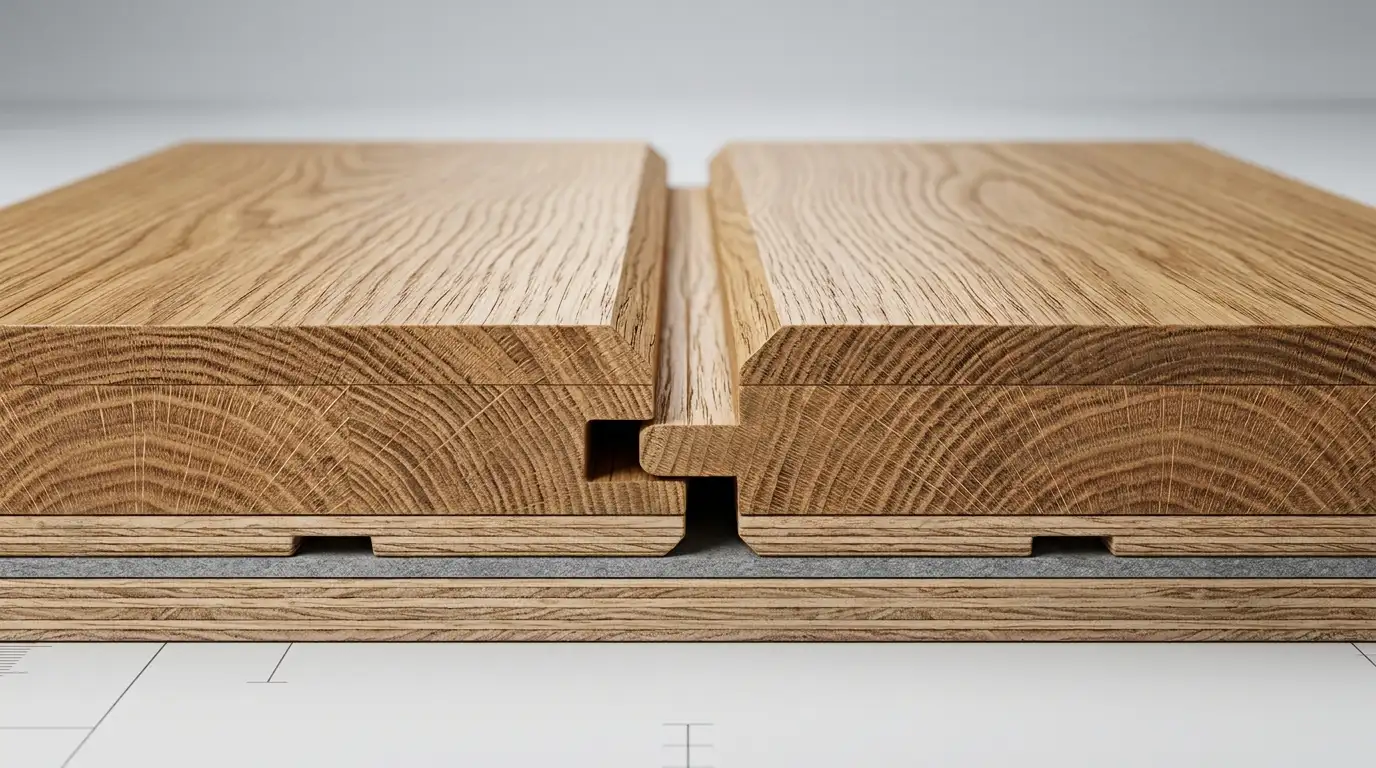
Tounge and groove flooring is the traditional flooring in the timber industry. As the name implies, the tongue is a milled edge that extends from the plank and the groove the corresponding opening located on the opposite edge of the plank. When fitted, tongue and groove flooring fit perfectly into the groove flooring in neighbouring boards. They cannot be anchored in place by themselves, so these boards need to be permanently attached to the subfloor. This is done by gluing in full completely to a concrete slab or by secret nailing into timber joists or plywood. It is primarily for solid hardwood, but can also be engineered.
what’s Click Lock Flooring?
Click lock flooring, on the other hand, is a more recent development that emphasizes speed and convenience. These boards have a special interlocking edge designed at the edges. Then you bend one board and slide it into the last board and push it down to the point that it clicks. This system provides a very close fit without the use of adhesive, nails or screws. Therefore, click floors are installed on an acoustical or moisture barrier underlay as a “floating floor.” Most current modern engineered timber, laminate and hybrid floors use it as their locking system.
According to Quick-Step Australia, its Uniclic Multifit system uses a tongue-and-groove connection that makes laying timber flooring easier, with the planks simply clicking together during installation.

The Benefits of Each System
It is important to know the advantages of each of these systems, since your selection will have an influence on your first cost, the acoustics of walking over it, and more.
Tongue and Groove offers several advantages
The biggest benefit of a glued or nailed tongue and groove melbourne system is that it is the most stable glued or nailed tongue and groove system ever. The boards stay attached to the subfloor permanently so there’s no give when walking across the floor. No hollow sound, no shifting, and little risk of squeaking will occur over time. Additionally, they are extremely long-lasting, as they can be sanded and refinished over the years, allowing the use of solid timber floors. When it comes to bespoke, architectural designs, fixed installations are practically a requirement. For instance, in the case of classic parquetry, researching the services offered by experts in parquet flooring melbourne is crucial, because the delicate design of classic patterns requires a stable glued tongue and groove floor system to support it.
There are several benefits of Click Lock Flooring.
However, the main advantage of click lock systems is convenience. Without the need for curing time for glues and the time-consuming task of nailing, a click floor can be installed quickly, which helps to save labour. It’s highly DIY in nature, so if you’re a handy person, you can install the floor on your own over a weekend. Also, if a center board is damaged beyond repair, a floating click floor can be “unclicked” from the wall towards the center to replace the damaged board and this is technically a relatively simple task, while fixing a board that is glued to a wall is a messy job that needs professional attention.

Common Problems and Mistakes with Wood Flooring Joints
Bad planning and installation mistakes can spoil a high dollar order for timber, whether it’s a traditional or modern locking system. These are the most frequent errors that people make with both systems.
Ignoring Subfloor Preparation
This is the one thing that people always get wrong when laying timber flooring. In the case of a floating click floor the subfloor has to be completely level (typically within 3 mm over a 3-metre radius). The click joints will end up being overworked, if the subfloor is not flat. The concrete slab should be completely dry for tongue and groove glued floors. If a moisture barrier (DPM) is not used before gluing, moisture will enter the timber causing cupping and buckling.
Forcing the Joints
It is a common DIY error to make too much effort while installing it. Too forceful a blow on the lock flooring with a tapping block can damage the locking lip. After that lip is broken, the boards will not ever be sitting flat and will cause ugly gaps. In a like manner, too much glue applied to the groove of a T&G board will not allow the tongue to seat properly, and will cause the whole row to go out of alignment.
Let go of the Acclimatisation and Expansion Gaps.
Timber is a natural product that varies in dimensions when wet and dry. One of the common errors made is buying timber directly from the vendor and laying it on the same day. Boards should be acclimatised in room where they will be installed for 48-72 hours. Also, if there is not enough space around the outer edges of the room (typically 10-15mm) then the floor will peak or buckle during the humid Melbourne summer.
Tongue and Groove or Click? How to Choose Right
Are you still asking yourself: Tongue and Groove or Click? The right choice depends entirely on your specific household needs, budget, and long-term plans. Here are our top professional tips for making the right call.
- To be able to evaluate the use of traffic and space.
The fixed stability of tongue and groove is strongly recommended if the area where the floor will be installed is a high traffic zone, such as open plan kitchen and living room. Good performance under heavy loads and feels like a premium product. Click lock floating floors are highly effective and much more easy to have approved by body corporates for areas that don’t have the same volume of foot traffic, bedrooms or upper level apartments where acoustic underlays are needed for building regulations reasons. - The True Cost is a factor to consider.
DO NOT consider the cost of the boards when making a budget. Although click lock flooring may be slightly higher in per m^2 pricing because of the milling process, it will save you a lot in the installation process and will not require the use of costly flooring adhesives. On the other hand, raw tongue and groove boards can appear cheaper but the work, leveling and glue can double the total project cost. - Source High-Quality Materials
For floating or fixed, it’s the accuracy of the manufacture which is important. Low cost milled boards will not have consistent joints, which will make installation a nightmare. When looking for materials, buy from good suppliers. For example, if you’re working on a custom renovation, you can rest assured that you’ll receive the highest quality parquet flooring supplies with a high-quality parquet flooring supply hawthorn provider who offers perfectly milled wood that fits tightly and shatters absolutely during the years.

When to Hire a Professional for Your Timber Flooring in Melbourne
It’s easy to see why you might want to do your own home improvement projects to save money, but timber flooring is a place where there’s a definite benefit to hiring a professional.
If you’ve selected a click lock floating floor, you can do it yourself if you are an experienced DIYer. But in a complicated room, stairs, or uneven concrete slab, you will save a lot of money from making costly mistakes if you hire a professional.
For those who have decided to install tongue and groove flooring, it is advisable to hire a professional for the job. Special pneumatic tools are needed for secret nailing and special knowledge of adhesive open-times and moisture barriers is required for full-trowel gluing. A professional installer will understand exactly what to do as far as subfloor levelling, acoustic requirements and correct expansion gaps for our local climate.
For a perfect look that truly enhances your home’s aesthetic, consider hiring professional Timber Flooring Melbourne services to install your new floors and enjoy a beautiful, long-lasting result.
Looking to get your floors transformed?
Choosing floors isn’t a difficult decision to make. We’ll help you choose between rock-solid tongue and groove or modern efficiency with a click lock system. Call us today for a free consultation and measure-up in Melbourne, and we can help make your dream home a reality!
FAQs
1. What’s the difference between tongue and groove and click wood flooring?
Click lock flooring is much better when it comes to DIY projects. The planks just slide into place to form a floating floor, without the use of messy adhesives or other complex nailing tools that are used with tongue and groove systems.
2. click lock flooring can be glued down?
Yes, although it’s created to be a floating floor, high quality engineered click lock flooring can frequently be glued down to the subfloor if you would like a solid quiet feel of a fixed floor. Always refer to manufacturer’s instructions first.
3. What are the pros and cons of using tongue flooring vs. click systems?
Traditional glued or nailed tongue flooring is often more durable and stable long term, with the additional benefit of being frequently solid hardwood, and can be refinished or sanded over the years.
4. Is underlayment needed for tongue and groove flooring?
Using a standard foam underlay is not used when the boards are glued or nailed directly to the subfloor. If you are covering over concrete, you’ll need a moisture barrier (DPM) however. The use of underlays is most common with floating click lock floors.
5. Tongue or groove or click? Which would be more beneficial for my house?
These both are excellent value, however a good hardwood tongue and groove floor installation is frequently considered a high quality, lifetime investment by prospective buyers, leading to resale value for bespoke properties.


2 Responses
I’m comparing traditional tongue-and-groove flooring with a modern click system for a renovation. Is the click method mainly easier to install, or are there other practical advantages once the floor is in use?
The main advantage of a click system is generally faster and simpler installation, but there can be practical benefits beyond that. Click flooring can provide a secure connection between boards and may be suitable for floating installations, depending on the product and subfloor.
Traditional tongue-and-groove flooring is more commonly fixed to the subfloor and can be a good option where long-term stability and the ability to sand and refinish the floor are priorities. The better choice depends on the specific timber, subfloor, installation method and how the room will be used. Always check the manufacturer’s installation requirements before choosing between the two systems.