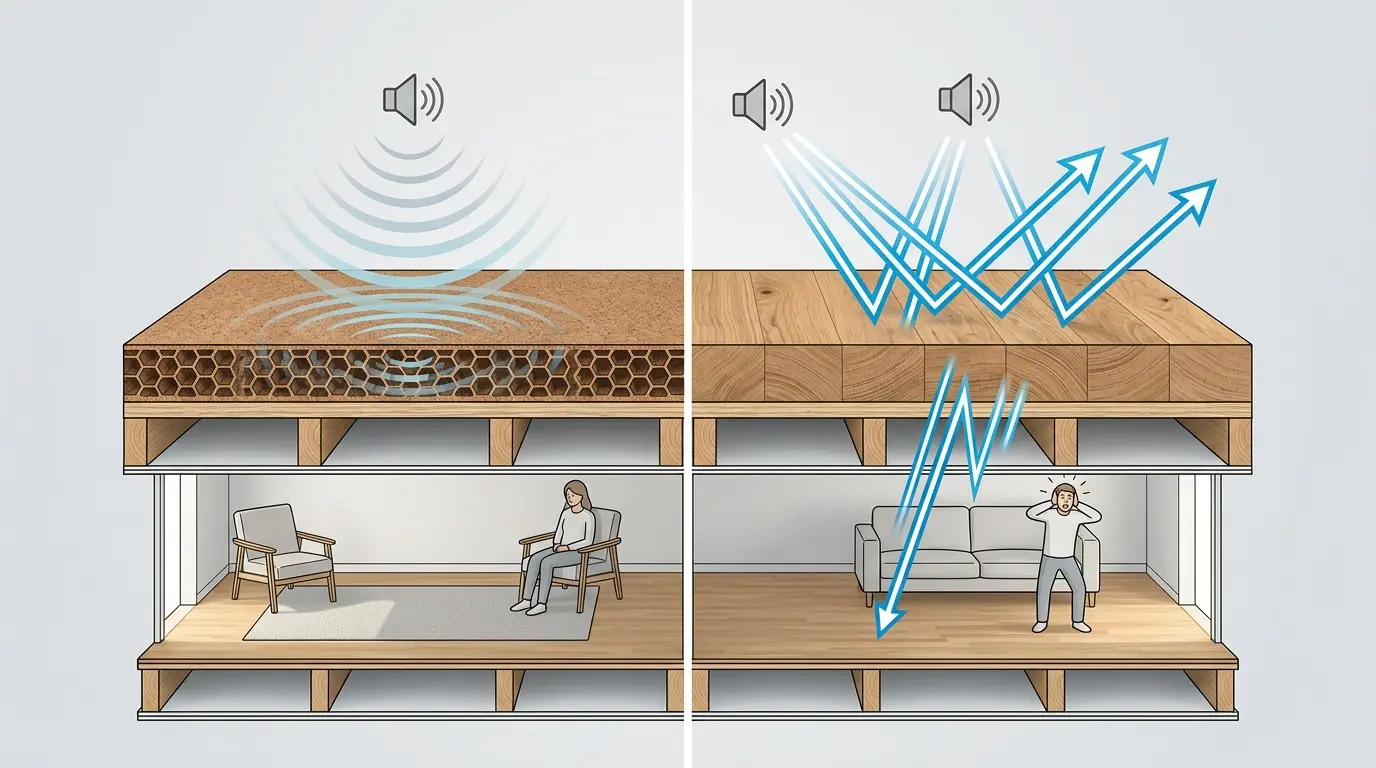
When asking compare cork vs timber flooring for eco homes?, the direct answer is that cork is naturally superior at absorbing impact noise due to its honeycomb cellular structure, making it incredibly quiet underfoot. Timber, being a dense and rigid material, naturally reflects and transmits sound, meaning it requires a high-quality acoustic underlay to achieve a similar level of noise reduction. If you are renovating an upper-level apartment or a bustling two-storey home in Melbourne, choosing the right material and the correct installation method is crucial to keeping your home peaceful and compliant with local acoustic regulations.
Below is a quick overview to help you understand the core acoustic differences before we dive into the technical details of these two popular flooring options.
| Feature | Cork Flooring | Timber Flooring |
| Natural Sound Insulation | Excellent (absorbs up to 53% of impact noise) | Poor to Moderate (reflects sound, requires underlay) |
| Cellular Structure | Millions of air-filled pockets | Dense, tightly packed wood fibres |
| Underfoot Feel | Soft, cushioned, and warm | Hard, solid, and traditional |
| Acoustic Underlay Needed? | Rarely (naturally dampens sound) | Absolutely essential for upper floors |
| Best Suited For | Upper-level flats, studios, bedrooms, playrooms | Ground floors, living spaces, luxury renovations |
Timber vs Cork
The only way to grasp how cork flooring vs hardwood can affect hollow footsteps and echoing voices is to have an understanding of the basic sound transmission mechanisms of building materials. There are typically two types of sound in a home; airborne sound (such as voices, television, music) and impact sound (heavy footsteps, dropped items, moving furniture).
How Cork Stops Noise
Timber vs Cork is a comparison of plant marvels. It is produced from the bark of the Cork Oak tree, and consists of millions of tiny, air-filled cells held together by a natural compound called suberin. This cellular structure is like a tiny sponge as air is a great insulating material. If a large foot comes in contact with a cork floor, the air pockets inside the floor absorb the kinetic energy and prevent the impact noise from reaching the floor below. It also helps to absorb sound waves from the air, which means it will help minimize the echo inside the room.
How timber transmits noise
Timber is heavy, dense and stiff, on the other hand. Wood fibres are compacted to give strength, regardless of the oak solid or composite. This density gives timber a tremendously strong resistance to decay, but it also makes it a good conductor of sound. A hard object hitting a bare wood surface transfers the impact energy directly to the floorboards, then into the subfloor and through the floor joists. That’s the reason why the steps of people on the ground timber floor sound like a drum to those living below. To prevent this, modern wood floors need acoustic underlays to keep them separated from the subfloor.

The Benefits of Cork Flooring VS Wood Flooring
Whatever kind of flooring you have, it needs to have a high acoustic rating if your living space is to be comfortable. However, sound insulation is just one piece of the puzzle. By being familiar with the wider advantages of Cork Flooring VS Wood Flooring you can make informed decisions concerning acoustics and aesthetics, and property valuation.
The Benefits of Cork Flooring
If you’re wondering is cork flooring soundproof, its phenomenal sound-absorbing properties make it extremely comfortable to stand on for extended periods of time, so it is a great option for kitchens. The trapped air which prevents sound also offers excellent thermal insulation to keep your Melbourne home warm in winter and cool in summer. This can result in measurable savings on your energy bills. Moreover, cork is among the most eco-friendly flooring materials in the world: the tree is not cut down, just the bark is removed and the tree grows back in its natural 9-year cycle.
Timber flooring offers these benefits
The natural anti-noise properties of cork are not available with timber, but the advantage is that it possesses timeless beauty and hence great property value. Having a good timber floor is a feature that buyers look for and is considered a luxury. It is very resistant to deep gouges and can last as long as a person’s lifetime, if maintained properly. The upside is that you don’t need to compromise on the music quality to appreciate the beauty of wood. With a high quality engineered timber floor melbourne product, a floating installation method can be used on top of a heavy-duty acoustic rubber or foam underlay. This contemporary solution brings the look of natural wood with a strong compliance to the strict noise requirements in the residential sector.
Durability: How Cork and Timber Handle Daily Wear
Durability comes down to how each material responds to daily impact, not just noise. Solid and engineered timber floors resist deep gouges exceptionally well and, thanks to their density, can be sanded back and refinished multiple times over decades — a distinct advantage in high-traffic hallways, living rooms and entryways. Cork behaves differently: its cellular structure gives it natural elasticity, so light scuffs, dropped items and furniture pressure marks tend to bounce back rather than dent permanently. This makes cork surprisingly resilient for a soft material, though it’s more prone to surface scratches from pet claws or dragged furniture than a sealed hardwood. For busy family homes or rental properties in Melbourne, timber generally wins on long-term wear resistance; for bedrooms, home offices and lower-traffic areas, cork’s natural give often outperforms expectations.
How Much Do Cork and Timber Flooring Cost in Melbourne?
As a general guide for the Melbourne market, floating cork flooring is typically more affordable to install than glue-down cork, which involves additional labour and adhesive preparation. Timber flooring covers a wider range depending on the type of timber, installation method, acoustic underlay, subfloor levelling and finishing requirements. Cork is usually the more budget-friendly option, especially for upper-level apartments where acoustic underlay may be required. Timber’s higher upfront cost is offset by its ability to be resanded and refinished, which cork cannot do to the same extent. For an accurate quote based on your subfloor condition, flooring type and chosen finish, contact us today to discuss your project.
Maintenance and Lifespan: What to Expect Over Time
Timber and cork age differently, and knowing the maintenance rhythm of each helps you budget beyond the initial install. A well-maintained timber floor can be sanded and refinished every 7 to 10 years, effectively resetting its surface and extending its life well beyond 30 years — some solid timber floors in older Melbourne homes are still going strong after 50. Cork needs a lighter but more frequent touch: resealing every 3 to 5 years keeps its surface water-resistant and protects the honeycomb structure underneath. Left unsealed, cork is more vulnerable to moisture damage and fading. With this care, cork floors typically last 15 to 30 years. Day-to-day, both are easy to live with — regular sweeping and a damp mop is enough for either floor between deeper maintenance cycles.
Moisture Resistance and Indoor Air Quality: Why Cork Suits Allergy-Prone Homes
Beyond acoustics, cork has a property that rarely gets mentioned: suberin, the natural wax-like compound in its cell walls, makes it naturally resistant to mould, mildew and dust mites. That’s part of why cork performs well in bathrooms and kitchens when properly sealed — a space timber generally avoids due to moisture sensitivity. Cork also doesn’t off-gas or trap allergens the way carpet does, which makes it a genuine option for households managing asthma or allergies, particularly in children’s bedrooms and playrooms. Timber, by contrast, needs consistent sealing and a stable indoor humidity level to avoid cupping or gapping, and while it’s a hygienic, easy-to-clean surface, it doesn’t offer the same built-in resistance to mould and dust that cork does.
Best Rooms for Cork vs Timber Flooring
Cork suits bedrooms, home offices, playrooms and even bathrooms or kitchens when sealed correctly — anywhere warmth, quiet and a forgiving surface underfoot matter most. Timber is the stronger choice for living rooms, dining areas, hallways and entryways, where its density and refinishing potential handle heavier daily traffic. Many Melbourne homeowners combine both: timber through the main living spaces, cork in bedrooms or a home office above a busy household.
According to CHOICE, cork flooring is “comfy, soft and warm to walk on”, while timber flooring is also durable, comfortable and easy to care for.
Common Problems with Cork vs. Timber Floor Installation
The acoustic performance of even the quietest of materials on the market will be lost if the material is not installed properly. Humidifiers and heating systems tend to cause some common mistakes when homeowners and unskilled tradespeople decide to install Cork vs. Timber Floor.Cork vs. Timber Floor Installation can have some common mistakes that homeowners and unskilled trades people make, which can result in noisy, echoing floors.
Acoustic Bridging (Flanking Noise)
An “acoustic bridge” is the most frequently made acoustic floor installation error. This happens when the hard flooring surface comes in contact with a vertical surface like a wall, pipe or skirting board. The best acoustic underlay in the world is below the floor if the timber or cork is wedged tightly against the skirting board, then the sound vibrations will pass round the underlay, up the wall and down into the structure of the building. This is referred to as flanking noise.
Ignoring Subfloor Preparation
With floating timber floors, if the concrete slab or wooden subfloor is not level, the timber will bend and ‘bounce’ under foot. This movement can cause a hollow sound and slap on the subfloor, wiping out the acoustic underlay benefits. The necessary prerequisite is a correct levelling.
Moisture and Expansion Issues
Both cork and timber need to breathe and expand and contract in a changing climate. If the perimeter expansion gap is not left sufficiently, the floor will expand and push against the walls. This will not only result in buckling and cupping of the overhang but will also produce an enormous acoustic bridge, directly linking each footfall into the structure of the building.

Tips for Perfect Sound Insulation
When choosing how to install your renovation project, you need to consider how it will impact on your downstairs neighbours, and how it will sound through your own house. Here are the top tips for achieving acoustic excellence.
1. Purchase the correct acoustic underlay.
The only way to prevent impact noise when using timber is through an underlay. Don’t use thin, low quality foam. A high density acoustic rubber, cork-blend or heavy foam underlay, specially designed to reduce the Lnw (Weighted Standardised Impact Sound Pressure Level), is required. The lower the Lnw rating, the greater the sound insulation.
2. Isolate the Perimeter
If there is any type of cabinetry or walls attached to the floor, allow for a clear gap of 10-15mm between the floor and the wall/cabinetry to avoid flanking noise. If you are fitting skirting boards or adding beading, secure the wood to the wall rather than pin it in the skirting boards. There should be no binding of any kind between the skirting and the flooring, which should be allowed to move freely underneath the skirting.
3. Please verify the regulations and availability with the local showrooms.
You can’t just lay a carpet in an apartment or strata managed building in Melbourne. Your body corporate will have a strict acoustic by-law (which is usually in line with or better than the National Construction Code). These are the decibel requirements that must be checked before buying any materials. Making a visit to a well-known local supplier, for instance a ringwood flooring specialist, can assist you to obtain regularly obtained materials that have laboratory acoustic test reports that your body corporate requires prior to approving the flooring.
4. Consider Hybrid Approaches
For the appearance of wood and the sound of cork, try a cork-backed engineered wood. The innovative planks have a real hardwood top layer for aesthetic use and are bonded directly to a base layer of high-density cork to provide an excellent combination of layers in upper level rooms.

When to Hire a Professional Timber Flooring Installer
It is a relatively simple weekend do-it-yourself project to click together a few laminate boards in a spare bedroom on the ground floor; but the installation of acoustic flooring in a space above or an apartment is a very technical job.
A project that fails to meet the strict body corporate acoustic requirements can be a costly problem. The body corporate legally has the authority to force you to remove the whole of your floor if your new floor fails the acoustic tests upon installation.
That’s why it’s so critical to hire a professional timber flooring installer. A professional will expertly level the subfloor, ensure accurate placement of heavy-duty acoustic underlays and source the right moisture barrier. They are fully aware of how to undercut doorjambs and leave proper expansion gaps, so they will know that nothing is ‘acoustic-bridged. In addition, a professional will issue a certificate of compliance for their workmanship, ensuring that you and your building manager have every confidence that the floor is structurally sound, completely quiet and fully compliant.
Looking to a quieter more beautiful home?
You don’t have to sacrifice style or quiet when you choose between a cork floor or an acoustically treated timber floor, both options offer superior natural or high-end acoustics with style. Call us today for a no-cost, no-obligation measure up and consultation in Melbourne. Our professionals will help you select the ideal material and underlay for your home to make it a peaceful and chic haven.
FAQs
1. Is timber vs cork flooring better for upstairs bedrooms?
From a purely acoustic standpoint, cork is naturally better for upstairs bedrooms as its cellular structure absorbs impact noise (like footsteps) without needing heavy underlays. However, timber can perform just as well if installed by a professional over a high-quality acoustic rubber or cork-blend underlay.
2. Are the costs of Cork vs. Timber Floor Installation vastly different?
Yes. Cork is generally more affordable to purchase and faster to install, especially in click-lock floating formats. Solid or engineered timber requires a larger initial investment for the material, and the mandatory acoustic underlays required for upper levels will increase the overall installation cost.
3. When comparing Cork Flooring VS Wood Flooring, which lasts longer?
Wood flooring generally boasts a longer lifespan. A high-quality solid or engineered timber floor can be sanded back and refinished multiple times over decades. Whilst modern cork floors are sealed with durable polyurethanes, they cannot be sanded as deeply or as often as dense hardwood.
4. Can I use a cork underlay beneath a timber floor?
Absolutely. Using a dense cork roll as an underlay beneath a floating timber floor is one of the most effective and eco-friendly ways to achieve brilliant sound insulation, combining the acoustic benefits of cork with the visual appeal of wood.
5. How do I stop my timber floor from echoing in the room?
If your room suffers from airborne noise echoing (reverberation), the floor itself can only do so much. You need to soften the room’s acoustics by adding area rugs, heavy fabric curtains, acoustic wall panels, and soft furnishings to absorb the sound waves bouncing off the hard timber surface.
6. How long do cork and timber floors actually last?
With proper care, cork flooring typically lasts 15 to 30 years, needing resealing every 3 to 5 years. Timber flooring can last several decades longer, since solid and engineered boards can be sanded back and refinished every 7 to 10 years, effectively renewing the surface each time.
7. Is cork flooring good for allergies?
Yes. Cork’s natural suberin compound resists mould, mildew and dust mites, and unlike carpet it doesn’t trap allergens in its surface. This makes it a popular choice for bedrooms and playrooms in households managing asthma or allergies.


2 Responses
I’m deciding between timber and cork flooring for a family living room. Is cork noticeably more comfortable underfoot, or would timber be the better long-term option for a busy household?
Cork is generally softer and more forgiving underfoot than timber, so it can feel warmer and more comfortable for a family living area where people spend a lot of time standing or walking. It also has some natural acoustic and insulating properties.
Timber, however, offers a hard-wearing surface and can often be sanded and refinished when it starts to show wear, which can be a significant advantage over the long term. For a busy household, the choice really comes down to the balance you want between underfoot comfort, durability, maintenance and the overall look of the room. A quality finish and proper installation are important with either option.