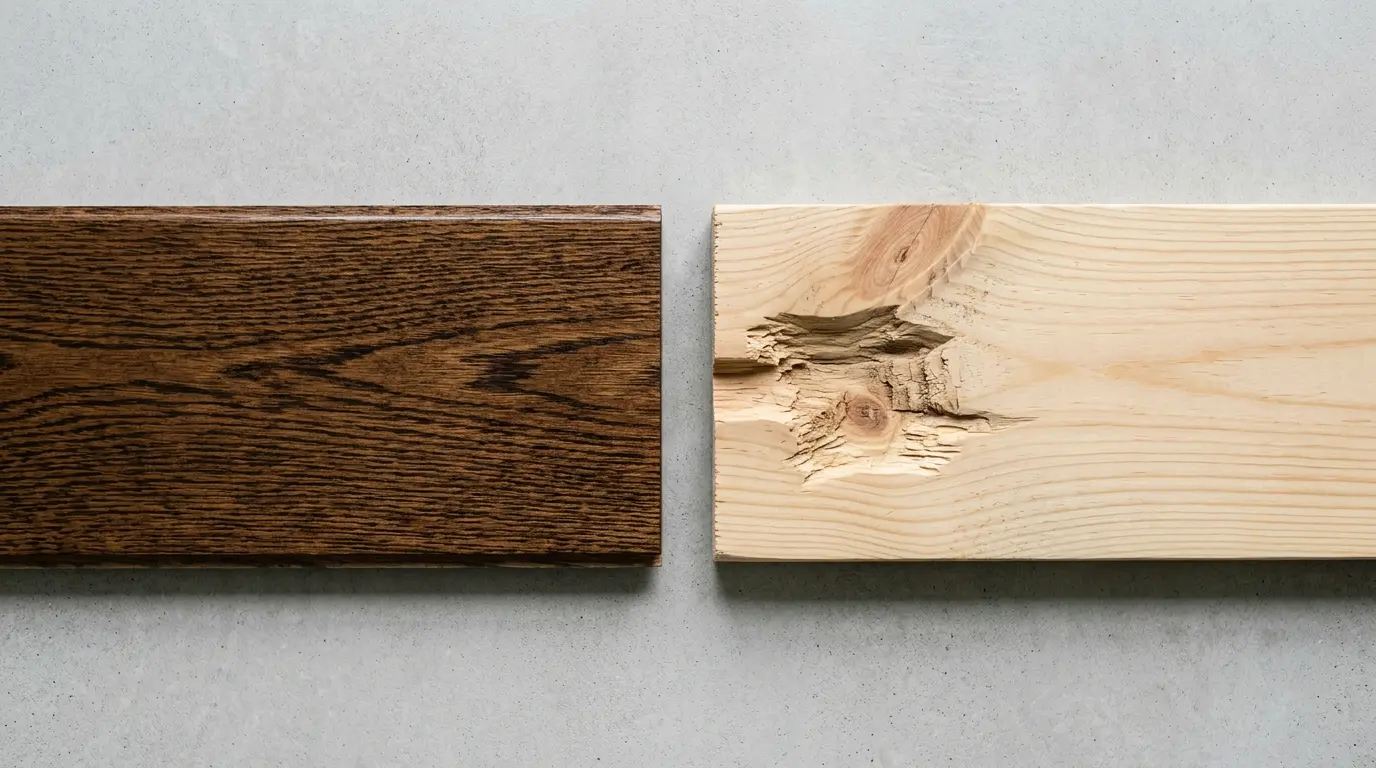
When comparing softwood and hardwood flooring durability, the direct answer is that hardwood is generally denser, more resilient to scratches, and offers a longer lifespan for high-traffic areas, whilst softwood is less dense, more affordable, and provides a charming, rustic warmth. Choosing the right timber for your Melbourne home is crucial, as our distinct seasonal climate changes require a floor that can not only handle daily wear and tear but also natural expansion and contraction.
Below is a quick overview to help you understand the fundamental characteristics before we explore the depths of timber durability.
| Feature | Hardwood Flooring | Softwood Flooring |
| Durability & Density | Highly durable, resistant to dents and scratches | Softer, prone to denting and scratching over time |
| Cost | Higher initial investment | Generally more cost-effective |
| Lifespan | Can last 100+ years (can be refinished many times) | Can last decades if maintained properly |
| Common Species | Oak, Maple, Spotted Gum, Blackbutt, Walnut | Pine, Cedar, Fir, Spruce |
| Best Suited For | Living rooms, hallways, kitchens, busy family homes | Bedrooms, low-traffic areas, rustic period homes |
Understanding Hardwood and Softwood
It is important to know the meaning behind these terms before choosing the one that best fits your renovation or new build project, as this will help you make an informed decision. Interestingly, the term ‘hardwood’ and ‘softwood’ is not about the weight and density of the wood, but about the botanical methods of reproduction of the tree.
What is Hardwood?
Hardwoods are derived from angiosperms, a group of trees that bear seed that has some sort of cover, like a fruit or a hard shell like an acorn. Such trees are generally deciduous, or ‘leaf’ dropping trees. Due to their relatively slow growth, cell structure is very condensed and complex. This slow growth produces a much more compact wood fibre. Hardwoods (e.g. European Oak, American Walnut, Australian native e.g. Spotted Gum, Blackbutt) are very dense, heavy and structurally strong.
What is Softwood?
Softwoods are derived from gymnosperm trees. These are trees that release seeds without any covering (e.g., pine cones). Most softwood trees are conifers (evergreen) trees that maintain their needles throughout the year. Due to the rapid growth of these trees compared with deciduous trees, they have a lower density, thus more air and sap. Common flooring softwoods are Pine, Douglas Fir and Cedar. Although it is true that these trees are botanically softwoods, in the flooring industry, this term more aptly describes the physical attributes of the product: softwood is softer underfoot and more easily marked than its hardwood counterpart.
According to WoodSolutions, “the selection of a hard timber species improves resistance to indentation and abrasion,” while softer timber species used for flooring can be more prone to indentation.

The Benefits of Each Timber Type
It is imperative that you have an understanding of Hardwood Vs Softwood Timber as it will have a direct affect on your budget, the maintenance process and how your home feels and operates every day. Each type has its own distinctive benefits to offer a property.
Hardwood flooring has a number of advantages
Hardwood’s main advantage is that it is more durable than other materials. Hardwood is built for the active family with children, indoor dogs and frequent visitors. The high density of cells makes it very resistant to any impact caused by dropped objects, high heels or moving furniture. In addition, hardwood is a great investment asset. A superior solid timber floor can last for a lifetime. After 10-20 years or so the surface will start to look tired and scratched and can be sanded back and refinished several times, and appear as a brand new floor without paying for replacement. Also, hardwood flooring is much in demand on the Melbourne property market and often provides a significant resale value to any property.
There are a few advantages of softwood flooring
Although softwood may not be as impact resistant as hardwood, it has a number of attractive features. One is, first, that softwood is much less costly. Gymnosperm trees grow quickly, which means there is more material available, and easier to pick up, reducing the amount of the material cost. This is ideal for use on budget upgrades or high ceilings, such as a bedroom on the upper level of the house which may not be heavily trafficked. Secondly, softwood has a unique warm rustic charm. The knotty, gold colour of Baltic Pine is a popular feature in many Victorian and Edwardian period houses throughout Melbourne. The less dense structure of softwood also makes it less harsh and warmer to walk on. Lastly, due to the rapid growth of these trees, they are also ‘highly sustainable’ and ‘rapidly renewable’ construction materials.

Common Problems and Mistakes
Homeowners, when they make Softwood Vs Hardwood comparisons, are likely to make critical mistakes in choosing and maintaining their flooring, resulting in damage and high repair costs.
Assuming All Hardwoods Are Indestructible
One of the biggest misconceptions is that a hardwood can’t be damaged if it’s marked “hardwood”. Hardwood is very durable but not a stone. Over time even the toughest of Australian timbers will be dented and scratched by dragging heavy furniture, walking in the house with lace up heels that don’t have rubber heel caps or the failure to trim a large dogs nails.
The installation of Softwood in Heavy Traffic Zones.
A very common grievance in flooring is putting a beautiful Pine floor in a very high traffic area, such as a kitchen or main entryway. Softwood can be broken easily, a tin can dropped in the kitchen or walking in with grit on the shoes will leave deep gouges and permanent marks in the wood. When selecting softwood, consider using it in quieter areas, such as bedrooms.
Failure to follow the correct Refinishing Cycles
Hardwood and softwood trees need maintenance but the most common problem is when the protective coating is not managed. When the polyurethane or oil finish fades away, the raw wood comes into contact with moisture, dirt and rapid deterioration. Unsealed softwood floors will start to deteriorate in no time at all. The ability to recognise when to call in professionals for maintenance is crucial, for example, with Floor Sanding Donvale, one can save an extremely worn floor so that the wood is not irreparably damaged.
Failure to take care of Moisture and Acclimatisation.
Timber is hygroscopic and will absorb and expel moisture according to the humidity of the room. Melbourne is well-known for the phenomenon of “four seasons in one day” leading to indoor humidity that can swing dramatically. One of the biggest mistakes is not allowing the timber to acclimatise for a few days before the timber is installed in a home. Without this, boards will either spread or contract, causing cupping (upward edges) or crowning (upward centres) or ugly gaps between the floorboards.
How to Do It Right
Careful planning and understanding of investment protection is required to decide on choosing the Hardwood vs. Softwood choice. Follow these tips from us, the professionals, for selecting and caring for your timber floors.
1. To know the Janka Hardness Scale.
The Janka rating is what you need to consider when purchasing timber flooring. A standard test which measures the resistance of a sample of wood to denting and wear. It is defined as the force needed to penetrate the wood to half its diameter with a steel ball of 11.28mm diameter. The higher the number the harder the wood. For instance, the Janka of Radiata Pine is very low (approx. 3.3 kN), while that of Australian Spotted Gum is very high (approx. 11.0 kN) as a premium hardwood. Always consider the Janka scale, not just the names of timbers.
2. Match the Letters to the Peach
Be strategic. It’s not necessary to employ the same kind of timber throughout. A great option is to choose a high quality hardwood (such as Blackbutt) for the living and dining spaces that receive a lot of foot traffic and switch to a high quality carpet or soft wood in your bedrooms upstairs where people tend to walk on their feet.
3. Implement Preventative Protection
No matter which of the hardest Oak or softest Pine you pick, the best treatment is prevention.
- Install entry mats: Make sure to put in high quality mats at every external door which will catch dirt and grit before it acts like sandpaper to your floor.
- Felt pads: Put heavy duty felt pads on the bottom of all furniture legs, particularly dining chairs which are pushed in and out a lot.
- Area rugs in high traffic areas: Put them in hallways or under the coffee table in the living room to absorb the daily action.
- Clean properly: Drying mop is not an appropriate cleaning tool for a timber floor. Keep the timber floor clean with a slightly damp microfibre mop and a pH neutral timber floor cleaner to avoid moisture getting into joints.

When to Hire a Professional
It’s a great weekend do-it-yourself project to paint a wall, but installing timber flooring is a whole new ball game. Proper subfloor preparation, expansion gaps, and fastening methods are crucial to the structural integrity, aesthetic appearance, and longevity of your floor.
When you are putting your money into quality timbers it’s a bad investment to risk doing it yourself. A professional knows just what to do to get the job done right with a moisture barrier, to level a concrete slab, and to undercut door jambs for a smooth finish. More importantly, they know the different ways each timber will respond to Melbourne’s climate.
In order to make sure your investment is safe and you can see a perfect timber floor for decades for years to come, it would definitely be wise of you to hire a professional timber flooring installer to install your floor. They will ensure the integrity of the floor, as well as warranties for workmanship, thus giving you total peace of mind.
Looking to Upgrade Your Flors?
From Australian hardwoods to softwoods, the right timber can make all the difference in the entire ambiance of your home. When you’re still not sure which one is right for you, our team can help you and your loved ones decide on the best option for your lifestyle. Call us today to discuss your timber floor options for your Melbourne home and we will help you determine the best solution for your home!
FAQs
1. The primary difference between hardwood and softwood flooring is?
The main difference is in density and durability. Hardwood has broad leaves and grows slowly, and is extremely resistant to scratches and dents, while softwood is more expensive, grows more rapidly, is less resistant, and tends to wear out over time.
2. Is there any difference between what is required for maintenance of hardwoods and softwoods?
Yes, the day to day maintenance is quite similar. They both need to be swept regularly, a damp (not wet) microfibre mop used and protection from heavy furniture. But a softwood floor will need to be professionally refinished and sanded sooner than a dense hardwood floor because of the wear and tear.
3. Hardwood vs. Softwood which gives more value to a house?
Usually, solid hardwood flooring is more valuable in terms of money. Hardwood floors are a sought after, high-end flooring option due to their durability and long lifespan as well as their aesthetic appearance.
4. Is there a possibility of using softwood floor in a kitchen?
Soft wood is not recommended for use in a kitchen, but can be used. Kitchens have a high level of activity that can lead to dropped utensils, moisture, and lots of foot traffic. A softwood floor will dent and scratch very rapidly in this environment compared to a sturdy hardwood floor.
5. Which is greener: soft wood or hard wood?
In terms of sustainability, softwood is usually thought to be more environmentally friendly and sustainable in the short term, since conifer trees such as Pine grow at a much faster pace and can be harvested in a relatively short time. But ethically sourced hardwood is also sustainable and will have a much longer life span, meaning there isn’t a requirement for replacing the floor over the course of the 100 years.


2 Responses
I’m trying to choose between hardwood and softwood flooring for a busy family home. Is hardwood always the better choice for areas with heavy foot traffic, or are there situations where softwood can still be a practical option?
Hardwood is generally more resistant to dents and wear, which can make it a practical choice for areas with heavy foot traffic. However, softwood isn’t automatically unsuitable for a family home. Species such as pine can work well when homeowners are comfortable with a floor that develops dents, marks and character over time.
The finish, board construction and maintenance routine also affect how the floor performs. Softwood can be a good option where its natural appearance and softer feel are priorities, while hardwood may be preferable where resistance to everyday wear is more important.