
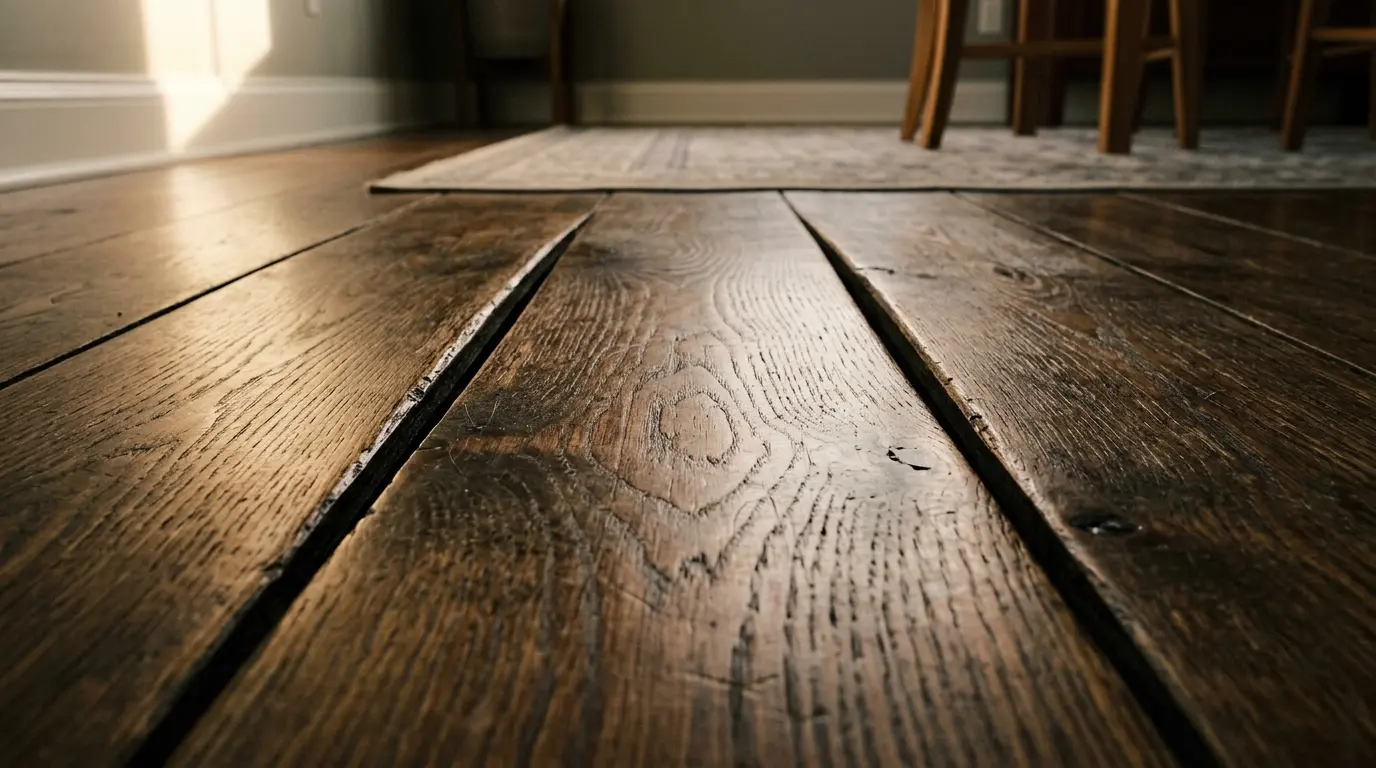
Timber floorboards cupping and crowning are physical deformations caused by a moisture imbalance between the top and bottom surfaces of the wood, leading the boards to bend across their width. In Melbourne’s fluctuating climate where dry winter heating alternates with humid spring rains and coastal moisture these structural shifts are a common challenge for both period heritage homes and modern builds.
Understanding the precise differences between cupping floorboards and crowning is critical; applying the wrong repair method to wet timber will permanently ruin your floorboards. To help you quickly diagnose your floor’s condition and choose the right restoration path, here is a direct comparison of symptoms, causes, and corrective actions.
| Feature | Wood Floor Cupping | Wood Floor Crowning |
| Visual Appearance | The edges of the board are higher than the centre (saucer or concave shape). | The centre of the board is higher than the edges (convex or hump shape). |
| Primary Cause | Excess moisture originating from beneath the floor (subfloor damp, plumbing leaks). | Excess moisture from above (surface floods), or sanding a cupped floor before it dries. |
| Immediate Action | Eliminate the subfloor moisture source and deploy industrial dehumidifiers. | Stop surface wetting immediately; verify internal wood moisture levels with a meter. |
| Restoration Fix | Allow timber to dry completely; most boards will flatten naturally without sanding. | Requires professional orbital and drum sanding to level the permanent centre hump. |
What is Wood Floor Cupping and Crowning?
Solid timber is a living material that is hygroscopic. Natural wood always absorbs and releases moisture vapor to maintain equilibrium with the surrounding air even years after it has been felled, milled and kiln dried. A moisture dampening of a floorboard causes the wood fibers to expand, and moisture loss causes the wood fibers to contract.
Timber floor boards are attached to a subfloor and cannot move around freely in all directions. If moisture strikes just one side of the board, there will be differential expansion, causing the timber to warp and form characteristic shapes called cupping and crowning. Understanding the differences in wood floor cupping vs crowning can help identify the source of the moisture and determine the appropriate repair approach.

What is Cupping in Wood Floors?
If you’re asking what is wood floor cupping, the answer is easy: When the edges of a timber floorboard are higher than the middle, it forms a trough or washboard pattern over the top of the floor.
When the bottom of the floorboard absorbs more moisture than the top face, this is known as cupping. The bottom of the wood absorbs water and the cells in the bottom expand. Maintaining a dry top face surface helps the lower face to expand upward, causing the lengthwise edges of the board to bend away from the subfloor surface. The classic indications of moisture ingress underground are cup-like shapes in Melbourne homes, whether it is from rising damp that has seeped into brick piers, inadequate underflow ventilation under suspended wooden framing or leakage from a pipe under a concrete slab.
what does Crowning mean for Solid Timber Flooring?
The opposite of cupping is a problem with the crown of the solid timber flooring. Crowned floor means the floorboard in the middle rises up and there is a raised hump along the centre of each board and the edges slope down.
Sometimes, the most often occurring problem is the constant saturation of water at the top surface of the floor, which may be caused by too much water used when mopping routine, a plumbing flood from the top, or pet urine that is not promptly removed from the top protective layer. The most common cause of crowning, however, is human error in the repair of a cupped floor.
A homeowner or an inexperienced tradesperson observes a cupped floor and without hesitation, sands down the raised edges, thus destroying the natural geometry of the board. The bottom of the floorboard dries out and contracts again after a few weeks or months, leaving the centre of the floorboard up with the sanded outer edges. This leaves a permanently over-crowned floor which can’t be corrected.
“A lack of sufficient ventilation in the sub floor space can result in high humidity, which will in turn cause expansion and cupping of floorboards.”
Source : WoodSolutions – Flooring
Why Early Intervention Matters for Deformed Timber
Ignoring minor cupping or crowning can quickly transform a manageable surface issue into an expensive structural failure. Addressing moisture deformation as soon as you spot the first ripples in your floorboards protects your property in three critical ways:
1. Reduce Irreversible Cell Damage
Timber has a natural elasticity called its fiber saturation point. If the moisture content is moderately high for only a brief period, the wood may swell and then return to normal size without any damage. If the wood cells are kept wet for weeks, however, they will disintegrate under great compression. The boards will eventually dry and will no longer lay flat, but rather will split deep in the surface, have checking and gaps between the tongues and grooves which will collect dirt and destroy the structural integrity of the floor.
2. Subfloor and Structural Framing Protection
Cupping is almost always more than a simple surface issue, it is a visual signal that means there is moisture under your feet. Trapped dampness under a timber floor can seriously damage the glue that bonds the boards to the slab or underlay, very quickly. The subfloor moisture levels are high in heritage homes throughout South Melbourne, Albert Park and Richmond and these conditions are ideal for timber-destroying fungi to thrive such as dry rot (Serpula lacrymans) and wet rot. When left unchecked this rot can work its way from the decorative floorboards into load bearing floor joists and bearers, putting the whole structure at risk.
3. Preserving Your Wear Layer and Financial Investment
Each solid timber floorboard contains a specific “wear layer” or thickness of wood that rests on the tongue and groove joint. As the floor is aggressively sanded to get rid of cupping or crowning, a few millimeters of valuable wood are irretrievably lost each time. When sanding too soon and creating humps, you will need to sand the floor again to even the humps. This double sanding can remove the entire wear layer of the timber, leaving the nail heads or tongues exposed, and before this wood’s natural life span is over decades will have passed.

Common Problems and Fatal DIY Mistakes
When dealing with deformed hardwood, panicked property owners often rush into corrective actions that worsen the damage. To protect your timber floors, avoid these critical errors:
Sanding in too early (The direct cause of crowning)
The worst statement of the floor can be sanded before it reaches a normal Equilibrium Moisture Content (EMC) of 10% to 12% for Victoria, before the moisture core returns to its normal levels. Flattening a board with sand paper is always to be avoided until it has been thoroughly dry equilibrated by an industrial pinless moisture meter at the top, middle and bottom of the timber.
To speed up the drying process, the room is cranked up to a high heat.
High output space heaters, radiant gas heaters or directed industrial blowers can produce extreme thermal shock when cupped timber. If the ambient air temperature rises too quickly the wood surface dries quickly at the top and slowly at the bottom. This extreme differential moisture gradient makes the timber fibers on top jump violently about a swollen middle, which is called “case hardening. The consequence is that the wood becomes brittle and splits, checks and splinters across the grain.
To seal moisture, you just need to use surface sealers.
Some do-it-yourselfers will try to correct the cupping by applying thick coats of polyurethane or wax to the boards to be sure the wood is sealed and will be forced straight. In fact, any topcoats placed over wet wood trap moisture within the wood grain! The water vapor tries to rise and the new finish blisters, bubbles, peels and turns milky and cloudy white.
Over-wetting due to routine maintenance work.
There are a surprising number of crownings and cupping that are caused by poor cleaning practices in modern residential homes. With wet string mops, steam mops or automated floor washing robots, hot water and steam are pushed directly into the micro-bevels and joints between solid timber boards. This repeated saturation over time causes the top fibers to become swollen, resulting in a persistent crowning along the edges of the board.
How to Fix and Prevent Cupping and Crowning Right
When the timber is distorted, moisture management must be done in a step-by-step and scientific way to restore it. Apply this professional procedure to remedy existing warping and to build a home that won’t warp in the future:
1. Produce a moisture source diagnosis and terminate the moisture source.
The wood can’t be properly repaired until the water source is repaired. Conducting a thorough environmental assessment:
- Look for Subfloor Ventilation: If your house is on stumps and bearers, make sure there are no garden mulch, concrete pathways or foliage blocking outdoor air bricks and subfloor vents. Use automatic subfloor extraction fans to blow out stale, moist air from under the floor.
- Inspect Plumbing and Drainage: Look for slow drip under kitchen sinks, dishwasher connections and bathroom vanities. Make sure exterior storm water downpipes are at least 2 metres away from the building perimeter.
- Test Concrete Slab Moisture: When timber is glued onto a concrete slab, check for rising damp from poor vapor barrier, heavy rainfall, and for hydrostatic pressure.
2. Apply Pressure and Lift Technique
After moisture source has been removed, establish a controlled drying area. To remove moisture from the air in the room, use commercial grade condensing dehumidifiers. Place oscillating air movers so they create a steady flow of air around the surface of the floor. Check the drying daily with a special wood moisture meter (natural flattening takes from 2 to 6 weeks, depending on the wood species and thickness).
3. Sanding and precision restoration.
After the timber has achieved a normal moisture reading (and only then) check the surface profile. In as many as 80% of the minor cupping cases, the boards will be perfectly flat again after drying without any physical treatment.
When the wood is completely dry, but still slightly curved, raised, or crowned, it’s time for mechanical leveling. Professional Floor sanding and polishing is required with calibrated drum sanders and planetary finishing machines. A specialist will remove the small amount of wood just required to create a glass flat surface and then coat the grain with high-quality surface sealers like commercial water-based polyurethanes or penetrating hardwax oils, to ensure the grain is protected from future air changes.
4. Melbourne Homes Energy Management Accounting Services (MEMA)
To prevent seasonal cupping and crowning, maintain a stable indoor environment:
- Maintain indoor humidity 45-60% relative all year round.
- Use reverse cycle air conditioning in Melbourne’s humid spring & summer months to remove excess moisture from the air.
- Never use steam mops. Rather, use a microfiber spray mop that is filled with a special, pH-neutral hardwood floor cleaner, and mist it lightly.
- If you are remodeling or extending older homes and buildings, use good quality, properly kilned lumber. Local suppliers of solid timber flooring South Melbourne suppliers have the expertise to ensure timber is properly seasoned and acclimatised and has undergone adequate treatment to cope with the distinctive climate of Victorian coastal and inner city environments.

When to Hire a Professional Flooring Specialist
Room ventilation enhancements and home heating system adjustments are great DIY tasks while structural timber restoration is a specialist trade that needs specialized diagnostic machinery and commercial tooling. If you have any of these issues, you should seek the help of a certified flooring restoration specialist immediately:
- It’s impossible to determine the underground water source that is causing your floorboards to cup.
- Moisture meter readings in your floorboards are still high after 3 weeks of environmental drying.
- You are facing complex crowning and leveling without grinding through the remaining historic or engineered crowning layer.
- Surgical board replacement and color matching are required as individual boards have buckled, cracked and/or physically lifted from the subfloor adhesives.
Professional contractors can provide sophisticated industrial drying equipment, extensive experience and expertise in Australian hardwood species (e.g. Spotted Gum, Blackbutt and Tasmanian Oak) and sanding machinery to remove human error. A cupped or crowned floor cannot be sanded properly with hire shop sanding equipment, and may create deep drum marks, uneven gouges and permanent dips in the timber. An experienced professional guarantees that your foundation is dry, level and beautifully restored to its former glory.
Looking to restore the cupped or crowned timber floors?
Don’t let too much water damage permanently bend your valuable hardwood floorboards. Even if your edge cupping is minor and the result of a seasonal humidity change, it’s important to have this assessed quickly by a professional and to have it managed through controlled restoration procedures.
If you are experiencing ripples, humps or gaps in your flooring, do not delay, the wood cells can be damaged beyond repair. Call our specialist Melbourne timber floor restoration team now for a full moisture assessment, a subfloor diagnostic check and a clear (no obligation) quote. Have our professional wood floor installers level, buff and preserve your wood floor for generations to come!
Frequently Asked Questions (FAQs)
Will cupped timber floors flatten out after drying?
Yes, in the vast majority of cases, mildly cupped timber floors will naturally flatten out once the underlying moisture source is fixed and the wood is allowed to dry completely. However, the drying process must be slow and controlled, often taking between 3 to 6 weeks. If the timber was saturated for an extended period, minor residual cupping may remain, which can be easily leveled with professional light sanding.
Why did my timber floor develop a hump after I sanded it?
This is the classic definition of crowning, and it happens when a cupped floor is sanded while the timber is still wet. By sanding off the raised edges of a wet, cupped board to make it look flat temporarily, you remove excess wood from the sides. Once the moisture eventually evaporates from the bottom of the board, the timber shrinks back to its normal shape, causing the un-sanded centre to stick up higher than the shaved edges.
How do I know if my wood floor cupping is caused by subfloor moisture?
If the edges of your boards are curling upward across a wide area of the room—especially on the ground floor of a home built over a crawlspace or concrete slab—it is almost certainly subfloor moisture. Other accompanying signs include a musty or damp smell in the room, efflorescence (white salt deposits) on external brickwork, or high pinless moisture meter readings on the bottom side of the boards compared to the top surface.
How much does it cost to fix cupped or crowned hardwood floors in Melbourne?
The required intervention will determine the extent of the restoration process. Simple non-destructive structural drying using commercial dehumidifiers and air movers is often sufficient in less severe cases. If the floor has completely dried but still requires professional levelling, orbital sanding, and premium 3-coat polishing to address crowning or residual distortion, a more comprehensive refinishing approach may be necessary.


2 Responses
I found the distinction between cupping and crowning particularly useful, especially the point that sanding too early can make the problem worse. Moisture conditions beneath the floor are easy to overlook, but they seem to be one of the first things worth checking before attempting any repair.
Absolutely. Checking the moisture conditions first is one of the most important steps when dealing with cupping or crowning. Sanding before the underlying moisture issue has been identified and resolved can remove material unnecessarily and may cause the boards to distort again. Once moisture levels have stabilised, the flooring can be assessed properly to determine whether sanding or another repair method is appropriate.